Showing posts with label Trades and businesses. Show all posts

Monday, 29 May 2023

Photographic History of Eton Wick and Eton - The End of Arnolds and Bonds shop.


The Bonds hand over their family greengrocery business and retire after trading in the village for over 90 years. The photograph shows Bob McGrath (on the left) taking over the business from Frank Bond on July 4th, 1988. Next to Frank is his sister Edith Stacey and Joan, widow of brother Albert Bond, who died in 1986. Joan ran the Bond's Eton shop. Bob McGrath formerly managed a Burnham supermarket. 


Roy and Joan Arnold retired in 1998 from their Butchers shop opened in 1951 by Roy's father Ted in the then newly built parade of shops. With Roy and Joan is daughter Julie. 

This article was first published in A Pictorial History of Eton Wick & Eton.


Monday, 24 April 2023

Photographic History of Eton Wick and Eton - Shakespere Stores


Shakespeare Stores, Alma Road
Fred and Olive Willsher
outside their shop in 1939

Olive ran the shop; Fred was a musician on a liner. In its early days the shop was in the hands of Charles Ayres; the Willshers took the shop on from Lucy and Jess Binfield in the mid-1930s and handed over to Mr and Mrs Gerry Chinnery in the mid 1940s. Note the pre-war style advertising plates on the shed door. The last business use before becoming a domestic residence was by Harry Cook, Builder/Jobber. 

This article was first published in A Pictorial History of Eton Wick & Eton.


Monday, 27 March 2023

Photographic History of Eton Wick and Eton - Market Gardeners


The Ayres/Prior family
outside 'Home Close' in Bell Lane c1910. 

Adults from left: James Ayres, Hannah (daughter), her husband Harry Prior (Sen.) and children Avis, Harry (Jun.) and Mary. 

In the 1880/90s James sold off some of his land, parcel by parcel for the building of the then designated Boveney New Town — Alma, Inkerman and Northfield Roads. He gave, free of charge, the plot on which Annie Tough and her followers built the Methodist Chapel in Alma Road. In 1953 Harry Prior Jun. sold much of the family orchard for the building of homes in Lower Bell Lane. 

This article was first published in A Pictorial History of Eton Wick & Eton.


Monday, 27 February 2023

Photographic History of Eton Wick and Eton - Businesses - Moores Lane Petrol Station

Sibley and Moores Lane petrol pumps.

 Bill opened the Moores Lane filling station 1958, converting the end house of Primrose Villas to a newsagent/confectionery The row of houses comprising Primrose Villas were built for James Moore in 1885. His house, with a distinctive bay window facing onto the Alma Road side, being the one converted to the shop. During the 1930/40 period before establishing the shop, Bill sold newspapers on College Corner, Eton, and delivered papers throughout the village, from his then family home in The Walk. The petrol pumps are now dry, and the shop is by John Prior. 

This article was first published in A Pictorial History of Eton Wick & Eton.

Note John and Pat Prior closed their business and retired in August 2005. The premises were converted into residential accommodation.


Monday, 6 February 2023

Old Days of Eton Parish - CHAPTER XIII - A FEW STRAY INCIDENTS, 1774 TO 1854.

THE end of the eighteenth century and the beginning of the nineteenth were marked by unusual storms and much distress. In 1774 occurred the highest flood on record. The water on that occasion, according to a memorandum in the College Buttery, was 2 ft. 4 in. deep in the cellar under the Hall, and heavy floods and a notable storm occurred a few years later when many trees were demolished, and much other damage done. 

In 1809 six of the central arches of the old Fifteen Arch Bridge were carried away, and in 1826 or 1827 the whole of the High Street was under water and many of the inhabitants were driven up to the first-floor rooms and received supplies of food through the windows; an unpleasant experience which was repeated in the Wellington flood of 1852, and again in 1894. But there were graver troubles still. 

In 1803 the threatened invasion of England by Bonaparte was exciting the country generally, and volunteers were being raised for defence. 

Eton was not behindhand in furnishing its quota of men. Upwards of 200 inhabitants volunteered their services; out of these, forty-two were selected, and a fund was raised to assist the Government in providing them with clothing and equipment. 

The Eton Poor Estate with its usual generosity con-tributed twenty guineas for this purpose, and James Rogerson, Bridge Master for the year, was directed to hand over this sum to the Provost, Dr. Davies. In connection with the same event, a general meeting was called in 1804 for providing substitutes for those who had been drawn for the Militia. 

The next twenty years were years of depression. Food was dear, bread a costly luxury, work was scarce, and taxes enormous. The resident population at that date was 2026. The total amount of parish rates amounted to £1603 3s. 8d.: the rate was at six shillings in the pound. The result appears in the accounts of the Eton Poor Estate, in the unusual amount of uncollected rents, and in grants made to meet the wants of the necessitous poor. 

The death by drowning in 1834 of Jack Hall, who had been for nearly half a century a fisherman and servant of Eton College, led to the formation of the Eton and Windsor Royal Humane Society, and another sad accident at a much later date to a town-boy in Cuckoo Weir stream was the occasion for starting a regular bathing-place for the lads of the town under proper supervision. Both these institutions have proved lasting benefits to the town. 

In 1837 the first Eton Post Office was opened. The year 1846 saw the removal of the Christopher Inn from its former position in College to the High Street. It had long been a source of anxiety to Eton Masters, and Dr. Hawtrey at last succeeded in effecting its removal. The ground at the back, on which the Queen's Schools are built, appears in the map as Christopher Close, and the house fronting the street, now known as Christopher's, still represents part of the hospitable inn, famous in many stories of olden days.

At the same time several adjoining shops were pulled down to make room for College houses, but even in the fifties there were small shops both opposite the entrance to the School-yard and on the Slough Road near the ' New Schools.' 

One other event must be included in this chapter, the coming of the Great Western Railway, and the building of the viaduct across some of the Lammas land. 

It had originally been intended that the main line of this railway should pass through Windsor, Reading and Oxford. But the University of Oxford objected to such a dangerous innovation, and a like objection was raised by the authorities of Windsor Castle and Eton College, and the railway was diverted and constructed at a more respectful distance. It was not long before the desirability of a branch line from Slough to Windsor was mooted, but again an attempt was made to thwart it. A meeting of the inhabitants of Eton was summoned on October 2, 1846, to consider the threatened invasion. Although the requisition for the meeting was signed by the most influential people in the place, with the Provost at the head of the list, the opposition collapsed, and the project was carried through: the railway authorities were however obliged to place a watchman on the line to keep Eton boys from endangering their lives or the lives of passengers. This was continued to a late date in the century. 

But the coming of the railway affected the parish in another way. Compensation had to be paid by the Company to the parish, for the extinguishment of commonable rights, to the amount of £246 5s. id. This money remained in the hands of Trustees for many years and the Eton public were often asking the question at the annual vestry meeting as to the use to be made of it. Many proposals were made, but no satisfactory decision was reached for many years. At last in 1896 it was agreed that the proceeds of this, and another like compensation paid by the Local Board, should be spent in recreation grounds for Eton and Eton Wick. The fund having accumulated to £950, this was agreed to, and £650 of this was allotted to Eton and £300 to Eton Wick. 

In 1854 the Eton Gas Light Company was started, and gas was supplied to the town and College at 8s. per 1,000. Hitherto the town had been lighted with oil. 

OLD DAYS OF ETON PARISH by The Rev. John Shephard, M.A. was published in 1908 by Spottiswoode and Co Ltd. The text is has been copied from the original book that is now out of copyright.

Monday, 30 January 2023

Photographic History of Eton Wick and Eton - Businesses - Thames View Stores

Mr Barron in front of Thames View Stores

Thames View Stores in the 1970s. John Barron, the proprietor, pictured outside, possibly just off on a delivery run. Originally one of a pair of semi-detached houses known as Wellmans Cottages. It became a retail outlet in 1910 when William Hearn sold saddlery and harness, etc. 

After Barron's grocery stores closed it became an aquarium and pond shop, finally reverting to a private house in 1994. The opening of the new shopping parade in 1951, and later the superstores in Windsor and Slough brought out the decline of the village's small family run shops. 

This article was first published in A Pictorial History of Eton Wick & Eton.

Monday, 2 January 2023

Photographic History of Eton Wick and Eton - Businesses - The Old Dairy and Eton Court, Eton

The Windsor & Eton Dairies building was situated next to photographers Hills & Saunders in the High Street. It was a 15th century house with a central hall and solar wings, with many alterations over the years. After much deterioration the dairy was demolished in 1967. Many of the older residents of Eton will remember the small statue of the golden cow in the window, how cool it was to step down into the dairy on a hot summer's day, and of being served by Rosie, the auburn-haired assistant. 


The lower photograph shows the entrance to Eton Court car park looking towards the High Street. Part of the Austin Leigh and Baldwin Institute is visible on the left of the photograph. What the shops that can be seen in the High Street were selling then cannot be discerned from the picture. 

This article was first published in A Pictorial History of Eton Wick & Eton.

Monday, 5 December 2022

Photographic History of Eton Wick and Eton - Businesses - The changing face of Ada Cottages

Lovell's Shop and Post Office

Ada Cottages are immediately west of the Three Horseshoes public house on the Eton Wick Road. The first photograph shows the village's first Post Office and bakery shop — Lovell's General Stores. Thomas Lovell was in the stores from c1880 to c1914. Possibly Thomas Lovell is the man in the shop doorway, and his baker is standing by the delivery barrow. Brother Fred Lovell had a draper and footwear business. 


In the late 1930s Ada Cottages housed the 'UNEED US' haberdashery. The two partners were Marjorie Morris and Mabel Woolhouse. Marjorie was the village Girl Guide Captain. Mabel was the Guide Lieutenant and the daughter of Ted Woolhouse, the Cycle Shop proprietor. Wartime clothes rationing made the clothes shop unviable. 


The George Williams ironmongery shop
in the eastern half of Ada Cottages in the 1970
 
The shop will be remembered by many anglers for supplying fishing tackle. George Willaims came to Eton Wick from Windsor and was a cobbler by trade. He transferred his business to the second parade of Council shops when they opened, later retiring to Australia, where he died. The school lollipop man in the white coat is Tom Cox. Tom a leg in WWI. 

Ada Cottages and Three Horseshoes
at the end of the 20th century.

Other businesses operating from Ada Cottages include Bright's Fish and Chip shop (1930s); Gurdock's Tailoring and Haberdashery (a WWII Jewish evacuee family) and Eric Springford's Shoe Repairs (1960s). 

This article was first published in A Pictorial History of Eton Wick & Eton.

Wednesday, 31 August 2022

Photographic History - Agriculture - The Village Blacksmith

 The village blacksmith. 

This is believed to be blacksmith Arthur Gregory (left) with Charlie Benham, which would date the photo as early 1920s, as Jack Newell became the village blacksmith in the mid-1920s. The forge was located in Wheelwrights Piece, across the common brook opposite the Greyhound public house. It was a favourite place with the village children for spending a few hours watching the blacksmith at work. The lads helped with bellowing the fire and other odd jobs, while the girls could get steel hoops made for a penny. 

This article was first published in A Pictorial History of Eton Wick & Eton.

Tuesday, 3 May 2022

Photographic History - Village Characters - Harry Chantler


Harry Chantler and his wife Hilda being presented with a cheque and a bound book containing the signatures of many local residents marking their respect and affection, on the occasion of Harry's retirement in March 1973. Harry's father took on the village store at Clifton House in 1929. Following his father's death in 1932, Harry carried on the grocery business and sub-post office for over 40 years. He was active in many local organisations, being a member of Eton Poor Estate, the Parochial Church Council and serving as a School Governor. The presentation took place at the Women's Institute meeting and was made by the president, Mrs Joan Ballhatchet (right). 

This article was first published in A Pictorial History of Eton Wick & Eton.

Monday, 7 March 2022

Photographic History - Village Characters - The Hoods


Brothers Albert and Dick Hood delivering coal to the Three Horseshoes public house. Also, in this c1935 photo are younger brother Don Hood (on the running board) and the landlord's son Peter Short. Within a few years, Dick was to become a WW2 fatality in Italy. The brothers had taken over the business from their father, Scottie Hood. The business converted to mechanical transport around 1932, when a fire at the Sheepcote Road stables killed the horse and destroyed the cart.

This article was first published in A Pictorial History of Eton Wick & Eton.

Monday, 14 February 2022

Photographic History - Village Characters - George Paget and Chris Rigden


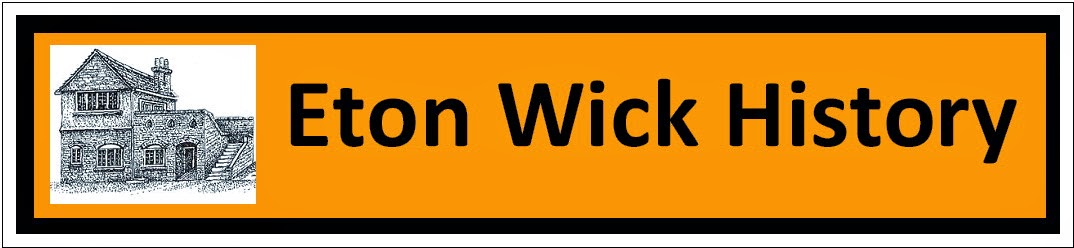
George used his horse and cart to trade in greengroceries, removals and other odd jobs. He also ran pony and trap trips for tourists, operating from the Windsor Castle taxi rank. George and his horse-drawn trans-port appeared in several films, which included the 'Carry on' series. George served in the Western Desert Army during the Second World War. 

Chris owned the Cockpit Restaurant in Eton High Street before taking over the Barksfield Bakery in Dorney. In the 1960s Chris regularly waited each night at the Burning Bush bus stop for the last Green Line coach of the evening, bringing his step-daughter Penny home from her leading role in the 'Black and White Minstrels' show at London's Victoria Palace Theatre. The photograph, taken in the late 1940s shows the now removed Eton Parish Church spire, the Roman Catholic Church and the 'Well's' timber built shed, now replaced with an office block. 

This article was first published in A Pictorial History of Eton Wick & Eton.

Monday, 20 December 2021

Photographic History - Village Characters - J.T. Ireland

 J T Ireland

 At one time the village firm of J T Ireland employed around 60 men and apprentices. James (Jimmy) Ireland started his business on leaving the army after the Second World War and built extensively in Eton Wick and Dorney. Eton Wick developments include east side of Tilstone Avenue and the eastern end of Queens Road. In this photograph Jimmy is presenting a gold watch to Charlie Simpson to mark his 25 years' service with the company. Mrs Ireland is on the right. 

Jimmy was a great supporter and benefactor of the village Scouts and the Youth Club. He became an Eton Urban District Councillor in 1947 and served as Chairman of the Housing Committee, and then as Chairman of the Council up to 1954. 

Between 1952 and 1981 he served on Buckinghamshire County Council as Chairman of Works, Planning, Staff and Finance and also as Vice Chairman of the County Council for 10 years, besides various other appointments. In 1957 he became a Magistrate and served as Chairman for 15 years. In 1975 he became Deputy Lieutenant of Buckinghamshire and in 1982 was appointed Commander of the British Empire (C.B.E.). 

This article was first published in A Pictorial History of Eton Wick & Eton.

Monday, 4 October 2021

From the Parish Magazine - Eton Wick History Group Meeting - A History of the River Thames

A report on the May 1996 meeting held at the Village Hall.

Roy Dunstan is a Lock Keeper, at present at Old Windsor, and my word he knows his River Thames, from its source at seven Springs in Gloucestershire to the Estuary. He was the speaker at the May meeting of The Eton Wick History Group and he talked of the changes in the control of the river over the centuries, the various organisations which held jurisdiction over it - from the Mayor of the City of London in the twelfth century right through to today's Environment Agency, with particularly fond mention of the Thames Conservancy. He spoke on the serious subject of pollution and, in contrast we heard about the Lock Keeper's wife at Cliveden - 'Mad Mary' - with her long tweed skirt and wildly swinging legs!

Boveney Lock Keeper
Dave Gibson
Mr Dunstan told us about the early weirs and locks - Boulters was built in 1772 and Bray,Boveney and Old Windsor locks were built during the first half of the 19th century; and he explained how busy the Thames used to be, with barges carrying Witney wool and Cotswold stone down to London; and some of the barges were huge - apparently one weighed 140 tons, and had a crew of six and was towed by twelve horses. In the 17th century over 100,000 tons of cargo was being carried on the Thames - now, of course, we see it used mainly for recreation. In more recent times, one huge barge almost caused a disaster when, in 1992, the unmanned ‘Actief’ (a floating restaurant) broke loose from its mooring and drifted down towards Windsor Bridge - Dave Gibson, the Boveney Lock Keeper saw what had happened, jumped on his bike, overtook the vessel, enlisted the aid of a couple of College staff near Windsor Bridge, and between them they managed to board the boat and make it safe before it could collide with the bridge - unchecked it could have badly damaged the bridge or swung across it, stopping the river's flow and causing flooding to the surrounding area. The heroes received a Norris McWhirter award for their bravery.

Barge horses sometimes had to be swum across the river when the towpaths changed from one bank to the other – a situation often caused by rich riparian land-owns not wanting the towpath (but really the bargees) on their side of the river. These riparian owners also objected to the visitors who wanted to enjoy the Thames when passing through Maidenhead during Ascot Week, but their 'Keep Out' notices merely served to provide bonfire fuel for the visiting city dwellers.

Thanks to the conservators, who have been busy cleaning up the Thames since 1866, the river is now cleaner that it has been for many years and fish have a better chance of survival; salmon have returned and to encourage them further some of the weirs have been fitted with salmon ladders to assist them up stream. The river's flow is now expertly controlled by skilful management.

During the 1990's the Parish Magazine of Eton, Eton Wick and Boveney reported on the meetings of the Eton Wick History Group. A member of the audience took shorthand notes in the darkened hall. This article was published in the June edition of 1996.

Monday, 9 August 2021

Photographic History - Village Characters - The Sons of Albert and Florance Bond

The sons of Albert and Florance Bond taken in 1935. 

Albert started up the village greengrocery business with a donkey (and later a horse) and cart when he was about 14 years old in 1899. The family came to Eton Wick from Hazelmere, Bucks. Albert's brother Tom Bond also ran a Fruit and Vegetable growers and wholesale business in the Wick. They were also cousins of Roland Bond (Contractors). 

The brothers are , from left to right at the back: Frank and Albert Jnr., and the front Edward and Ernest (twins) and Alfred. There were also three older sisters, Edith ( married name Stacey), Eva and Nora (married name Bell). 

Albert (junior) continued the mobile side of the business and Frank joined the firm when they acquired the first of the village council-built shops in 1951. They subsequently added shops in Langley, Holyport and Eton. 

This article was first published in A Pictorial History of Eton Wick & Eton.

Monday, 26 July 2021

From the Parish Magazine - Eton Wick History Group Meeting - The Original Christopher Inn

A report on the December 1997 meeting held at the Village Hall.

The 1998 programme of talks was issued at the Group's meeting on the 10th December, promising yet another year of interesting topics; the Committee never seems to run short of subjects, despite the fact that this meeting marked the end of the 7th year of the Eton Wick History Group. The 1998 programme appears separately in this magazine. Mary Gyngell has had her hip operation and is home - we wish her well. (Needless to say, she made the cakes again!). Congratulations to Vi Millis and her husband who celebrate their 60th Wedding Anniversary and Vi's 90th Birthday last month. A man in Canada had sent Frank Bond an 1897 map of Boveney New Town and one of Windsor and a £1 note! 

Tony Cullum then entertained the Group with a talk on the original 'Christopher" Inn, which was situated opposite College Chapel in Eton. Mr. Cullum used the opportunity to take us on a journey through history, commencing with the Inn at Bethlehem at which there was no room and easing us through time, touching on maps of the 6,000 miles of excellent Roman roads in Britain, Hadrians Wall and the other wall from the Clyde to the Forth. 

Soon we had left Augustus, Tiberius, Caligula and Claudius behind and were into stage-wagons, drawn by six or eight horses; and then the spring suspension stage coach, high-perch phaetons, cabriolets and landaus - a trip from London to Bath would probably have been a three to four day journey - hence the need for coaching inns like the "Christopher". 

 And, did you know the difference between a tollgate and a turnpike gate? (A turnpike gate is sturdier and had spikes on the top!). 

There was talk of Thomas Telford and also of john Macadam - who found that the secret of a good, lasting road was to dig down to a depth of 12" , fill with granite chippings and leave it to the horses" hooves to grind it down into a solid base. And there were plenty of horses hooves pounding away, with over 1,000 vehicles leaving London every day in the early 1800s.

 Stagecoaches would leave Windsor at 7 a.m., 9 a.m. and 3 p.m. and, in good conditions, would take about 4 hours to get to London. There is mention of 'The Christopher' in 1511, when it was a shown as a large complex of buildings with land leased with it "contained within 1 acre and occupied by Ruth Cox". The Inn has held various landlords including in 1636 Francis Dickin, from 1753 to 1775 a George King and, when the Inn finally closed, the landlord was a Jack Knight. 

For some time it was the only ale house in Eton which could offer bedrooms. In September 1803 a Baldwin's Bridge Trust dinner was held there at a cost of £5.6s.6d. plus 10/- for extras.

In 1665 College boys were forbidden to go there, but it later became very popular with them and they would claim that they had to go there to meet friends coming from London, or to collect parcels from the mail. Eton's 'Pop' boys used to enjoy the food and ale there, particularly a drink (a bit like punch) called 'Bishop' at 12 shillings per barrel. 

Under the then Head Master, Dr. Hawtrey, the College obtained possession of the site in 1842 and it was used first as a French Pupil Room and then as a boarding house. Jack Knight, the former landlord, moved into 131 High Street and set up shop selling drinks to the boys; in 1871 his lease and goodwill were taken over by a Mrs. Emily Brown and in 1872 it was moved o the present Rowlands/Tap. The present 'Christopher' was opened in 1846 at 110 High Street and owes its existence to the closure of the old 'Christopher' - now called Hodgson House. 

Extract from John Denham's index of Eton Traders

For the remainder of the evening, the Group repaired to the Small Meeting Room to enjoy a splendid buffet meal and Christmas punch. 

The next meeting took place on 21st lanuary when the topic was the 'HISTORY OF SALTERS STEAMERS' and the speaker, Keith French. 

During the 1990's the Parish Magazine of Eton, Eton Wick and Boveney reported on the meetings of the Eton Wick History Group. A member of the audience took shorthand notes in the darkened hall. This article was published in the first edition of 1998.


Friday, 4 June 2021

Photographic History - Village Characters - The Prior Family

The Priors were a well known Eton Wick family. Those in the photo, c1915/16, are, back row, left to right: Harry (Junior), Kate, Nellie; seated: Hannah (mother), Avis, Mary, and father Charlie. Charlie and Harry were life-long choirmen and served as sextons for St Johns. Harry Junior operated a greengrocery business from his horse and cart. 

This article was first published in A Pictorial History of Eton Wick & Eton.


Tuesday, 25 May 2021

From the Parish Magazine - Eton Wick History Group Meeting - Village Shopkeepers - Past and Present

"As we live day by day we don't notice changes which are happening around us " 

So said Frank Bond as he introduced his talk on "Village Shopkeepers - Past and Present" on the 27th May 1998. He referred first to the hamlet which was Eton Wick in the year 1800, with just 100 residents; and the to the early 20th Century shops which sold hardware„ groceries etc., and his talk progressed through to illustrate not only the various changes which had occurred. in Eton Wick' s shops and services up to the present day, but also the considerable changes in the community itself There had been seven farms, now some had been adapted for riding schools and others given over to engineering. The countryside itself has undergone changes with areas previously used for crops now given over to leisure and recreation facilities. 165 years ago there were 300 people living in Eton Wick. There was no evidence of any shops here then, or any easy means of getting to shops elsewhere; for there was no transport, other than horse-drawn vehicle or 'Shank' s pony' . People grew their own vegetables, they would purchase milk, flour etc. from the farmers, and they would make home-make jams, pickles and other preserves for their larders; some would have kept poultry for their eggs and meat. There would have been work for the village' s blacksmith, a chimney-sweep, and also for cobblers and  boot makers. 

MUFFIN-MAN

By the 1920' s Eton Wick was being visited by the muffin-man, and a winkle-man and a man who sold fly-papers; did the fly-paper become a muffin-man or a cobbler in the Winter months? Gypsies came selling clothesline props and pegs - most people were a little afraid of Gypsies because of their apparent ability to successfully lay a curse on you if you upset them. Visits from the 'rag and bone man' with his horse and cart were more welcome, particularly by the children who might be given a balloon in ex-change for old rags. As the years progressed there were the annual visits from a `gentleman-of-a-darker-hue' who went from door to door selling ties, collar-studs, etc. from a suitcase. A Mr. Henry came out from Windsor every Thursday with a cart loaded with galvanised goods, ironmongery, soda, soap-flakes and the famous 'Reckitts Blue'. Another welcome visitor, perhaps in later years, was Tom Cox on his Walls Ice Cream Stop Me and Buy One' tricycle - the fact that he only had one leg gave him few problems. There were two other ice-cream vendors - Vettise's and Sacco's - they just came round on Sundays. Out of season these ice-cream sellers would use their carts to transport the rabbit skins and other goods they bought locally. Tom Cox also sold cakes and bread for Denney's bakery (14 cakes for 1s. 0d.). He was also pretty handy with his bicycle pump in that when some poor soul stepped out of hedge in front of him he hit him over the head with it. 

STABLE FIRE 

The Greyhound Pub with Mr & Mrs Newell

Eton Wick had its own coal merchants, delivering by horse and cart. Bill Parrot' s horse was stabled in what is now 'The Greyhound' skittle alley. Early in the 1930's Scottie Hood' s horse' s stable caught fire and Scottie had to be physically restrained from entering the inferno to rescue his horse. The horse perished but the village had a whip-round and raised enough for him to buy another horse. The coal carts, and others, would be cleaned up and would carry the children of the village on Sunday School outings. 

Chantler then took the shop over and added gas masks to the provisions on offer. Harry Chanter was a very helpful and kind man. He was a trustee of the Eton Poor's Estate for 60 years, he was held in great an affection. There were other tenants of the shop after Mr. Chantler, until it was converted into flats in 1987. 

ICE CREAM 

A Mr. Slade set up shops in St  Leonard' s Place (possibly named so because of its view across the Thames to St Leonard' Hill?), this was the first shop in Eton Wick to sell ice-cream. Mr Slade moved on to The Grapes'. In the mid 30' s Joan Taylor set up as a newsagents, early in the 50's it was taken over by the Cowells, then Paxton, Lock and in the 1960' s by Mr. Lunn. In recent years the shop has been converted into fiats and is now called Taylor Court. Yet another shop which no longer exists is the old aquarium shop in Wellmans Cottages. This shop was run from 1908 until 1923 by Bill Hearn - he stocked umbrellas, saddlery, etc. He sold the shop when his wife died and took premises in Victoria Road (From `General' Hill who made nuts in the War?) where he set up a workshop - he ran two taxis. Later this business was to become Ellis Motors, and engineering works was still in operation at the time of the talk. Mr Wiggins followed Mr. Hearn into the 'aquarium' shop (yet another place where Tom Cox used to work); it became Graham's grocers and Provision Merchant, then John Barron. Later it became The Aquarium Shop, and has now reverted to being a private dwelling. We mustn't forget the cycle shop run by Ted Woolhouse from Bonaccorde Cottages "Royal Enfield Made Like a Gun", now a private residence. 

There was a doctor' s surgery in Alma Road, and can you believe we once had a Co-op in Alma Road! There was also a small shop in Shakespere Place (1880). Charlie Ayres started selling groceries in there in 1898. Bill Bolton failed as a butcher there; he was followed by Lucie Binfield, then Mr. Wilshire and then the Chinneries who dealt with rationing. Harry Cook then used it as a workshop. This too, has since been convened into flats. Prior' s, the newsagents in Moore's Lane, was built by Annie Tough's father, James Moore. This shop was occupied by Mr Sibley and then by Mr Prior. 

31 & 31a Eton Wick Road

Another butcher's shop was George Mumford's at 31 Eton Wick Road (Bracken Flowers and a Betting Shop were there in 1998). Mr Mumford tended to get into trouble for letting people have meat in excess of the ration (it  even had a 'Flanagan and Allen' mention at the Victoria Palace). Mr Mumford altered the premises to accommodate his elder daughter and converted part (later to become the betting shop) into a Laundrette. The butcher's shop was later to become a Greengrocers, then a baker' s and is now Bracken the Florist. 

Bistro

In 1951 the Eton Urban District Council built the `Darvilles' parade of shops. In the shop 

nearest to the Village Hall was Mr Barnes (wet and fried fish), next came 'Arnolds' the Butcher's, (when Roy Arnold retired it became a hairdressers).The third shop was O'Flaherty (chemist); fourth was Clinch's Bakery and Darvilles the grocer next to them. Anderson (newsagent and gents' hairdresser) occupied the sixth unit and A. Bond & Son (greengrocer) the final shop opposite the Shepherds Hut. 

Terry Anderson (who acquired the land for the Catholic Church) sold to Gowers; Clinch sold to Darville - who doubled the size of the shop; O'Flaherty sold out to a Mrs. Baker, but there have been several tenants since. When Frank Bond sold his Greengrocers shop it had been in business for 90 years. 

In I973 the Bell Lane parade of shops was built; Joyce Howard (ladies clothing); another was for hi-fi and electrical goods and then homemade brewing equipment and vehicle sundries. Country Fair, the equestrian shop, is to close and be replaced by a bistro. The hairdresser' s has become `Pipedreams' for cake-baking accessories. 

The final photograph shown on this fascinating evening was of Mrs. Cooley and Pam with their milk-float - the last of our milk delivery people. A suggestion for a Millennium Memorial - commemorate site of the 1st school, the 1st official building for church services and the 1st Institute for Eton Wick. All in one building at the bottom of the garden of 'The Greyhound'

The following meeting was held on the 8th July 1998 when the topic was LOCAL FETES, FAIRS, CARNIVALS AND CONCERTS. 

During the 1990's the Parish Magazine of Eton, Eton Wick and Boveney reported on the meetings of the Eton Wick History Group. A member of the audience took shorthand notes in the darkened hall. This article was published in the June 1998 edition.


Monday, 23 November 2020

Eton Wick History Group Meeting - 'PAST MANUFACTURERS AND TRADERS AND CRAFTSMEN OF ETON given on 14th July 1999

During the 1990's the Parish Magazine of Eton, Eton wick and Boveney reported on the meetings of the Eton Wick History Group. A member of the audience took shorthand notes in the darkened hall. 

History Group Meeting held on 14th July 1999

The History group audience were welcomed by Mr. Frank Bond, who was able to give news of three members who were in hospital : Mrs. Mary Gyngell had had another knee operation and was making good progress; Fred Hunt had unfortunately had a stroke; Bill Welford, too, was in hospital - we wish them well. 

Mr.Bond confirmed that the November walk would celebrate the 1849 arrival of the railways to Windsor; and he dispelled doubts caused by reference elsewhere to the date being 1848. The railway archivists would not loan their picture of the original wooden viaduct, but it is hoped that they will let it be photographed. Subscriptions for that particular evening's meeting will have to increase to £1 or perhaps £1.20. 

Mr. Bond reported the sad loss of James Kinross. Mr. Kinross had been very generous to the History Group, thus enabling the award of Eton Wick History Group Certificates and books to children at Eton Wick School. The children prepare books illustrating their impressions of Eton Wick; winners receive the Kinross Award. 

Next year's programme is under discussion and ideas for subjects would be welcomed. 

Mr. John Denham's topic for that evening's talk was 'PAST MANUFACTURERS AND TRADERS AND CRAFTSMEN OF ETON'; and it spanned the period from the mid 18th Century to the present day. 

He illustrated how, initially, trade in Eton and Eton Wick was mainly in response to the servicing demands for the College and the Castle, enhanced perhaps by Eton's proximity to London and the need to cater for visitors to the area - so, the earlier traders ran boot and shoe shops, they were tailors, butchers, hatters and milliners, watch and clock makers and cricket bat makers; they sold clay pipes and guns and sewing machines - sewing machines having been invented in Britain but developed in America. Eton High Street, from the College to the Windsor Bridge, measures just under 800 yards and in this small area trades and businesses flourished between the 15th and 20th centuries. In 1798 there were twenty-six shoe-makers (or cordwainers as they were then known) and that excluded those who dressed and tanned the leather; the 'clickers' who cut the hide were highly skilled and many went on to become merchants in their own right. Ladies, too, had their own sets of shoe-making tools. (And, did you know that when shoe buckles changed from being a fastening to a decoration, the Birmingham manufacturers had to make 20,000 employees redundant!). Mr. Denham was able to trace, with both dates and addresses, the progress of the various Eton traders and their families. To give some examples towards the end of the last century Gane's shoe shop was run by a Mr. Howard and Mr. Hunt, and their 'clicker' had space in the courtyard at the back (the courtyard also contained a waterbutt - into which a small, cheeky apprentice was dropped as a punishment); all the shop's rooms were connected with old-fashioned speaking tubes blow 3 times for Room 3 and the occupier of Room 3 would answer. Gane's provided shoes and boots for College boys and these boys often became lifelong customers, with Gane's employees attending on them at their London clubs. 

There are records of many clay pipe-makers in Eton from 1706 to 1899. (Pipe-smoking itself is referred to as early as 1573 "taking smoke from an Indian herb called tobacco" - it was very strong then and very expensive). Between 1830 and 1939 there were twenty-six tailoring businesses, seven dressmaking and millinery businesses and, of course, hat makers, hosiers, and stay-makers (ladies' corsets), etc. At 30 High Street (above the chemists) whilst the wife made hats and bonnets, the husband made barometers. 

Dressmakers started to lose trade when in 1873, Butterrick's paper patterns came from America and more ladies began to make their own clothes. The main tailor in Eton has been Tom Brown; the company was founded in 1784 and initially worked from Keate's Lane, subsequently moving to I High Street and then taking over No. 2 from Alfred Holdemess, a baker. 

15 High Street was a hosier and hatters, W V Brown - he had two employees a Mr. New and Miss Lingwood, who in 1865 decided to set up in opposition -hence 'New and Lingwood'. An employee of W V Brown and then New and Lingwood, for 60 years, was Solomon (i.e. John Thomas Harris), a 'lusher' of top hats he ironed silk top hats in a little den in the shop! 19 High Street was a hairdresser's (Henry Jeffries) in 1890 and still operates as a hairdressers today Murrays of Eton). Then, of course, there was Willis and Son at the cycle depot but that, as Mr. Denham said "is another story for another day," 

Eton trades index

The following  talk, on 29th September 1999, was on 'THE FIRES AND RESTORATION OF WINDSOR CASTLE' with Sheila and Patrick Rooney. 

The list of talks arranged by the Eton Wick History Group can be found by clicking on the Programme of Talks tab at the top of this page.


Monday, 28 September 2020

Slough Trading Estate at 100: 1920 - 2020

The Great War of 1914-18 had unforeseen influence on the future development of Slough. The perk of war was to be lorries or at least the wrecks of lorries. 


1914-1918 war lorries vehicle repair
Image courtesy of SEGRO

There are those that profit by war and those that loose out by war, Slough definitely belonged to the former. Location played a very major role in taking Slough into the industrial world of the 20th century. The use of mechanised transport on the field of battle proved costly, In this case Lorries. 


Damaged lorries
Image courtesy of SEGRO
By 1917 the huge number of damaged military vehicles suitable for repair lying in all corners of the battlefields and the inability of contractors to keep pace with the demand for repairs convince the war department that they should have their own military vehicle repair depot. The search for a suitable site that would meet the requirement of good communications, near to London and the War Office and easy to develop quickly. Looking in a 25 mile radius of London the cornfields of Cippenham Court Farm seemed the ideal site for Military Mechanical repair Depot. Having purchased the 600 acres of excellent agricultural land the work began on the site July 1918. Armistice in November 1918 rather made the depot redundant for military purposes, but it was decided to carry on building the many workshops of the complex. It had been decided that the returned vehicles rather than sell for scrap could be repaired and sold on to the civil market.

The rusting broken vehicles that began to pile up on the depot soon locally earned it the name of 'The Dump'. Like many government ideas, the cost escalated, and no doubt after the usual official excuses to cover the extravagance the whole place was turned over to the Government Surplus Disposal Board for sale. In the April of 1920, the Disposal Board sold the Depot with all its contents including surplus British military transport throughout the world for just over £7,000,000 to 'the Slough Trading Company'. The idea of the trading company had come from Sir Percival Perry, chairman of the Ford Motor Company, with Mr Noel Mobbs, later Knighted in 1948, in charge of the trading company. 

The sale by auction in 1920 of repaired surplus army vehicles brought in much needed returns to the 'Slough Trading Company', one of the first sales day realising over £30,000. Future sales saw Daimler charabancs sold for £805 and Peerless lorries for £350 every vehicle having a six month guarantee, in fact the vehicle sales from Slough exceeded the total output of UK commercial motor manufacturers for 1921. The vehicle repair business became the Four Wheel Drive Company' and American company which had grown out of the depot vehicle repair business. Later known as Modern Wheel Drive. 

Who were these early companies that gave Slough its growth in population and international fame?


Gillette Razor courtesy of Modern Mechanix
Early tenants on the estate in the 1920's included Crossley Motors, repairing ex-army motor cycles, the Perfection enamelling painting Co. , Gillette razor company, the Mentholatum Co. maker of healing cream, John & Johnson the American surgical dressing manufacturer, and the Hygienic Ice Co. suppliers of ice to hospitals and hotels etc. O'cedar Mop Company Also remembered, St. Helens Cable and Rubber Company. Makers of insulating tapes, hot water bottles and inner tubes for tyres. To make the employees feel at home many of whom had moved South with the firm from Warrington, Slough Estates named one of its housing estate streets `Warrington Avenue'. 

Having repaired the saleable vehicles by 1925, on which a workforce of up to 8000 persons had been employed, it was decided to continue to develop buildings and services on the site and rent out sheds and workshops to expanding and aspiring new companies. From this beginning sprang the Slough Trading Estate we know today. The Slough Trading Company received the Royal Assent 7th August 1925. Changing their name to Slough Estates Limited in June 1926. The management of Slough Estates set a new pattern in Landlord and Tenant agreements, making the estate a more industrial community than a collection of factory sheds. 


Sir Noel Mobbs
courtesy of Stories of London

From 1925 to 1929 Slough Estates expanded the premises and facilities available to new and established tenants. During this period the government opened a training centre for a number of trades on the Estate, this trained 18 to 32 aged men (up to 35 years for ex-service men) for a six months course to acquire basic skills to fill the vacancies in building, engineering, woodworking and other operating skills required by the growing number of companies moving onto the Estate. At this period the national unemployment had reached seven figures and rising, but Slough figure was claimed to be the lowest proportion in the country at 1%. The publication of this claim caused at the time such a large influx of job seekers that the available housing and factories could not absorb. Slough Estates had built and were in the process of building 2000 houses on their land and in other parts of the growing town. Slough gained the reputation of the 'Hardest working town in Britain'. The Estate brought rapid growth to Slough from a population of 16,000 in 1920 to 50,000 on becoming a Borough in 1938. 


An overseas firm that gave a boost to the town and to employment on the Estate by setting up of an assembly unit was Citroën Cars. Andre Citroen was a descendant of a family originating in Holland. As a young engineer he had set up a small factory before 1914 to make double v gears whose patent he had bought in Poland. From the tooth design of the gears his Citroen sign is taken—an inverted double V. Citroën cars had been imported and distributed from London prior to 1925 but the imposition of import duties on cars led Andre Citroën to consider producing cars in England. Car bodies had on a small scale, already been stored at Slough since 1923 which gave the English buyer the choice of a French or English car body. To assemble cars in Slough Citroën took over Unit 1 Dundee Road, the largest shed on the estate which called for a large investment. It was good news for Slough as it was announcing that 1000 men were to be taken on immediately with the prospect of up to 5000 more being employed when the plant was in full production. The plant which opened officially in February 1926 closed in 1966 as the factory was considered inefficient for modern production methods. The development of the trading estate since 1925 has brought other internationally known companies to set up manufacturing bases in Slough. Their range of products has covered a very wide spectrum and has created wealth for an ever-increasing town population. 
Andre Citroën at the opening of the factory in Slough
courtesy of Britain by Car.
Citroen

An overseas firm that gave a boost to the town and to employment on the Estate by setting up of an assembly unit was Citroën Cars. Andre Citroen was a descendant of a family originating in Holland. As a young engineer he had set up a small factory before 1914 to make double v gears whose patent he had bought in Poland. From the tooth design of the gears his Citroen sign is taken—an inverted double V. Citroën cars had been imported and distributed from London prior to 1925 but the imposition of import duties on cars led Andre Citroën to consider producing cars in England. Car bodies had on a small scale, already been stored at Slough since 1923 which gave the English buyer the choice of a French or English car body. To assemble cars in Slough Citroën took over Unit 1 Dundee Road, the largest shed on the estate which called for a large investment. It was good news for Slough as it was announcing that 1000 men were to be taken on immediately with the prospect of up to 5000 more being employed when the plant was in full production. The plant which opened officially in February 1926 closed in 1966 as the factory was considered inefficient for modern production methods. The development of the trading estate since 1925 has brought other internationally known companies to set up manufacturing bases in Slough. Their range of products has covered a very wide spectrum and has created wealth for an ever-increasing town population. 

Ford GT40 courtesy of Postcards from Slough
Ford Advanced Vehicles brought fame to the town when under the directorship of John Wyler they produced the GT 40 which raced and won at Le Mans in 1966, 67 and 68. Seven mark three with seven litre engines were built and today, if you can find one, expect to pay £375,000 to £400,000 (2001 valuation). 


Aspro Ltd, Old original Buildings 
Aspro was developed in Australia during the years 1915 to 1917 by George Nicholas when the name Aspro was registered. This wonder aspirin was eventually to be made in Slough through the foresight and the influence of Aspro financial advisor George Garcia, a Spanish Australian Jew, who was visiting England for the 1924 Empire exhibition. He thought there was a market for the product in the UK and picked Lancashire and Yorkshire for the launch territories with Manchester the headquarters. Initially sales were a disaster because the packs of 25 tablets where too expensive for unemployed England but after some misgivings the Aspro board decided to struggle on and eventually things improved which led to the important policy decision to manufacture in England. Garcia chose a factory in Buckingham Avenue on the Slough Trading Estate and George Nicholson was sent from Australia to install the machines. The first tablets came off the line on August 11th, 1927. By 22nd of November the same year sales in Britain overtook sales in Australia but all was not well, At the time there was a certain distrust of patent medicines and certain newspapers wary of the claims made by pharmaceutical companies, refused advertising copy. Aspro management reacted quickly inviting the newspaper to send its own experts to the Slough Factory and make whatever test they liked. Three analytical chemists arrived to inspect the factory and take away samples. Their test and favourable report gave the Aspro a boost and advertising of the product met no further opposition. 


The Aspro-Nicholas was acquired by Sara Lee in 1984
In 1957 on a site bought before the outbreak of WWII the new Aspro factory was built on the Bath Road. There were construction delays due to the public footpath that crossed the site and much legal argument followed before agreement was reached that the path could be moved to one side. The path runs from the Bath Road alongside Sara Lee to emerge beside Westgate school onto the Cippenham Road. The new factory only came into being due to the perseverance of the then UK manager director Jamison who brought his new factory into production in 1958 Aspro became famous locally for their entertainment, Dances, Pantomimes and other showtime entertainments.


Shortly after the establishment of Aspro in Buckingham Avenue, High Duty Alloys which had been started by Colonel Devereux took the premises next to Aspro. H.D.A. also became large employers on the estate attracting labour locally and from other parts of the country especially during the war years where castings for aero engines and other requirements of war were manufactured. The thump of the heavy duty forging hammer operating day and night during the war years that was heard over a wide area is still remembered.


New building of 75 to 79 Buckingham Avenue              High Duty Alloys New Building Development 

High Duty Alloys closed in the late 1970's. The new buildings some of which are vacant in 2002 have housed the headquarters of various small 'IT ' Companies. Little engineering or consumer goods manufacture now remains on the Slough Estate. Warehousing and retail fill many of the new buildings. 


This McDonald's fast food hut now stands where buildings that housed the security police and the canteen of High Duty Alloys. 

The site is now occupied (2002) by computer software companies, DIY warehouse, freight company and a postal delivery company. 

The HDA sand foundry buildings were taken by Vitatex in the mid 1970's and became their textile dying and finishing departments 


OS Map revised 1938
courtesy of the Nation Library of Scotland
At the close of 1927 there were 65 firms operating within the confines of the estate and the name of Slough Estates was well known through articles appearing in the national press. These reports attracted the attention of men from the depressed areas of South Wales. The year was 1933 and unemployment in the country was approaching three million. On a bitter night in February 1934, two hundred and eighty-five Welsh Hunger marchers arrived in the town and were cared for by a specially formed Slough Reception Committee. They stopped overnight in the town before going on their way to demand action from the Government.

The downturn in trade had not escape Slough firms and Slough Estate management arranged deals in rent and loans for Hygienic Ice and St. Martins Preserving Company who were in serious trouble. One firm sacked workers and offered reemployment at a penny an hour less. Unemployed Welsh girls and men offered to work for less than local labour which obviously did no go down well with local towns people. 

At the same time other new firms were opening premises on the trading estate and bringing in their skilled employees who would train the newly recruited staff skills to manufacture new products such as Metal Colours that was mainly staffed by Germans, Flexello wheels and castors started by Marcel Menko, a Frenchman of Dutch parentage. 


Mars

Here we have a difference in the historical facts, myths, and memories and folklore of the best-known company in Slough. There is not a great deal written of the company from the English point of view, the book 'The Chocolate Wars ' give a very American slant to the story. 

Like many a son, at some time in our early life we think we know better than our parents, History says likewise about Forrest Mars but in this case, son did have more go and vision than Dad. 

Mars senior commenced making candy bar in America in 1923 with Forrest joining when he graduated in 1928. The business expanded but Mars senior having gone bankrupt twice was cautious, whilst son Forrest wished to conquer the world. Disagreement followed and Forrest took off for Europe with a wife and baby son and $50,000. Having studied various chocolate methods on the continent he headed for England in 1932 where at least he could speak the language. At 28 years old he arrived and with a burning desire to prove himself by making candy. Having spoken to Philip Wrigley of chewing gum fame and James Horlick who told him to see Nigel Mobbs, Forrest Mars found himself with a large leaky shed in Dorset Avenue. Within four months of arriving he had had his factory ready for production and the first Mars Bars were ready to launch onto the marketplace. From these small beginnings Mars rose to become in fifty years the estate largest production unit and employer. 


Gresham Road 1934
VitaTex

Other firms followed such as 4711 Cologne, Coopers Mechanical Joints makers of gaskets for the motor trade and Mr Steven Wessely who started VitaTex, to make lingerie and textiles. Mr Wessely had come from Czechoslovakia in 1933 to work as a cutter in the north of England. His ambition was to have his own plant.

Charmaine work room, Gresham Road
He came to Slough in 1934 to visit the trading estate site and was met by Nigel Mobbs at the station with a Rolls Royce. What with being taken to lunch and riding in the Rolls Steven was hooked and took a small factory in Gresham Road calling it Charmaine, there to produce ladies underwear. 

Warp Knitting machines at Gresham Road in 1950's.
The annual rent was 1/- a square foot. The company expanded over the next fifty years producing all manner of textiles for the fashion, furniture and automotive industries. The Wessely family sold out to British Vita and the plant closed in 1995.


Sewing room staff with Mr Wessely in the centre.
Mr Wesseley
after 50 years as owner and chairman of VitaTex

Note — Fun Knickers. 


A young lad on joining Charmaine the task of putting printing ink on his hands and then printing his hand prints on the back panels of ladies knickers. A fun project.

This article is an extract from at talk that was given by John Denham on Industry’s Influence on Slough given on October 16, 2001. 

He worked at Mars on the maintenance team for a few months in the early 1960's and from 1965 to his retirement nearly 30 years later worked for VitaTex. His children remember their summer holiday in 1965 as their Dad was called back to work early as there had been a disastrous fire at 108 Buckingham Avenue. He told his children that dust from the Flock printing was the cause.