Showing posts with label 18th century. Show all posts

Monday, 11 December 2023

The 18th Century Village of Eton Wick – Part Three - The Village and its Inhabitants 1700 —1800

Note. 240 pennies were equal to £1 

How and Where they lived in the Village  

No person can be an Island and no community can really isolate itself from its neighbours so what influenced the daily life of the eight-teeth century inhabitants of Eton Wick.


As to where they lived within the village is hard to define and the lifestyle changes during the century brought many changes to local farming and other employment. In the eighteenth century the area now thought of as the old village became the centre of the community for the first time. A parish map of 1797 ('itself a copy of an older one of 1742) cottages laying dispersed along the short stretch of common from shows about ten cottages laying dispersed along the short stretch of common from the Wheatbutts to Sheepcote not far way from the brook or one of its tributaries. 

In the rest of Eton Wick, to the east, north and west there were only about another dozen, and most of these were the older timber-framed houses giving a total of about twenty or so homesteads. Two of these houses can be dated with reasonable certainty as having been built within the first quarter of the eighteenth century - Wheatbutts and Hope Cottage (now part of nos. 37 and 39 Common Road). 

Wheatbutts was built for William Lyford, a butcher from Eton, between 1704, when the land was described as 'all that close of arable land called Wheatbutts and 1716; by which time the house had been built in the corner of the close and the rest converted into a orchard. It is known that by 1716 William Lyford was living at Old Windsor so it is doubtful that he ever lived at the Wheatbutts as the property was sold to the Eton Poor Estate.

Hope Cottage was built a few years later in about 1725. At that date a small close of just over an acre was bought from William Lyford by Anthony Warwick, a yeoman of Eton. Again it is doubtful that Warwick ever lived in the village for he was landlord of several cottages including five in Dorney,. Seven years later in 1732 he sold the cottage in Eton Wick to the tenant, Elizabeth Griffiths, a widow. She and her married son, William, converted it to an ale house known as the Bull's Head. Probably about this time the cottage was divided into two.

William bought the property from his mother in 1745 and continued to be the victualler there for the next eleven years (1756). William sold the property to the farmer, John Fennel. Whose widow, Elizabeth, continued to live there until her death in 1785. In her Will she left one of the cottages to her niece, Anne Hope, by which the cottages became known. 

At the time of her death this cottage was the home of Robert Tarrant whilst the other cottage, in which Elizabeth herself had been living, she left to relative, Robert Wilkins and his wife and son for their lives. Among her other bequest was a green iron bedstead and her furniture to Anne Hope whilst the rest of her goods and chattels went to Anne Hope and Mary Wilkins,

Even before the Bull's Head had closed its door another alehouse had opened in the village. this was the Three Horseshoes. Exactly when it received its first licence is unknown but, like the Bull's Head, it is recorded in the Victuallers' Recognizances of 1753. 

Three Horseshoes Pub 1910 

The house itself was built sometime before 1705 when it was purchased by Joseph Johnson, yeoman of Eton Wick, from John and Mary Bell. The Pub has been owned by various Windsor Brewers including in 1762, Richard Grape. It is intriguing to speculate which of these two inns was the first in the village, though it is possible that neither was, as is suggested by an isolated reference in the parish registers to 'The Small Fox' at Eton Wick . Perhaps the village could not support two pubs.

About fifty years on in 1813 a survey showed the local farming community of Eton as having 6 farmhouses, among which could have been Bell Farm, Saddocks Farm, Crown farm, Manor Farm, Dairy Farm or Little Common farm with 150 cottages the majority of which were in Eton, about 20 homesteads being in Eton Wick whose population was then about 100. 

Dorney had 5 farmhouses and 12 cottages. but the rich farming community at Burnham boasted 8 farmhouses and 15 cottages; the latter two being enclosed. Farms within Eton varied in acreage from 20 to 200 acres whilst Burnham with much land under the plough has establishments from 40 to 1000 acres. 

Eton Wick, unlike some other Hamlets and small villages of England at that time, was not an isolated community, being bordered by Eton. Windsor, Burnham, Slough and Maidenhead with which there was probably almost daily communication by someone on foot or by horse and cart. Also the village proximity to the River Thames gave its residents a nodding acquaintance with the bargemen plying between Maidenhead and London therefore local and national news of events filtered through by word of mouth to the village. 

No doubt, during the 18th century, as at the present time, the locals of Eton and Eton Wick discussed and expressed their views on National political events in so much as it affected their daily lives,. for example the accessions of the of King George's 1st, 2nd and 3rd, the war with the French. the capture of Gibraltar , the union of England and Scotland; the appointment of Robert Walpole as first Prime Minister of Great Britain, and the Declaration of Independence by the American Colonies, together with the scare of the local smallpox outbreak in Windsor in April 1729 having just experience one of the coldest winters on record that ended in March 1729.

However uppermost in the minds of those getting a living or sustenance from the land was the enclosure of the common lands. Although there may have been other employment opportunities in Windsor, Eton and Slough the right to the use of the land to produce ones food if only at a subsistence level was paramount to the villagers. 

For the whole of the eighteenth century and beyond the open field system remained the way of farming in the parish; each farmer cultivating his various strips of the field to grow corn, barley, oats, beans , turnips, cabbage and potatoes, also the full use of grazing rights on the common land and pastures would be utilized. (A true field being a large area of arable land divided into strips.

How much mechanical and animal power was available to the village freeholder or tenant is difficult to assess but the Buckinghamshire Posse Comitatus for 1798 indicated that there was approximately 40 draught horses within Eton and Eton Wick. Robert Mills of Crown Farm had 4 draught horses ,1 wagon and 3 carts whilst it appears that John Atkins of Bell Farm owned 5 horses, 1 wagon and 2 carts. 

The improved farming methods over the century and the increasing employment opportunities that became available in Eton during the century gave rise to a higher standard of living which induced some tenants and commoners to give up their strips to the more successful. There were certain rules and arrangements to be abide by as a document from the sixteenth 

This was part of the script for a talk given by John Denham at a meet of the Windsor & District University of the Third Age in 2003.


Thursday, 2 November 2023

The 18th Century Village of Eton Wick – Part Two - Life for Cottager's in the Wick

 18th Century Cottager in the Wick 

1797 Village map courtesy of Dr Judith Hunter's Story of a Village

The early years of the Century were hard for families getting their subsidence from the land and for those few families living in the Wick the daily toil brought its woes and ill health. Prey to diseases as smallpox, diphtheria, influenza, and tuberculosis to say nothing of accidents. There was also a high risk to women dying in childbirth. Cottages built in Eton Wick were timbered framed with infilling of brick and cob. The floors of stone slab or compacted earth covered with rush mats with an open wood burning fireplace and lighting by candle or perhaps an oil lamp provided warmth and lighting in the small dim rooms. 

Clothing was mainly home made by wives and daughters of the family and a variety of footwear such as leather boots, canvas shoes, wooden sandals and clog type shoes dependant on the family financial status was worn by those working on the land. 

The more successful farmer or small holder no doubt could afford to buy foot-ware but often for the poorer it would be hand me downs or go barefoot. 

With a water supply from well, pond or river health and cleanliness were two factors that suffered. Fleas and head lice were prevalent. The passing years brought slow improvement.

During the century to those living in Eton and Eton Wick, trade increased in Eton with new premises opening with tailors and dress makers, boot and shoemakers, together with other trades. These were family businesses where young people from Eton Wick found employment, and with the change in their financial fortune left the land to the more successful farmer. 

By the year 1830 there were approximately seventy professional business services and shops in the Eton High Street supplying local needs and hand made goods to the London shops. 

The increasing local trade and wealth gave rise to house building in Eton Wick as the century drew to its close continuing during the 19th and 20th centuries until all available land free of lammas rights or common land within the Wick had been taken for building. 

This was part of the script for a talk given by John Denham at a meet of the Windsor & District University of the Third Age in 2003.


Wednesday, 11 October 2023

The 18th Century Village of Eton Wick – Part One - Why Eton Wick is surrounded by open fields

The Village landscape was like the majority of Berkshire and Buckinghamshire in years leading up to the 18th century one of open fields, commons and other waste land with small tenant farmers, cottagers and squatters utilizing a rented un-enclosed strip of land from the Lord of the Manor or exercising a common right to graze their pigs, geese or maybe a cow upon the common land. During the late 17th and early 18th century improvements in animal husbandry and the harvest of arable crops gave impetus to enclosure of land by landlords and the Government. These changes in farming practice at that time could have led to later developments that would have made Eton Wick Urban in the late 20th century, an urban sprawl but for the opposition of the villagers and the influence of Eton College in the Houses of Parliament. 


For at least 700 years Eton Wick was administered through the Vestry of Eton but in 1894 this came to an end through the Civil Parishes Act. Eton Town became an urban District and Eton Wick became a Civil Parish in the Eton Rural District. The decision by Henry VI to build Eton College whose presence over the last six centuries has influenced the lives of those living in Eton and Eton Wick immensely, whether through the purchase of property or the employment of services and labour. 

Queen Anne, King George 1st, King George 2nd and King George 3rd
The first four monarchs of Great Britain after the Union of England and Scotland in 1707

The 18th Century had commenced and closed with England at war with France. Queen Anne succeeded to the throne in 1702 to be followed by George 1st in 1714, George 2nd in 1727 and George 3rd in 1760. Technical innovation during the century brought vast changes to the way of life. The introduction of the flying shuttle to speed the pace of handloom weaving, followed by the efficiency in the use of steam power but some of the main advancement during the century was in agriculture. One Historian calculated that in the early 1700's each person engaged in farming fed 1.7 persons and by the end of the century one agricultural worker fed 2.5 persons. The late 1600's and early 1700's saw improvements in use of the soil which gave increased cereal and root crops leading to better fed cattle to produce more dung thereby increasing more yield from the land, also the improved yield of grain and the introduction of the turnip root crop allowed cattle to be winter rather than slaughtered for lack of winter feed. 

This together with new agricultural tools, like Jethro Tull's development of his seed drill, were

publicized in books such as the Annals of Agriculture by one Arthur Young in 1784 to be read by the progressive farmer and landowner. It also led to the birth of the agricultural engineering industry which also spawned the industry's catalogues for seeds, plants, and machinery. Similar books were published by Eton Printer and Bookseller, Joseph Pote, one title being 'Gentleman's Farriery, (or, a practical treatise, on the diseases of horses). The book was written by J. Bartlet and first published in 1753.

Landowners realised that to achieve higher output and returns from the land, enclosure of the open fields and the abandonment of the strip as the fundamental unit of tenancy, together with the common lands would be a necessary part of these improvements. No doubt news of these technical developments and the expanding international and local trade were talked of and marvelled at here about as like today, but for the village tenant farmer and cottager it was still the sweat of his brow that tilled the ground, sowed the crops and husband the animals for much of the century, but the threat of enclosure must have been an increasing worry, probably being the main talking point for the tenant farmer and commoner of Eton Wick. The implications for those who leased their land from an absence landlord, would see it as having a disastrous effect for their livelihood with no redress and no-one to stand up for them. 

Creeping enclosure of pasture had been practised since Tudor times with the widespread enclosure of Sheep ranges and with the penning of flocks to manure the land to sustain fertility. By rationalization of scattered inefficient holdings and their transfer as compact commercially viable units to farmers with expertise and a forward outlook on the market economy, enclosure of holdings gathered pace during the century either with the connivances of the Landlord or perhaps strong-arm influence. 

At first legal enclosure was obtained by a Chancery Degree but this was superseded by the introduction of acts of Parliament in the eighteenth century. 

The procedure for an Enclosure Act did not require the agreement of tenants but did require enough money to pay lawyers' and surveyors' fees, and for the planting of hedges and fences, roads etc. after the bill was passed. 

This was generally a formality as the Enclosure Commissioners surveying the land generally favoured those wishing to enclose and Parliament followed their recommendations. A general Enclosure Act was passed by Parliament in 1801 but by then more than 1,300 enclosure acts had been passed since 1760. 

The Parish plan showing field names.

The common fields, meadows and The Commons.

The strips on common fields.


The Hamlet of Eton Wick 1797 showing strips, ownership, tenants and acreage.

How and Why did this play an important role in the history of Eton Wick? 

Apart from the two commons, Eton Little and Eton Great there are Lammas lands which influence what can and cannot be done with the land within Eton and Eton Wick. The Lammas rights over much of the meadow and cultivated land in Eton and Eton Wick are a legacy from the Saxons and are a rare survival in this age. It was the right of those entitled householders to graze so many head of cattle in the fields once the corn had been gathered thereby fertilizing the land in the most natural way possible , from August 1st to October 31st. 

How many Commoners with these rights and residing in the village at the time is not known.

Lammas Day was the first day of August (the Gule of August) until 1752.  With the change to the Gregorian Calendar in September 1752 Lammas day 1753 fell on the 13th of August on which it was customary to consecrate bread made from the first ripe corn of harvest. (In Scotland it is one of the QUARTER DAYS.). Lammas Land (also Half Year Land) was common meadow on which manorial tenants were allowed to graze their livestock from Lammas Day until the next sowing.

Lammas Day: August 1st until 1752

 Lammas Day: August 13th from 1753

The strip was the fundamental unit of cultivation and tenancy in the open field system. Information from Collier's map of 1743 shows that Lord of the Manor, Abraham Wessell was the largest landowner in the parish with College, second. There were four open fields, the Hyde, North Field, South Field and West Field, the latter so named apparently because It lay west of Eton rather than on the west side of the parish; in later centuries it appears to have been renamed Stonebridge Field. Each field was divided into strips, and these grouped Into furlongs or pieces with distinctive names such as Long Furlong, Middle Furlong, Stone hul (hill), Long Wythebedde, Broken Furlong and Rossey piece. There was also land known simply as Village land'. No hedges or fences divided these strips and furlongs but, although each open field was planted with the same crops like cereal, beans etc. The different alignment of the furlongs gave the fields a patchwork appearance. The holdings of each man or woman, either owned or rented, were scattered throughout the fields and meadows. It is thought that originally each strip could be ploughed in one day and that the strips of land had been shared between the fields and its furlongs. Within the parish of Eton/ Eton Wick but mostly in Eton Wick there were six small holdings of only one strip each and two holdings of three strips possibly by cottagers, who are named as Oakley and Widow Griffin.

The rights of pasturage and to subsistence farm the land was crucial to the village householder and his family, therefore an ever a watchful eye was kept for any encroachment by those wishing to increase the small land holding around their farmstead or home. A complaint was brought against Henry Bell of Bell Farm in 1605 for enclosing several pieces of the King's waste including so pieces of Lammas Land. He also built eight cottages that did not go well with the parishioners. They claimed that the buildings took away privileges and benefits of the common. It appears that Bell got away with his transgression. 

There were some wooded areas especially around Saddocks Farm with fully grown trees and coppice. The use of the timber seems to have been controlled by the crown as a later tenant of Saddocks Farm was given the right to take timber for the repair of farm carts and buildings. An elm tree was supplied from Eton Wick in the mid 1400's for the refurbishment of the Eton church tower. 

The large open expanse of land without fences except where necessary, on the outer edges was divided into many strips. Exchanging ones worked strips with others so as to make one’s parcel of land larger and more convenient to work did take place as is shown by a detailed description of eighteen scattered acres owned by Sir William Stratton, exchanged for sixteen acres with John Jourdelay thus giving both more compact and manageable units. In the closing years of the eighteenth-century Crown Commissioners overseeing the enclosure of land showed interest in the enclosure of Eton's common and Lammas lands. estimated to cover three quarters of the parish. They did not consider it of any urgency taking no action until John Penn, Lord of the Manor of Stoke Poges bought the Manor of Eton in 1793. 

He, having succeeded against heavy opposition over the enclosure of Stoke Common then denied many poor families their right by custom of using the Common to gather wood for fuel which provoked more resentment against him. Bearing this in mind and wishing calm the situation Penn sought a compromise, in his planned bill to Parliament for enclosure at Eton, he specifically excluded the Eton Great Common from his proposed Bill. However, his Bill presented to Parliament did not take account of his oversight of not having consulted with the Crown or giving them an opportunity to appoint their own Enclosure Surveyor. Problems arose when trying to fairly rearrange and adjust strips and plots of land to formed compact blocks, such a difficulty occurred with the rearrangement of the land bordering Manor and Saddocks Farms. 

This hic-cup in the proceedings may have delayed Penn's plans a little because Officers of the Crown belatedly became aware of Penn's plans and realized it was too late to do any-thing except oppose the Bill. 

Enclosure not only drew battle lines between landowners; but also, townsfolk and villagers took up the fight as they became worried at the prospect of losing their rights of pasturage, eventually therefore they took the only course open them, they presented a petition to Parliament. They protested that the Bill would diminish the livelihood of the inhabitants by depriving them the use of the Lammas lands, thereby increasing the burden on the Poor Rate.

Over one hundred and eighty people signed the petition or made their mark if they could not write, and among who were Joseph and Phillip Tarrant, John Atkins and Thomas Goddard and others from Eton Wick.

Other parishes had presented petitions, often in vain, as Parliament was made up of powerful land-owning families together with the new industrial magnates and Ecclesiastical gentry who tended to think in terms of protecting their own interests. As tithe- owners the Provost and Fellows of Eton College had shown interest in John Penn's proposed Bill, but it is possible that at the last moment they had considered the fact that being considerable leaseholders from the Crown their loyalty maybe called into question. As many old Etonians were Members of Parliament there is the possibility that College had some influence in managing the vote, but this is speculation, and cannot be proven as the records were lost when the Houses of Parliament were burnt down. 

The opposition by parishioners to Penn's plan for enclosure led to a standoff that lasted until the Bill was defeated on 1st May, 1826: With much rejoicing the town and village celebrated with bonfires and feasting no doubt helped along with beer and homemade wines of the day. A blue silk banner emblazoned with the words ' May Eton flourish free and ever protect her rights’ was paraded triumphantly through Eton proclaiming the feelings of farmer and cottager. No other Bill for the enclosure of Eton was ever presented to Parliament. The people of the parish continued to be vigilant in preserving their rights, even to the extent of taking a man to court around the year 1840 for building two houses on part of South Field near the village. 

It was his own land: yet when the case was tried at Aylesbury, he was ordered to pull them down because they were built on laminas land. When in the middle of the nineteenth century the Crown once more became interested in enclosure, the College was opposed to it and the Penn estates were 'in circumstances that rendered it difficult’. 

in 1902 seventy-six years after the rejection of John Penn’s Enclosure Bill the Crown negotiated with the Lord of the Manor to overcome the inconvenience of the scattered strips and holdings. Lammas and pasturage were also exchanged, but rights were untouched. Some householders still exercised their rights to graze a horse or cow on the common or on other peoples' field into the 1920's from August 1st to October 31st. 

The Hayward— 1930's 

The cattle would have been in the charge of the village Hayward. It is recalled that the Hayward would lead one cow across the South Field each Lammas Day to lay claim to the Lammas rights. as they existed right up to the second half of the 20th century. Today there is no longer a Hayward as each farmer now looks after his own cattle.

The rights still exist though most people lost theirs through the Commons Registration Act of 1965. To some people the rights have become an inconvenient anachronism, while to the majority it is just something that has nothing to do with them but the lammas lands and the two commons were registered under the Commons Registration Act of 1965. This should mean that only by another Act of Parliament can this land be released for building thus protecting the village from speculative property developers and urban sprawl. 

This was part of the script for a talk given by John Denham at a meet of the Windsor & District University of the Third Age in 2003.


Monday, 6 February 2023

Old Days of Eton Parish - CHAPTER XIII - A FEW STRAY INCIDENTS, 1774 TO 1854.

THE end of the eighteenth century and the beginning of the nineteenth were marked by unusual storms and much distress. In 1774 occurred the highest flood on record. The water on that occasion, according to a memorandum in the College Buttery, was 2 ft. 4 in. deep in the cellar under the Hall, and heavy floods and a notable storm occurred a few years later when many trees were demolished, and much other damage done. 

In 1809 six of the central arches of the old Fifteen Arch Bridge were carried away, and in 1826 or 1827 the whole of the High Street was under water and many of the inhabitants were driven up to the first-floor rooms and received supplies of food through the windows; an unpleasant experience which was repeated in the Wellington flood of 1852, and again in 1894. But there were graver troubles still. 

In 1803 the threatened invasion of England by Bonaparte was exciting the country generally, and volunteers were being raised for defence. 

Eton was not behindhand in furnishing its quota of men. Upwards of 200 inhabitants volunteered their services; out of these, forty-two were selected, and a fund was raised to assist the Government in providing them with clothing and equipment. 

The Eton Poor Estate with its usual generosity con-tributed twenty guineas for this purpose, and James Rogerson, Bridge Master for the year, was directed to hand over this sum to the Provost, Dr. Davies. In connection with the same event, a general meeting was called in 1804 for providing substitutes for those who had been drawn for the Militia. 

The next twenty years were years of depression. Food was dear, bread a costly luxury, work was scarce, and taxes enormous. The resident population at that date was 2026. The total amount of parish rates amounted to £1603 3s. 8d.: the rate was at six shillings in the pound. The result appears in the accounts of the Eton Poor Estate, in the unusual amount of uncollected rents, and in grants made to meet the wants of the necessitous poor. 

The death by drowning in 1834 of Jack Hall, who had been for nearly half a century a fisherman and servant of Eton College, led to the formation of the Eton and Windsor Royal Humane Society, and another sad accident at a much later date to a town-boy in Cuckoo Weir stream was the occasion for starting a regular bathing-place for the lads of the town under proper supervision. Both these institutions have proved lasting benefits to the town. 

In 1837 the first Eton Post Office was opened. The year 1846 saw the removal of the Christopher Inn from its former position in College to the High Street. It had long been a source of anxiety to Eton Masters, and Dr. Hawtrey at last succeeded in effecting its removal. The ground at the back, on which the Queen's Schools are built, appears in the map as Christopher Close, and the house fronting the street, now known as Christopher's, still represents part of the hospitable inn, famous in many stories of olden days.

At the same time several adjoining shops were pulled down to make room for College houses, but even in the fifties there were small shops both opposite the entrance to the School-yard and on the Slough Road near the ' New Schools.' 

One other event must be included in this chapter, the coming of the Great Western Railway, and the building of the viaduct across some of the Lammas land. 

It had originally been intended that the main line of this railway should pass through Windsor, Reading and Oxford. But the University of Oxford objected to such a dangerous innovation, and a like objection was raised by the authorities of Windsor Castle and Eton College, and the railway was diverted and constructed at a more respectful distance. It was not long before the desirability of a branch line from Slough to Windsor was mooted, but again an attempt was made to thwart it. A meeting of the inhabitants of Eton was summoned on October 2, 1846, to consider the threatened invasion. Although the requisition for the meeting was signed by the most influential people in the place, with the Provost at the head of the list, the opposition collapsed, and the project was carried through: the railway authorities were however obliged to place a watchman on the line to keep Eton boys from endangering their lives or the lives of passengers. This was continued to a late date in the century. 

But the coming of the railway affected the parish in another way. Compensation had to be paid by the Company to the parish, for the extinguishment of commonable rights, to the amount of £246 5s. id. This money remained in the hands of Trustees for many years and the Eton public were often asking the question at the annual vestry meeting as to the use to be made of it. Many proposals were made, but no satisfactory decision was reached for many years. At last in 1896 it was agreed that the proceeds of this, and another like compensation paid by the Local Board, should be spent in recreation grounds for Eton and Eton Wick. The fund having accumulated to £950, this was agreed to, and £650 of this was allotted to Eton and £300 to Eton Wick. 

In 1854 the Eton Gas Light Company was started, and gas was supplied to the town and College at 8s. per 1,000. Hitherto the town had been lighted with oil. 

OLD DAYS OF ETON PARISH by The Rev. John Shephard, M.A. was published in 1908 by Spottiswoode and Co Ltd. The text is has been copied from the original book that is now out of copyright.


Monday, 12 December 2022

Old Days of Eton Parish - CHAPTER XI - SOME FORWARD MOVEMENT IN TOWN AND PARISH.

IN the middle of the eighteenth century there was very little life in the Church of England, except among the few who were stirred by John and Charles Wesley, and these for the most part met with but little sympathy from their fellow churchmen. Generally speaking, church worship was cold and dreary, and the sermons preached were dry moral essays. As far as can be gathered, Eton was no exception to this state of things. A tombstone in Old Upton Churchyard has a significant inscription, which reflects on the times. " Here lies the Body of Sarah Bramstone of Eton, Spinster, a person who dared to be just, in the reign of George the Second, obiit Jan. 30, 1765, aetat. 77." 

It has already been stated that the Collegiate Church was intended by Henry VI. to serve as Parish Church for the people, as well as the Chapel for the Foundation and School; and had his original design of a spacious nave been carried out, there would have been no need of any other buildings for the accommodation of the townspeople and parishioners. They would probably have had their own nave services, as is the case in some Cathedrals and in Merton College, Oxford. But in the course of two centuries the School had grown beyond his calculations, and nearly 400 Oppidans had to be accommodated, as well as the King's Scholars. The consequence was that the Church was overfilled, and the tradespeople and poorer parishioners, already ill provided for, were little by little crowded out. 

We can easily imagine the results. Many, finding themselves little welcomed, drifted off to Windsor, and a century later Windsor Church was popularly spoken of in Eton as 'the Parish Church'; others sought spiritual help in those dissenting communities which were then springing into existence, while with many others this unfortunate condition of things was the beginning of indifference and of the entire neglect of common worship. 

At last the evil impressed itself on a member of the College, the Rev. William Hetherington. In his desire in some measure to meet the wants of the townspeople, he built, at his sole expense, a small Chapel of Ease in the High Street, near the entrance of the approach to the present Church. As far as can be learnt, it was a very miserable building, and a very poor substitute for what was still the Parish Church, but it was better than nothing, and no doubt was the means of saving many in the parish from spiritual destitution. This building was consecrated on September 8, 1769, and stood till 1819. At the same time, and probably from the same source, £200 was invested and conveyed to the College for the repairs of this building and was in 1875 transferred by the College to the Vicar and Churchwardens. The College also undertook to allow a competent provision for a minister to officiate there. This same Mr. Hetherington is note-worthy as the founder of a most useful London charity for the blind. 

The population of the town seems to have further increased somewhat at the beginning of the next century. A census taken in 1811 gives the number in the parish as 2279; there were then 314 inhabited houses, 430 families, 272 persons employed in trade, etc., and twenty in agriculture. 

One consequence of this increase was that the first Chapel of Ease became too small, and accordingly in 1819 the Provost and Fellows undertook to rebuild it on a larger scale. The first stone was laid on August 5, and it was opened on October 29 in the next year. The Windsor and Eton Express of November 5, 1820, gives the following report. 

 " On Saturday last, the new Chapel at Eton, which has been erected by the liberality of the Provost and Fellows of Eton College, was opened for Divine Service. 

" An admirably appropriate sermon was preached by the Rev. J. B. Sumner (one of the Fellows, after-wards Archbishop of Canterbury). The Chapel is a very neat building, particularly in the interior, which is fitted up with great elegance. A most tasteful altar-piece has been presented to their native town by Mr. Ingalton and Mr. Evans, artists, of Eton, which in design and execution is highly creditable to their talent. We understand that a subscription has been raised by the inhabitants for the purpose of marking their grateful sense of their obligation to the College of Eton, by furnishing the Chapel with some handsome Communion Plate." 

This report no doubt fairly represented the taste of the day, but those who remember this Chapel describe it as mean and unsightly, both inside and out. Outside, against the east wall, and flush with the street, stood the parish watchman's box. Within there were galleries on three sides, and high pews facing the pulpit, which stood near the west end, so that, except in part of the Communion Service, when it was the custom for the congregation to face east, the backs of most people were turned to the altar. " The tasteful altar-piece " consisted of the Ten Commandments, illuminated, and supported by cherubs. A well-known Etonian of the last generation, then a little boy, William Adolphus Carter, is said to have sat for one of them. 

Until 1832, when a barrel organ was introduced, the hymns were accompanied by a band consisting of several instruments, such as comets, flutes and violins, played by young men living in Windsor and Eton. 

The services (they were but few) were under the care of the Conducts¹ of the College Chapel. The expenses were wholly defrayed by the College, and the worshippers there, as in too many English parishes, grew up in ignorance that it is the duty and privilege of church, people to maintain their place of worship and to contribute to the support of their ministers. 

The Communion Plate mentioned above was presented to the College and was by them transferred to the parish in 1875. 

The attempts thus made by the College to meet the wants of the town were not however considered satisfactory. The comment of a much respected townsman, made some seventy years ago, probably represents the sense of grievance expressed in the town generally. He writes : " This was very kind indeed, but it placed the townspeople in a false position in regard to the Parish Church, and so they have remained ever since, for in course of time it was supposed that this was the place of worship belonging to the town, and that the College had an exclusive right to the Parish Church." 

The interests of the town and the College also appear in opposition in another matter, and in October 1796 a case was tried at Quarter Sessions at Aylesbury between them. The College had pleaded exemption from the payment of Poor Rate on its property, but the decision was to the effect that the College was rightly liable. Since then, it has contributed its share of the rate.

But if sometimes there was a clashing of interests between the residents on the two sides of Barns Pool Bridge, there were also occasions when they fought side by side. 

In 1826 an attempt was made to bring into Parliament a Bill called the Eton Enclosure Bill, which would have done away with those Lammas rights described in Chapter I. By an energetic representation to the Commons, this Bill was defeated on May 1 by a majority of 173. The victory was celebrated in Eton with feastings and bonfires. 

A banner designed for the occasion, preserved for many years by the late John Harding at the " Crown and Cushion," is still in existence and is the property of Mr. H. J. Hetherington. On one side it is adorned with an illuminated inscription: 

The glorious 1st of May 1826. 

173. 

On the other is emblazoned: 

May Eton flourish and ever protect her rights. 

Some twenty years later another attempt was made to override these same Lammas rights by Mr. Thomas Hughes, who built two houses on Lammas ground oppo-site Eton Wick. An action was brought against him, and the case was tried at Aylesbury with the result that he was compelled to pull down his houses. This second triumph was also celebrated with rejoicings.

 Later in the century some exceptions were made in cases where the ground enclosed, or the building erected, was for the general benefit of the parish. But this concession was only granted after a unanimous vote of ratepayers, assembled at a public meeting. 


1 Conductitii Capellani, i.e. hired Chaplains. They were appointed by the Provost for seven, and later for ten, years, and were then entitled to certain of the College livings if a vacancy occurred. 

OLD DAYS OF ETON PARISH by The Rev. John Shephard, M.A. was published in 1908 by Spottiswoode and Co Ltd. The text is has been copied from the original book that is now out of copyright.


Monday, 21 November 2022

Old Days of Eton Parish - CHAPTER X - SOME ETON BENEFACTORS.

In 1695 Dr. Godolphin became Provost and Rector. He was noted for his liberality. The College owes to him the statue of the Founder which stands in the Schoolyard, and the parish is indebted to him, as the Table of Benefactors in the Church porch informs us, for having " built alms-houses at his sole expense, on ground held by lease under the Dean and Canons of Windsor, for the reception of ten poor women, to be appointed by the Provost of Eton." This has proved of great value to many a hard-working woman and secures a comfortable home and freedom from care in old age.

Part also of the property held by the Eton Poor Estate, viz, the close at Eton Wick called Wheat Butts, was purchased by the help of his gift of £50, added to a legacy left by Dr. Heaver, and other money.

It appears also that he subscribed £I,000 towards a fund for altering and re-arranging the Church, " so that the children of the Schole (the Eton boys we now call them) may appear under one view, and likewise that all the people of the parish may be so conveniently seated as to hear with ease all the public offices of the Church, which at present by reason of their number, and the ill disposition of the place, they cannot possibly do." The said alterations seem to have been affected with miserably bad taste, and most signs of them have long disappeared, but at any rate the intentions were good.

A few more particulars about the Eton Poor Estate may be of interest. This Trust seems to have been originated early in the seventeenth century with certain legacies, left for the benefit of the poor, by Fellows of the College. John Chambers left £40, Adam Robyns £20, Matthew Page £40, with which sums two houses were bought in Thames Street, Windsor, and are still the property of the Trust. In 1685 land was purchased at Langley Marish with £20 bequeathed by Robert Allestree, £20 by John Rosewell, and £50 by Mr. Searles.

Further additions were made to the Trust under the will of Dr. Heaver, who left £50 specially for the purpose of apprenticing boys, and Provost Godolphin added to this another £50. Out of this Trust, besides apprenticeships to boys, and clothes for girls entering service, a substantial sum is now contributed annually towards the maintenance of the District Nurse, and towards a few old-age pensions.

The generosity of the above benefactors encouraged others to follow in their steps, and these, although belonging to a somewhat later date, may be conveniently chronicled in this chapter. In 1729 a certain John Bateman left £100, to be spent in the purchase of lands or tenements for the benefit of the poor of Eton. This was carried out in 1733, and the rent is annually received by the overseers, and expended in March. By the will of Joseph Benwell, who died in 1773, £150 was left to the poor, to be disposed of at the discretion of the Baldwin Bridge Trustees. A little later, 1787, an old parishioner, Joseph Pote, who had taken great interest in the Trust and its records, left to the same trustees £50 to be put out to interest, and the proceeds distributed by equal portions in bread twice a year, on the first Sundays after the 29th of March and the 7th of November, " to each poor parishioner who shall attend divine service, if not disabled therefrom by distress, age or other incident." The will further directs " that on each of those days the tooth Psalm with the Gloria Patri be then sung by the congregation and poor attending this, as a thankful acknowledgment of peculiar instances of divine protection at those periods and other parts of my life."

For a long time the terms of the will were literally complied with, and the bread was brought to the Chapel for distribution. Since 1855 the Bridge Master has had the distribution carried out at the houses of the poor. 

At a later date still, in 1810, Provost Davies left £700 in 3 per cent reduced, for apprenticing two boys annually at £10 guineas each, and he also bequeathed £1000, the interest to be divided into four portions of £7 10s. and to be given yearly as pensions to two men and two women of sixty years of age. He further left £500, of which the interest was to be devoted to the almswomen.

All these gifts however were eclipsed by a bequest of greater importance still.

It is to Antoine Pyron du Martre, best known by his adopted name of Mark Anthony Porny, that the parish has most reason to be grateful. He was born at Caen in Normandy, and came from France in 1754 when a young man of twenty-three. After a severe struggle to maintain himself, he settled down as French Master in Eton in 1773, and occupied this position for thirty-three years.

It seems that, about 1790, steps were taken by Provost Roberts to establish a Charity and Sunday School for the children of the parish. A committee of twenty-two was appointed and subscriptions were collected, which enabled the good work to be carried on in a small way from year to year. This was the first attempt, since the College was founded, to give the children of the poor a religious and elementary education, and Mark Anthony Porny was much interested in it; but few knew how great his interest was, or anticipated his noble intentions.

It is, however, pleasant to learn that his worth of character was otherwise recognized, and that, towards the end of his life, he was appointed by George III. one of the Poor Knights of Windsor, and on his death in 1802 was buried on the south side of St. George's Chapel, where his grave is still to be seen with its Latin inscription.

By the hard work of teaching and writing school books, he managed to put by about £4000, and on his death it was found that " in gratitude for the little property he had acquired in this free and generous kingdom he had bequeathed the bulk of it upon trust unto the Treasurer of the Charity and Sunday School established in Eton in the County of Bucks, to be applied by the Trustees or Committee or by whatsoever name they may be designated for the time being, towards carrying out the laudable and useful designs of its institution." Mr. Charles Knight, Printer and Bookseller of New Windsor, was appointed his executor. There was some delay in carrying out this bequest, in consequence of a lawsuit instituted by some distant French relatives, and meantime the money was out at interest and had become worth £8,250. But at last the plaintiffs were defeated in their attempt to upset the will, and in 1813 steps were taken to build a Master and Mistress's house, now known as 129A and B High Street, with two schoolrooms behind which now serve as the Parish Room.1

The ideas of suitable school accommodation were much more limited than in these times, but, in the local press of the day, they are described as "neat and convenient buildings, in conformity with plans submitted to the Court of Chancery." They were built by contract for £1723 by Mr. Tebbott of Windsor.

The school was opened on April 26, 1813, the management of it being vested in the Provost and Fellows and eight other inhabitants of the parish, who were called Porny Trustees. After paying the cost of building, there still remained an endowment of £5200, the interest of which enabled the Porny Trustees to give a free education to ninety children. According to the old rules these scholars were elected from the Sunday schools, being the children of parishioners of Eton, born in wedlock, having been not less than one year in the Sunday school, and regular and punctual in their attendance.2

The Porny Trustees used to meet on the first Tuesday in each month except during the holidays. Every Porny scholar who reached the age of 14, and left school with a good character, received a Bible and Prayer Book.

The latter custom still survives, but in a later page some serious changes forced on the Trustees by altered circumstances will have to be recorded. 

1 A board bearing an inscription is still over the archway leading to the Parish Room.

2 The school hours in those days were in summer 8 to 12 and 2 to 5, in winter 9 to 12 and 1.30 to 4. On Sundays 8.30 a.m. and in the afternoon 2 to 5, or 6 in summer. 

OLD DAYS OF ETON PARISH by The Rev. John Shephard, M.A. was published in 1908 by Spottiswoode and Co Ltd. The text is has been copied from the original book that is now out of copyright.


Monday, 31 October 2022

The Three of Hundreds Chiltern - "Taking the Hundred"

Parish Map of the Chiltern Hundreds courtesy of British History Online

On 21st October 2022 Christian Matheson MP for City of Chester resigned his Parliamentary seat by being appointed by Jeremy Hunt, the Chancellor of the Exchequer to the post of Crown Steward and Bailiff of The Three of Hundreds Chiltern, he had "taken the hundred".  

Appointment to the position of Crown Steward and Bailiff of The Three of Hundreds Chiltern is a procedural device to allow Members of Parliament to resign from the House of Commons. Since MPs are technically unable to resign, resort is had to a legal fiction. An appointment to an "office of profit under The Crown" disqualifies an individual from sitting as a MP. Several offices were used in the past to allow MPs to resign, only the Crown Stewardships of the Chiltern Hundreds and the Manor of Northstead are in present use.

The Hundreds were local authority areas that they were set up during the late Saxon period across most of what became England and Wales, Rapes in Sussex the land of the South Saxons and Wapentake in areas of Medieval Scandinavian occupation and Wards in Northumbria and the other northern counties. 

Other MPs who have used applying to the Chiltern Hundreds included John Stonehouse who faked his own death in 1974, lived in Australia for several months and was arrested in Melbourne on 24 December 1974. He was extradited to the UK and convicted on 18 counts of theft and fraud, sentenced to seven years' imprisonment. He resigned as an MP on 27 August 1976 by way of application to become a steward of the Chiltern Hundreds. Another was John Profumo used the same method of resigning his seat in the House of Commons on 6th June 1963. 

The first application to become a Steward was John Pitt MP for Wareham, his application was on 25th January 1751. The most recent is Christian Matheson MP. Since January 1751 there have been 1073 MPs who have resigned their Parliamentary seat by applying to be Crown Steward and Bailiff of the three Chiltern Hundreds.

Tony Blair applied to The Three of Hundreds Chiltern and David Cameron chose the Manor of Northstead to leave to Commons after they relinquished their Premierships. 

The interest for the history of Eton Wick is that the Three Hundreds covered the south of Buckinghamshire are Burnham, Desborough and Stoke. The Stoke Hundred included the parishes of Colnbrook, Datchet, Denham, Eton, Fulmer, Hedgerley, Horton, Iver, Langley Marish, Stoke Poges, Upton-cum-Chalvey, Wexham, Wyrardisbury. Eton was initial within the Burnham Hundred.

Eton Wick may still only be a relatively small community it is part of the Chiltern Hundreds that still has a place in the UK's political life.

More details can be found on Wikipedia.


Monday, 17 October 2022

Old Days of Eton Parish - CHAPTER IX - SOME FORWARD MOVEMENT IN TOWN AND PARISH.

IN the middle of the eighteenth century there was very little life in the Church of England, except among the few who were stirred by John and Charles Wesley, and these for the most part met with but little sympathy from their fellow churchmen. Generally speaking, church worship was cold and dreary, and the sermons preached were dry moral essays. As far as can be gathered, Eton was no exception to this state of things. A tombstone in Old Upton Churchyard has a significant inscription, which reflects on the times. " Here lies the Body of Sarah Bramstone of Eton, Spinster, a person who dared to be just, in the reign of George the Second, obiit Jan. 30 1765, á´‚tat. 77." 

It has already been stated that the Collegiate Church was intended by Henry VI. to serve as Parish Church for the people, as well as the Chapel for the Foundation and School; and had his original design of a spacious nave been carried out, there would have been no need of any other buildings for the accommodation of the townspeople and parishioners. They would probably have had their own nave services, as is the case in some Cathedrals and in Merton College, Oxford. But in the course of two centuries the School; had grown beyond his calculations, and nearly 400 Oppidans had to be accommodated, as well as the King's Scholars. 

The consequence was that the Church was overfilled, and the tradespeople and poorer parishioners, already ill provided for, were little by little crowded out. 

We can easily imagine the results. Many, finding themselves little welcomed, drifted off to Windsor, and a century later Windsor Church was popularly spoken of in Eton as the Parish Church'; others sought spiritual help in those dissenting communities which were then springing into existence, while with many others this unfortunate condition of things was the beginning of indifference and of the entire neglect of common worship. 

At last the evil impressed itself on a member of the College, the Rev. William Hetherington. In his desire in some measure to meet the wants of the townspeople, he built, at his sole expense, a small Chapel of Ease in the High Street, near the entrance of the approach to the present Church. As far as can be learnt, it was a very miserable building, and a very poor substitute for what was still the Parish Church, but it was better than nothing, and no doubt was the means of saving many in the parish from spiritual destitution. This building was consecrated on September 8, 1769, and stood till 1819. At the same time, and probably from the same source, £200 was invested and conveyed to the College for the repairs of this building, and was in 1875 transferred by the College to the Vicar and Churchwardens. The College also undertook to allow a competent provision for a minister to officiate there. This same Mr. Hetherington is note-worthy as the founder of a most useful London charity for the blind. 

The population of the town seems to have further increased somewhat at the beginning of the next century. A census taken in 1811 gives the number in the parish as 2279 ; there were then 314 inhabited houses, 430 families, 272 persons employed in trade, etc., and twenty in agriculture. 

One consequence of this increase was that the first Chapel of Ease became too small, and accordingly in 1819 the Provost and Fellows undertook to rebuild it on a larger scale. The first stone was laid on August 5, and it was opened on October 29 in the next year. The Windsor and Eton Express of November 5, 1820, gives the following report. 

" On Saturday last, the new Chapel at Eton, which has been erected by the liberality of the Provost and Fellows of Eton College, was opened for Divine Service. 

" An admirably appropriate sermon was preached by the Rev. J. B. Sumner (one of the Fellows, afterwards Archbishop of Canterbury). The Chapel is a very neat building, particularly in the interior, which is fitted up with great elegance. A most tasteful altarpiece has been presented to their native town by Mr. Ingalton and Mr. Evans, artists, of Eton, which in design and execution is highly creditable to their talent. We understand that a subscription has been raised by the inhabitants for the purpose of marking their grateful sense of their obligation to the College of Eton, by furnishing the Chapel with some handsome Communion Plate."

This report no doubt fairly represented the taste of the day, but those who remember this Chapel describe it as mean and unsightly, both inside and out. Outside, against the east wall, and flush with the street, stood the parish watchman's box. Within there were galleries on three sides, and high pews facing the pulpit, which stood near the west end, so that, except in part of the Communion Service, when it was the custom for the congregation to face east, the backs of most people were turned to the altar. " The tasteful altarpiece " consisted of the Ten Commandments, illuminated, and supported by cherubs. A well-known Etonian of the last generation, then a little boy, William Adolphus Carter, is said to have sat for one of them. 

Until 1832, when a barrel organ was introduced, the hymns were accompanied by a band consisting of several instruments, such as comets, flutes and violins, played by young men living in Windsor and Eton. 

The services (they were but few) were under the care of the Conducts¹ of the College Chapel. The expenses were wholly defrayed by the College, and the worshippers there, as in too many English parishes, grew up in ignorance that it is the duty and privilege of church, people to maintain their place of worship and to contribute to the support of their ministers. 

The Communion Plate mentioned above was presented to the College, and was by them transferred to the parish in 1875. 

The attempts thus made by the College to meet the wants of the town were not however considered satisfactory. The comment of a much respected townsman, made some seventy years ago, probably represents the sense of grievance expressed in the town generally. He writes : " This was very kind indeed, but it placed the townspeople in a false position in regard to the Parish Church, and so they have remained ever since, for in course of time it was supposed that this was the place of worship belonging to the town, and that the College had an exclusive right to the Parish Church." 

The interests of the town and the College also appear in opposition in another matter, and in October 1796 a case was tried at Quarter Sessions at Aylesbury between them. The College had pleaded exemption from the payment of Poor Rate on its property, but the decision was to the effect that the College was rightly liable. Since then it has contributed its share of the rate.

But if sometimes there was a clashing of interests between the residents on the two sides of Barns Pool Bridge, there were also occasions when they fought side by side. 

In 1826 an attempt was made to bring into Parliament a Bill called the Eton Enclosure Bill, which would have done away with those Lammas rights described in Chapter I. By an energetic representation to the Commons, this Bill was defeated on May 1 by a majority of 173. The victory was celebrated in Eton with feastings and bonfires. 

A banner designed for the occasion, preserved for many years by the late John Harding at the " Crown and Cushion," is still in existence and is the property of Mr. H. J. Hetherington. On one side it is adorned with an illuminated inscription: 

The glorious 1st of May 1826. 

173. 

On the other is emblazoned: 

May Eton flourish and ever protect her rights. 

Some twenty years later another attempt was made to override these same Lammas rights by Mr. Thomas Hughes, who built two houses on Lammas ground oppo-site Eton Wick. An action was brought against him, and the case was tried at Aylesbury with the result that he was compelled to pull down his houses. This second triumph was also celebrated with rejoicings. 

Later in the century some exceptions were made in cases where the ground enclosed, or the building erected, was for the general benefit of the parish. But this concession was only granted after a unanimous vote of ratepayers, assembled at a public meeting. 

Notes

1 Conductitii Capellani, i.e. hired Chaplains. They were ap-pointed by the Provost for seven, and later for ten, years, and were then entitled to certain of the College livings if a vacancy occurred. 

OLD DAYS OF ETON PARISH by The Rev. John Shephard, M.A. was published in 1908 by Spottiswoode and Co Ltd. The text is has been copied from the original book that is now out of copyright.


Tuesday, 20 September 2022

Old Days of Eton Parish - CHAPTER X - SOME ETON BENEFACTORS.

In 1695 Dr. Godolphin became Provost and Rector. He was noted for his liberality. The College owes to him the statue of the Founder which stands in the Schoolyard, and the parish is indebted to him, as the Table of Benefactors in the Church porch informs us, for having " built alms-houses at his sole expense, on ground held by lease under the Dean and Canons of Windsor, for the reception of ten poor women, to be appointed by the Provost of Eton." This has proved of great value to many a hard-working woman and secures a comfortable home and freedom from care in old age.

Part also of the property held by the Eton Poor Estate, viz, the close at Eton Wick called Wheat Butts, was purchased by the help of his gift of £50, added to a legacy left by Dr. Heaver, and other money.

It appears also that he subscribed £I,000 towards a fund for altering and re-arranging the Church, " so that the children of the Schole (the Eton boys we now call them) may appear under one view, and likewise that all the people of the parish may be so conveniently seated as to hear with ease all the public offices of the Church, which at present by reason of their number, and the ill disposition of the place, they cannot possibly do." The said alterations seem to have been effected with miserably bad taste, and most signs of them have long disappeared, but at any rate the intentions were good.

A few more particulars about the Eton Poor Estate may be of interest. This Trust seems to have been originated early in the seventeenth century with certain legacies, left for the benefit of the poor, by Fellows of the College. John Chambers left £40, Adam Robyns £20, Matthew Page £40, with which sums two houses were bought in Thames Street, Windsor, and are still the property of the Trust. In 1685 land was purchased at Langley Marish with £20 bequeathed by Robert Allestree, £20 by John Rosewell, and £50 by Mr. Searles.

Further additions were made to the Trust under the will of Dr. Heaver, who left £50 specially for the purpose of apprenticing boys, and Provost Godolphin added to this another £50. Out of this Trust, besides apprenticeships to boys, and clothes for girls entering service, a substantial sum is now contributed annually towards the maintenance of the District Nurse, and towards a few old-age pensions.

The generosity of the above benefactors encouraged others to follow in their steps, and these, although belonging to a somewhat later date, may be conveniently chronicled in this chapter. In 1729 a certain John Bateman left £100, to be spent in the purchase of lands or tenements for the benefit of the poor of Eton. This was carried out in 1733, and the rent is annually received by the overseers, and expended in March. By the will of Joseph Benwell, who died in 1773, £150 was left to the poor, to be disposed of at the discretion of the Baldwin Bridge Trustees. A little later, 1787, an old parishioner, Joseph Pote, who had taken great interest in the Trust and its records, left to the same trustees £50 to be put out to interest, and the proceeds distributed by equal portions in bread twice a year, on the first Sundays after the 29th of March and the 7th of November, " to each poor parishioner who shall attend divine service, if not disabled therefrom by distress, age or other incident." The will further directs " that on each of those days the tooth Psalm with the Gloria Patri be then sung by the congregation and poor attending this, as a thankful acknowledgment of peculiar instances of divine protection at those periods and other parts of my life."

For a long time the terms of the will were literally complied with, and the bread was brought to the Chapel for distribution. Since 1855 the Bridge Master has had the distribution carried out at the houses of the poor. 

At a later date still, in 1810, Provost Davies left £700 in 3 per cent reduced, for apprenticing two boys annually at £10 guineas each, and he also bequeathed £1000, the interest to be divided into four portions of £7 10s. and to be given yearly as pensions to two men and two women of sixty years of age. He further left £500, of which the interest was to be devoted to the almswomen.

All these gifts however were eclipsed by a bequest of greater importance still.

It is to Antoine Pyron du Martre, best known by his adopted name of Mark Anthony Porny, that the parish has most reason to be grateful. He was born at Caen in Normandy, and came from France in 1754 when a young man of twenty-three. After a severe struggle to maintain himself, he settled down as French Master in Eton in 1773, and occupied this position for thirty-three years.

It seems that, about 1790, steps were taken by Provost Roberts to establish a Charity and Sunday School for the children of the parish. A committee of twenty-two was appointed and subscriptions were collected, which enabled the good work to be carried on in a small way from year to year. This was the first attempt, since the College was founded, to give the children of the poor a religious and elementary education, and Mark Anthony Porny was much interested in it; but few knew how great his interest was, or anticipated his noble intentions.

It is, however, pleasant to learn that his worth of character was otherwise recognized, and that, towards the end of his life, he was appointed by George III. one of the Poor Knights of Windsor, and on his death in 1802 was buried on the south side of St. George's Chapel, where his grave is still to be seen with its Latin inscription.

By the hard work of teaching and writing school books, he managed to put by about £4000, and on his death it was found that " in gratitude for the little property he had acquired in this free and generous kingdom he had bequeathed the bulk of it upon trust unto the Treasurer of the Charity and Sunday School established in Eton in the County of Bucks, to be applied by the Trustees or Committee or by whatsoever name they may be designated for the time being, towards carrying out the laudable and useful designs of its institution." Mr. Charles Knight, Printer and Bookseller of New Windsor, was appointed his executor. There was some delay in carrying out this bequest, in consequence of a lawsuit instituted by some distant French relatives, and meantime the money was out at interest and had become worth £8,250. But at last the plaintiffs were defeated in their attempt to upset the will, and in 1813 steps were taken to build a Master and Mistress's house, now known as 129A and B High Street, with two schoolrooms behind which now serve as the Parish Room.1

The ideas of suitable school accommodation were much more limited than in these times, but, in the local press of the day, they are described as "neat and convenient buildings, in conformity with plans submitted to the Court of Chancery." They were built by contract for £1723 by Mr. Tebbott of Windsor.

The school was opened on April 26, 1813, the management of it being vested in the Provost and Fellows and eight other inhabitants of the parish, who were called Porny Trustees. After paying the cost of building, there still remained an endowment of £5200, the interest of which enabled the Porny Trustees to give a free education to ninety children. According to the old rules these scholars were elected from the Sunday schools, being the children of parishioners of Eton, born in wedlock, having been not less than one year in the Sunday school, and regular and punctual in their attendance.2

The Porny Trustees used to meet on the first Tuesday in each month except during the holidays. Every Porny scholar who reached the age of 14, and left school with a good character, received a Bible and Prayer Book.

The latter custom still survives, but in a later page some serious changes forced on the Trustees by altered circumstances will have to be recorded. 

Notes

1 A board bearing an inscription is still over the archway leading to the Parish Room.

2 The school hours in those days were in summer 8 to 12 and 2 to 5, in winter 9 to 12 and 1.30 to 4. On Sundays 8.30 a.m. and in the afternoon 2 to 5, or 6 in summer. 

OLD DAYS OF ETON PARISH by The Rev. John Shephard, M.A. was published in 1908 by Spottiswoode and Co Ltd. The text is has been copied from the original book that is now out of copyright.

Monday, 26 April 2021

From the Parish Magazine - Eton Wick History Group Meeting - Press Gang

The History Group meeting on the 3rd March 1998

Press Gangs and the Kings shilling!

A talk about Press Gangs presented by Dr. Judith Hunter

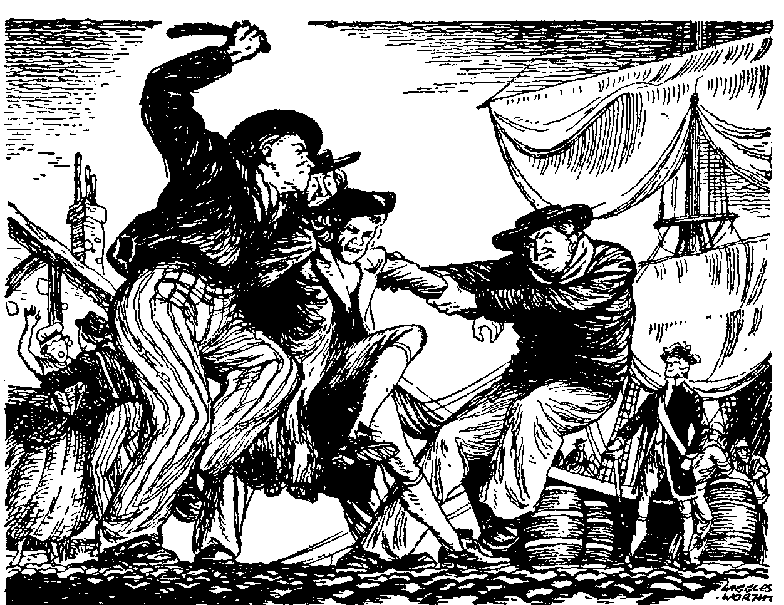
I believe the general picture of a Press Gang is that of a gang of seafarers storming around seaside towns, knocking chaps on the head and bundling them on board ship to act as crew; or for the 'luckier' ones, tricking them by slipping coins into the poor innocents' tankards of ale and then claiming that they had entered into a contract by accepting pay in advance - and off to sea they went. But no, it is far more complicated than that, as the Eton Wick History Group found out from Dr. Judith Hunter at their meeting on 4th March. 

Armed with information gleaned from the Admiralty Minute Books, the Public Records Office at Kew and various other sources, and prompted to investigate simply as a result of curiosity triggered by coming across a reference to a Press Gang in Reading, Dr. Hunter covered the history of the Press Gang in as far as the Seven Year War against Austria, France and Russia (1756-1763). Apparently in 1754, lust before the War began the number of men in the navy was just under 10,000 but by the end of the War they numbered approximately 82,000 - the majority of whom came from Merchant Navy ships. The Royal Navy ships would be stationed in the Channel and would send a gang, under a Lieutenant, to board inward-bound merchant ships and gather up the seaman, returning with them to the Royal Navy ships; sometimes fire would be exchanged but nevertheless the majority of sailors were impressed from the merchant ships and so could end up spending many years at sea unable to return home to far, and friends. The Royal Navy didn't train its sailors, it preferred that they came already experienced from being in the Merchant Service. Some of the coastal traders were issued with a certificate which protected them from being pressed into service; unless, of course, there was a 'hot press' which would be at a time of emergency when anyone could be taken - even from theft own homes - and a record shows that on a least one occasion the groom, best man and half the male guests from a Wedding Reception were taken; but once these impressed people had been checked over perhaps only a third of them would be retained as being sufficiently able-bodied to be of use. 

Almost every coastal village and town had its fishermen and so these areas were a natural source of manpower. A press gang, under the command of a Captain (on half-pay + £5 per week) would 'open a rendezvous' at a village and stay overnight, perhaps publicising the fact by hanging a flag outside, or employing a fife drummer. The Captain (who would probably lodge at a rather better class of Inn than that used for the rendezvous) would have two or three Lieutenants (each earning 5s.0d. per day plus 10s.0d. for acquiring each able seaman or 5s.0d. for an able-bodied landman) and these Lieutenants would be supervised and regulated by the Captain - hence he would be called a Regulating Captain. They would take seamen for preference, but they could also take land workers as well - if they looked suitably young and strong; and they would try encouraging people to join voluntarily, initially, tempting them with exciting stories of life at sea. and exotic ports of call, and the weekly ration of I lb. bread, I lb. port, 1/2 pint, peas and 1 gallon beer. 

The gangs operating under the Lieutenants were usually composed of local residents generally hired specifically for the purpose and who would be aware that they were less likely to be impressed themselves if they were part of the official press gang. The King and Government would offer a 'Royal Bounty' of £3 per able-bodied seaman, £2 for an ordinary seaman and f1 for a landman; some Mayors offered their own bounties and there is a record in Bristol of a wife receiving additional corporation bounty; so perhaps these bounties were passed on to the families of the seaman. It is hoped so because wives and families lost their breadwinner when their man was impressed and would have had to have applied to the Parish Officers for some small amount of money; soldiers' wives and children were on a starvation list. When things were warming up for the Seven Year War the Admiralty ordered that press warrants be issued to cover many towns, both coastal and inland, including Reading. There are records of the Mayor of Oxford asking that the Regulating Captain at Reading assist him by guarding five men who he had 'secured' at Oxford. Those taken were often gathered together in a gaol, or Bridewell. It is assumed that they were then made to walk to a port (London?) and if a tender was not available to take them to a ship, they would be gaoled again at the port until one was available. 

Once at sea, the impressed seamen could do quite well:. Their pay (paid out by the ship's captain) would come from the Admiralty and 'prize money' was paid out when an enemy ship was Captured 3/8 of the prize went to the Captain, 1/4 went to the Captain of the Marines, 1/8 went to the Lieutenants, and the crew and Marine 'other ranks' received 1/4 between them; and there is a record in 1762 of the capture of a Spanish frigate resulting in seamen receiving prize money of £485 each - although a more normal amount would be £10-20. Dr. Hunter read from copies of letters from Admirals and Captains dated around the mid-18th century and they made fascinating listening. Mr. Frank Bond thanked Dr. Hunter and her husband, Rip, for this very enlightening talk. 

The the following meeting held on 15th April 1998 and the topic was the "History of Local Bridges over Streams and River" - presented by John Denham. 

During the 1990's the Parish Magazine of Eton, Eton Wick and Boveney reported on the meetings of the Eton Wick History Group. A member of the audience took shorthand notes in the darkened hall. This article was published in the April 1998 edition.