Showing posts with label Ypers. Show all posts

Saturday, 19 May 2018

Charles Fountain Ralph Godwin (Trumpeter No. 2556) — 1st Battalion Life Guards

Charles Fountain Ralph Godwin (Trumpeter No. 2556) — 1st Battalion Life Guards 7th Cavalry Brigade 3rd Cavalry Division. [After 1918 No. 1 Battalion, Guards Machine Gun Regiment).

Charles Godwin
from a family photograph
courtesy of Anton Yuskan
Charles Godwin's home address until he married was 11 Parson's Green Lane, Fulham. He was a regular peacetime soldier serving as a trumpeter in the band of the 1st Life Guards. As a bandsman he had trained at the Kneller Hall School of Music. He was one of several guardsmen who, while stationed at Windsor, met and married local girls. After he married Nellie Bunce his home address was given as Rosedale, Eton Wick. This was a fine detached house, next to the parsonage, home of local farmer and village councillor Mr Henry Bunce and his family. The Bunces had always been very supportive of Nellie, and when the Godwins had a baby daughter in 1915 they were pleased to accept yet another new addition to their household.

The Life Guards, together with the Royal Horse Guards (the Blues) constituted the Household Brigade 'the soldiers of the Sovereign". On August 4th 1914, the day war was declared, the 1st Life Guards were at Hyde Park, and on September 1st they moved to Ludgershall along with the 2nd Life Guards and the Royal Horse Guards. On October 7th 1914 the Brigade moved to Zeebrugge, and a week later were en route to Passchendaele, east of Ypres. An account of this journey by a Life Guard office, Lord Worsley, states: 

The day before yesterday we were in the saddle for 17 hours, scarcely off one's horse all that time; then 2 hours rest and off again for 16 hours. 

The village of Passchendaele in 1914 bore no comparison to the utter devastation and carnage of later in the war.

Charles was a bandsman, but in wartime the musicians were usually used as stretcher bearers within their unit, and most probably he would have been engaged in this other role from time to time. The Guards of the Household Regiment were better paid than other soldiers. Privates received Is 9d (9p) a day, whilst other cavalry privates received 1s 2d (6p) a day and the infantry privates 1s 0d (5p) a day.

Both Battalions of Life Guards were involved in the October Battle of First Ypres. At the end of the month they bore the brunt of a German attack south of Zandvoorde and were forced back to Klein Zillebeke after suffering very heavy casualties. The following month they had further action against the Prussian In May 1915 they fought, Guard at Nonne-Bosschen, again with heavy losses. dismounted, during the Frezenberg Ridge actions. They fought on the Somme in 1916, and the following year, as a unit of the Household Cavalry, they stood by in readiness for the breakthrough of the enemy lines during the fighting in Arras. The chaos of a modern battlefield, together with machine guns, made such a cavalry attack quite impractical however. On March 10th 1918 it was decided to retrain the 3rd Cavalry Division and designate them The Guards Machine Gun Regiment (G.M.G.R.).

The 1st Life Guards becoming the 1st G.M.G. Battalion the 2nd Life Guards the 2nd G.M.G. Battalion, and the Royal Horse Guards the 3rd G.M.G.B. They went into training for their new role in April/May 1918 at Étaples, on the French coast, between Boulogne and Paris. Étaples was in fact a series of military camps and hospitals spread over a large coastal area. It was during this period of training that Charles Godwin died. His daughter Lilian said she understood her father was killed while playing with the band in hospital grounds by a German aircraft returning from a raid over England.

The facts are marginally different. On May 19th 1918 Whit Sunday, 20 to 30 Gotha bombers raided London, killing 44 and injuring 179 people. Seven planes were shot down. At 10 pm two squadrons of Gothas attacked Étaples. The 2nd Battalion left their quarters for the open spaces, One hour later, another Gotha plane attacked the camp. On this occasion, the tents and two companies of the 1st Battalion were hit. The toll was 43 killed and 82 wounded. No mention is made of the band playing, but allowing for the late hour, and it being Whit Sunday, it is very probably the band did play in front of a hospital but earlier on that day.

Étaples Military Cemetery courtesy CWGC
Trooper Godwin was among the 43 killed. Four days later the training was completed and the machine gunners went to the front, near Arras. The Windsor and Eton Express of June 8th 1918 printed: 

Godwin C.F.R. Trumpeter Band of 1st Life Guards. Killed in France May 19th 1918. Dearly loved husband of Nellie Godwin of "Rosedale" Eton Wick.

Softly at night the stars are gleaming,
Over his silent grave,
Now he is safely in God's keeping,
One we have lost, but could not save.

Charles is buried in Étaples Military Cemetery, France. It is a large cemetery, the grave is in Plot 66; Row C; Number 14. The recorded deaths in the cemetery are: 8,786 UK, 1,122 Canadian, 461 Australian, 261 New Zealand, 113 other allied and 655 Germans. His widow, Nellie, married again and as Mrs Slade had two more children. At one time she kept the shop at what we now know as Taylor's Court and later, lived at The Grapes public house (later renamed The Pickwick) where her husband was the landlord. 

Charles's age is not known, but was probably in his mid-twenties. He is commemorated on the Eton Wick Memorial and on the Eton Church Memorial Gates.


This is an extract from Their Names Shall Be Carved in Stone  
and published here with grateful thanks to the author Frank Bond.


The Eton Wick War Memorial page on Buckinghamshire Remembers website.


Grave Registration courtesy CWGC


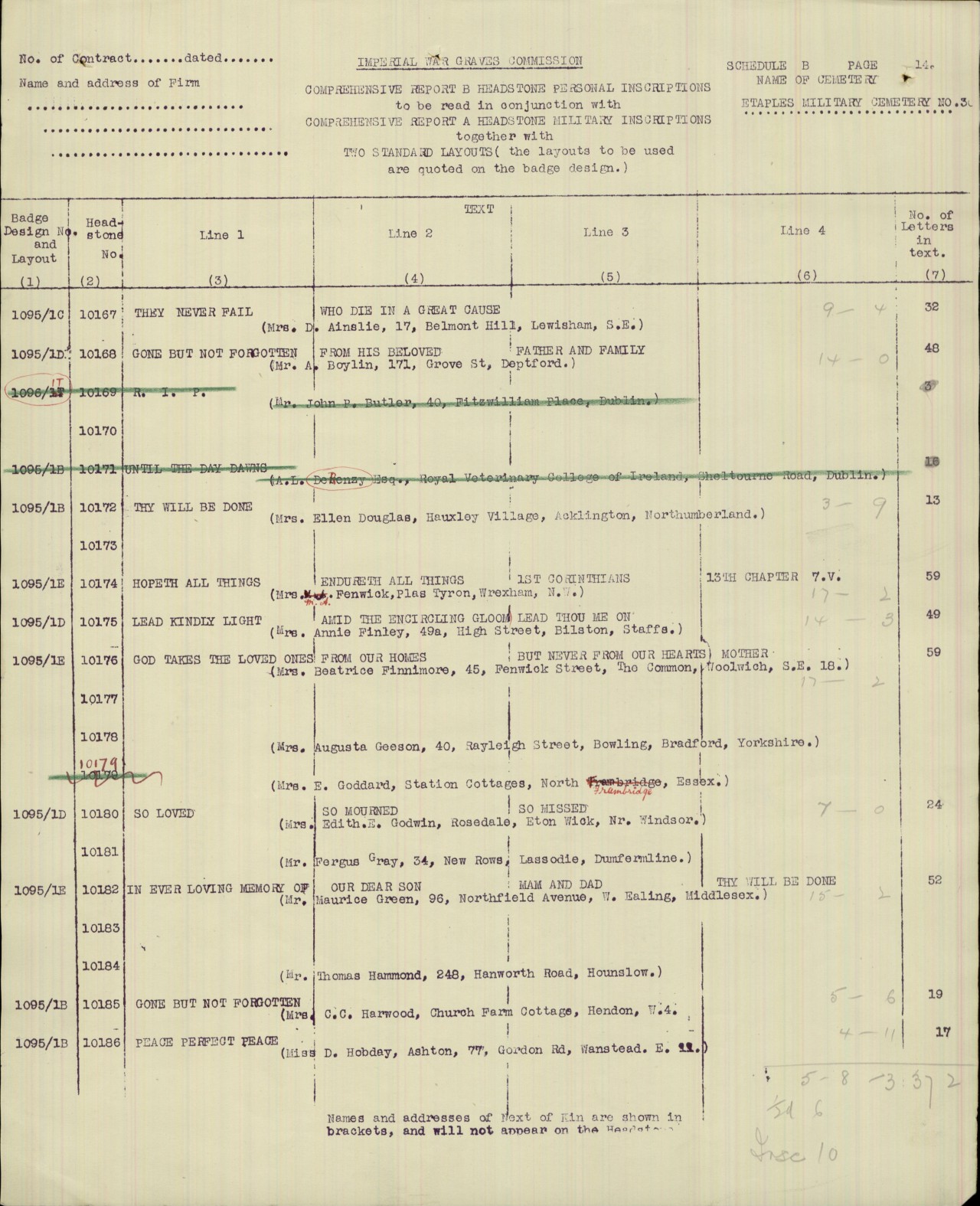
 Headstone documents courtesy CWGC

Note: Charles Godwin was born on 4th September 1890 and christened at St Andrew's Church, West Kensington on 27th March 1892 during the same service as his younger sister Violet.

Tuesday, 24 April 2018

George Peter Baldwin - 6th Battalion Royal Berkshire Regiment

George Peter Baldwin - 16671
6th Battalion Royal Berkshire Regiment — 53rd Brigade — 18th Division

No reference has been found to confirm George as an Eton Wick resident before he was married, at which time he, and Alice May his wife, set up their home at No. 6 Clifton Cottages, Common Road, Eton Wick. These were old terrace houses situated between The Greyhound public house and Sheepcote Road, long since demolished and replaced by Georgian style homes.

The Eton Parish Magazine recorded a son being born in 1904 and christened Peter George. Regrettably, the baby only lived nine months and was buried on May 27th 1905. At this time George was 23 years old. With the outbreak of the Great War he decided to volunteer for the Army, regardless of belng over 30 years old and having two young children. A Parish Magazine booklet lists him as serving by the end of the first year of the war, and his service was with the Battalion Royal Berkshires, a new army (Kitchener) Battalion formed at Reading and trained at Colchester. On July 24th 1915 they embarked for Boulogne.

Unlike many units the 6th Berkshire were perhaps fortunate in having plenty of time to familiarise themselves with the terrain over which they would attack in the Battle of the Somme on July 1st 1916. They were positioned on the right of the British 18 miles line when they advanced from their trenches near Carnoy. Their early objectives were quickly taken as they pushed toward Montauban, despite suffering approximately 350 casualties, half of the Battalion's initial attacking strength. The following day they were relieved and returned to Carnoy. They saw further Somme action on July 18th and again between the and 21 st at Delville Wood, resulting in more casualties. On July 24th they were moved to Armentiéres and two months later returned to the Somme fighting where they manned front line trenches at Thiepval and participated in the capture of Regina Trench. The following year the Berks were engaged in the Third Ypres Battles and were in action between the Sanctuary and Glencourse Woods. On October 22nd, with Third Ypres drawing to a close, there was yet more fierce action in the Poelcappelle sector.


In February 1918 the 6tl Battalion Berkshire was disbanded and it is believed George was then transferred to the 8th Berkshire, who took their place with the 18th Division. The following month the German army launched a massive attack against the British line, causing many miles of hard won territory to be evacuated. By July the Germans had advanced to a varying depth of up to 40 miles on a front stretching from Ypres to Reims, but nowhere had they destroyed the British/French defence that had stubbornly withdrawn under the attacks.

George Baldwin was killed on or about April 24th 1918, during the Anglo/French defence of Amiens. At that time the 18th Division was heavily engaged south of Villers Bretonneux. The local newspaper in July 1918 reported his death and then wrote:

Dearly Loved Husband of Alice May Baldwin — Greater love hath no man than that he lay down his life for his friends,

We miss him, Oh! no tongue can tell
How much we loved him or how well
God loved him too, but he thought best
To take him home with him to rest

And again on the anniversary in April 1919 the same paper:

In Memoriam Baldwin — George Peter
In loving memory of a dear husband and loving father. Private G. P. Baldwin — Battalion, Royal Berks. Killed in action April 24 h 1918 and buried at Hangard Wood Cemetery in France. From his sorrowing wife and children.

We often think of days gone by, When we were all together
A shadow o'er our life is cast, Our dear one gone forever
Sad thoughts may wander round our hearts, And tears they often flow
But to your sad and lonely grave, Our thoughts do often go

The Hangard Wood Cemetery is a pretty little British war cemetery in the Somme department of France. The cemetery contains 161 graves, of which 58 are British, 61 Canadian, 17 Australian, 5 South African and 20 are French. Situated in a very rural roadside setting, it is surrounded by a low brick wall and planted with Irish Yew Trees and flowering shrubs. The village of Villers Bretonneux is approximately 2 % miles north of the cemetery.

George is commemorated on the Village Memorial as P. G. Baldwin and also on the Memorial Tablets on the Eton Church Gates as Peter Baldwin. The Commonwealth War Graves Commission however list him as G. P. Baldwin and the 'Memoriam' entry in the local paper from Mrs Baldwin names him George Baldwin. He was 36 years of age and left a widow and at least two children. The family lived in the same house for several years after the war.


This is an extract from Their Names Shall Be Carved in Stone  
and published here with grateful thanks to the author Frank Bond.

Note. George Baldwin was born in Windsor in 1882 and the 1901 Census records that he was living at 22 Russell Street with his widowed mother Mary and three siblings. He was a house painter. 


Grave Registration Documents courtesy of CWGC


Headstone Inscription Documents courtesy CWGC


Cemetery Plan courtesy CWGC

Sunday, 15 April 2018

GEORGE F. PERCY - ROYAL WARWICKSHIRE REGT.

George Frederick Percy (Private No. 34891) - 1st Battalion Royal Warwickshire Regiment - 10th Brigade - 4th Division

The Percy Family - George 2nd from left standing.
George was a village lad and the second son in a family of six sons and six daughters. He was born on October 21st 1898, and attended the Eton Wick Infant School until he was 6½ years old; he then went to Eton Porny School, starting there on May 1st 1905. The family home was at No. 1, Castle View Villas in Sheepcote Road, not to be confused with Castle View Terrace in Boveney's, Victoria Road. Castle View Villas was a terraced row of eight houses on the west side of Sheepcote Road and having an uninterrupted view, over allotments and fields, of Windsor Castle, approximately 2½ miles away. All of this area was redeveloped after the Second World War.


George was very young to leave the village infants school, and showed something of the same haste to leave the Porny School. It was in fact midterm, and three days before his 14th birthday, when he left school and gave as his reason for leaving "To Be A Houseboy". Presumably this was work in an Eton College boys' house. We do not know if it was a "live in" occupation, but with at least seven younger brothers and sisters at home it would have had advantages if he had been accommodated at his place of work.

His older brother Alfred was in the pre-war Royal Navy. Certainly he was listed as serving on the Royal New Zealand Navy ship Philomel by September 1914, and by the time the war ended four years later he was a Petty Officer, Gunnery Instructor. In 1914 George was barely 16 years old, and at this time the Percy family were living at "Bangor Place" in Boveney Newtown. No date has been found when George enlisted in Slough, but in view of his age it was probably not before 1916. By this time the 1st Warwickshires had seen plenty of fighting, suffered many casualties and frequently had drafts of young replacements.

In 1915 they had been used to seal a breach in the defence caused by an enemy gas attack. Well over half the Battalion became casualties. By 1916, when George may have joined the Battalion, they were fiercely involved in the opening assaults of the Battle of the Somme on July 1st. The 4th Division suffered a total of 4,692 casualties. The Battalion was in and out of the front line until July 24th when they moved to the Ypres sector. In September 1916 they were again back on the Somme, taking up positions east of Lesboeufs, before moving on to Guillemont and Bernafay Wood. The Somme offensive died down in November.

In 1917 the Battalion, as a unit of the 4th Division, were actively involved in the Battle of Third Ypres, culminating at Passchendaele and all the appalling conditions associated with it. The following year brought ever increasing numbers of American troops onto the continent. Conscious of the effect these fresh troops would have, the Germans launched a massive assault along the allied line on March 21st 1918. Their attack was preceded by a shattering bombardment by over 6,000 guns. Both sides suffered heavy casualties and the allied line was forced to fall back alarmingly. As enemy pressure was renewed, still more ground had to be vacated.

Ploegsteert Memorial
n April a determined thrust was made in the Lys River region, and it was here that the 1st Warwickshires were defending the line. General Plumer decided to shorten the line by straightening it during the night of 15/16th April. This meant giving up all the ground so bitterly won during the Passchendaele fighting of only a few months earlier. It was here, at La Bassee, on April 15th that George Percy was killed. His body was not identified, and having no known grave he is commemorated on the Ploegsteert Memorial to the missing, on Panels 2 and 3. The memorial is on the same site as the Berkshire Cemetery Extension, 9 miles south of Ypres and 4½ miles north of Armentieres, in Belgium. The memorial records the names of 11,447 missing men who fell in the battles of Armentieres and Aubers Ridge 1914; Loos 1915; Fromelles 1916 Estaires, Hazebrouck and Outtersteene Ridge 1918.

One year after George's death the local paper reported:

Percy - George F. 1st Warwickshire Regiment, the second son of Mr & Mrs A Percy of Bangor Place, Boveney, Eton Wick. Reported as wounded and missing on April 15th 1918 now officially confirmed as killed on April 15th 1918 "Sadly missed by family and friends".

George was one of Eton Wick's youngest fatality at 19½years old. John Carfrae Clark was also 19 years, but his exact age has not been established. George is commemorated on the Eton Wick Memorial and on the Eton Church Memorial Gates. The village family grave also bears his name.

Eighty two years later there was still a Mrs Percy living in Bangor Place. She was the widow of a younger brother to George, and her own son, David, together with his family, lives in Victoria Road, Eton Wick.

This is an extract from Their Names Shall Be Carved in Stone  
and published here with grateful thanks to the author Frank Bond.

Grave Registration courtesy CWGC

Panel List courtesy CWGC

Tuesday, 27 March 2018

A Bruce Highland Light Infantry

Angus Bruce D.C.M. Company Sergeant Major No. 19160 14th Battalion Highland Light Infantry (Formerly 12th Battalion) 120th Brigade - 40th Division

Angus was a Scot from Uig on the Isle of Skye. He had been a regular serving peacetime soldier and a former Pipe Major with the 1st Battalion Scots Guards.

At the time the Great War started he had most probably served his term of service and was living with his wife Lottie and two children at 5, Primrose Alma Road in Boveney Newtown. He enlisted in London. The name Bruce was first recorded locally in a Parish Magazine of 1904 which stated that a son was christened Angus George on January 11th that year. They also had a daughter named Ailsa, both good Scottish names. The father, Angus, was 23 years old when his son was christened and was almost certainly still in the Scots Guards.

August 4th 1914 found the 1st Scots stationed at Aldershot as part of the 1st Guards Brigade. 1st Division. They landed at Havre 10 days later and on August 20th they were transferred to the 2nd Brigade. The Battalion was very actively engaged during October and November in what was later termed the First Battle of Ypres. From October 26th they were holding the line near Chateau and three days later were fiercely resisting a strong German dawn attack. One estimate suggested there were well over 1000 German dead, with the Scots saving the day, despite their own heavy casualties.

When First Ypres finally ended the Battalion was reduced to one officer and 69 men, and of the B.E.F. it was said "The country's peacetime army had gone to its grave". Fresh drafts brought the Battalions back to numerical strength and September 1915 saw the 1st Scots Guards in action at the Battle of Loos. On the third day of the battle, September 27th, the Guards Division was brought up in support of the 21st and 25th Divisions, and although they made an initial advance they were later repelled. After two days of fighting the Brigade had suffered losses of 42 officers, and 1266 men.

The real loss, however, was not just measured in the numbers but in the irreplaceable experience of the professional soldiers. Of the few survivors, many were needed to train and command the tide of fresh volunteers and later, conscripts. joining the army. At some time Angus Bruce was transferred from the Scots Guards to the 12th Battalion Highland Light Infantry. There he won the highest decoration awarded in the Great War to any soldier recorded on the Eton Wick memorial.

Recorded in "The London Gazette of January 14th, 1916 is: C.S.M. 19160 A. Bruce 12th Highland Light Infantry D.C.M. and two months later we have the citation dated 11.3.1916: C.S.M. 19160 A. Bruce 12th H.L.I. citation:

For conspicuous gallantry and ability. After all his officers had been put out of action in an attack on the enemy’s front trench, Company Sergeant Major Bruce took command and handled his men with the great ability. He gave throughout the action a fine example, to all with him, of devotion to duty.

Angus served another two years before himself being killed. At some time he is thought to have been transferred to the 14th Battalion H.L.I. This was a Bantam Battalion which had been formed in Ayrshire in the summer of 1915 and arrived in France the following June. Perhaps Angus joined them on their arrival there. Bantam Battalions are made up of men below the normal acceptable height for soldiers.

The movements of the Battalion during the next 18 months are not very specific until the spring of 1918 when, perhaps conscious of the stream of American troops reinforcing the British and French, the Germans launched a massive attack along a 50 mile front on March 21st. This followed a shattering artillery bombardment by 6,500 guns. The 14th H.L.I., along with the other Battalions of the 40th Division, were being held in reserve. The front reached from three miles north of Arras to Le Fire, with the British Third Army north of the line and the Fifth Army to the south.

By the end of the first day, the 40th Division was brought forward from reserve in an attempt to stem the enemy advance against the centre of the Third Army positions. By April 5th, when the assault ended, the Germans had advanced up to 40 miles and taken 1000 square miles of territory. The British armies had suffered 160,000 casualties including 22,000 killed, 63,000 wounded and 75,000 prisoners of war.

Angus Bruce is recorded as being killed during the first week of the great battle, between March 21st and 27th 1918. The C.W.G.C. give the 27th as the accepted date. He has no known grave and is commemorated on the Memorial to the Missing at Arras on Bay 8. One year later, on March 29th 1919, The Windsor and Eton Express printed:

Angus Bruce - In proud and loving memory of Angus Bruce ex-Pipe Major of the 1st Scots Guards and Regimental Sergeant Major of the Highland Light Infantry D.C.M. Killed in action March 21st to 27th 1918. From his wife and two bairns - Angus and Ailsa Bruce of Boveney Newtown, Eton Wick.

Better lo'ed ye canna be 
Will you no come back again.

This appears to be wrong, as no evidence is found of his being the Regimental Sergeant Major and all records list him as being a Company Sergeant Major. Lottie and the children lived on in Primrose Villas for many more years.

The Arras Memorial records the names of 35,928 men who were killed in the area and have no known graves. It stands at the entrance to the Faubourg d'Amiens Cemetery which itself contains 2,677 military graves. It is situated 1 ½ miles north-west of the Arras rail station.

Angus was 37 years old; he held the highest rank among the village's Great War Dead and was awarded the highest decoration given to an Eton Wick man in the conflict. He is commemorated on the village memorial and also on the Eton Church gates.


This is an extract from Their Names Shall Be Carved in Stone  
and published here with grateful thanks to the author Frank Bond.

The Eton Wick War Memorial page on Buckinghamshire Remembers website.
Grave Register courtesy of CWGC

The entry for C.S.M. Angus Bruce in the War Graves Register refers to his widow, Lottie as living at 5, Primrose Villas, New Boveney instead of Boveney Newtown.


Memorial Panel List courtesy of CWGC.

Thursday, 15 February 2018

Joseph Springford (Private No. 940171) - 17th Battalion Sherwood Foresters

Joseph Springford (Private No. 94017) - 17th Battalion Sherwood Foresters - 117th Brigade - 39th Division. (Formerly No. 8671 The Cambridgeshire Regiment)

Joseph was one of a large local family. He first registered for school at Eton Porny on the 21st October, 1895 and left school in December 1902. In all probability he attended the infants' school in Eton Wick for two years before going to Eton. The family home in 1895 was recorded as 6, Bell Cottages, Alma Road, Boveney Newtown. Later the family moved to No. 4, Hope Cottages, Common Road, and some years later to 3, Victoria Place, a terraced house about eight doors along the same road from Hope Cottages. By the beginning of 1918 there were six Springford brothers serving in the armed forces. Two were destined to die before the November armistice, although Albert and Harry who enlisted early in the war, returned safely.

It is not known when Joseph enlisted in the army at Oxford, or what work he pursued before joining the 17th Battalion Sherwood Foresters, also known as the Welbeck Rangers. It was June 1st, 1915 when the Battalion was raised by the Mayor and recruiting committee of Nottingham. It was not unusual, at this early stage of the Great War, for Battalions to be raised by local dignitaries, towns, cities and even sporting associations. In October 1915 the 17th went to Aldershot as part of 117th Brigade, 39th Division. The following month they moved to Witley, and on December 10th were taken over by the War Office.

On March 6th, 1916 the Battalion arrived in France. The Battle of the Somme started at 7.30 a.m. on July 1st, 1916, but not until the end of August would the 17th Sherwood Foresters become involved. From the 24th August until the 28th they were being moved towards the front, and on September 2nd went into trenches near Beaumont Hamel. At 5.10 a.m. on the 3rd, 650 men and 20 officers of the Battalion advanced through No Man's Land and by 6 a.m. had taken the German front line. In attempting to advance further they met strong machine gun fire. At 1.50 p.m. they withdrew, having suffered many casualties.

That evening they fell back to Mailly Maillet Wood having sustained 454 killed and wounded of the original 670. The Battalion's first day of action was a bitter experience. Further Somme action followed at the Serre sector front line on September 20th, at Bertrancourt on September 30th and at the Thiepval sector of the front line on October 5th. It was here that the enemy attacked using flamethrowers before being driven back. The 17th Battalion were again in on the front line at Thiepval River sector on the 16th October. Subsequent action involved more hard combat near Senlis and Martinsart Wood.

On November 14th, with Somme battles drawing to an inconclusive end, the Battalion was relieved and sent to Warloy, Three days later they entrained at Candas for St Omer. In July 1917 the Battalion, still part of the 117th Brigade, 39th Division, were in the XVIII Corps of the Fifth Army and involved in the battles of Pilkem Ridge (July 31st) and at Langemarck; the Merlin Road Ridge; Polygon Wood and Passchendaele (in the Third Ypres) between August and November of that year. At this time they were with X Corps, Second Army.
St. Sever Cemetery Extention
The atrocious conditions of the Passchendaele offensive effectively ended in November when the German defence of the ridge was overcome. Three months later The Windsor & Eton Express reported:

Springford, Joseph, Private 17th Sherwood Foresters died 15.2.18 at No. 3 Stationary Hospital, Rouen aged 30.

And again on March 9th, 1918 the same paper reported:

Springford, Joseph, Private Sherwood Foresters son of Mr. T Springford of 3, Victoria Place, Eton Wick, died of kidney disease on February 15th, 1918 while in No. 3 Stationary Hospital, Rouen, France.

Joseph was the first of two Springford fatalities. His younger brother Isaac died 4 ½ months later as the result of severe gassing and was buried in Eton Wick. Joseph is buried in the St. Sever Cemetery Extension, Rouen and his grave is No 73, Row K, Plot 6, Block P. The cemetery extension is two miles south of Rouen Cathedral and records 8,356 burials with a further 3,083 in the main St. Sever Cemetery to which the Extension is part. All these burials are of the 1914-18 war. The Extension contains 6,600 U.K. soldiers, 783 Australian, 311 Canadian, 271 Indian, 134 New Zealand, 88 British West Indian, 84 South African, 11 Newfoundlanders, three from Guernsey, one Bermudan, six unknown, one Egyptian, 44 Chinese labour force, 18 Italian and one Portuguese. The large number of different nationalities is due to the fact that the cemetery was for men dying of wounds or sickness in the No. 3 Stationery Hospital.

Joseph is commemorated on the Eton Wick Memorial and on the Eton Church Gates.

This is an extract from Their Names Shall Be Carved in Stone  
and published here with grateful thanks to the author Frank Bond.

Joseph Springford: The For King & Country page.


The Eton Wick War Memorial page on Buckinghamshire Remembers website.

http://www.wartimememoriesproject.com/greatwar/ 


Grave registration documents courtesy of the CWGC 


Sunday, 12 November 2017

Remembrance Sunday 2017


The Eton Wick History Group laid its first wreath on the village War Memorial on Remembrance Sunday 1999. They have continued to do this each year since then and will be doing so again today.

During 1917 11 men who called Eton Wick their home died in the service of the country.

Private Herbert Pithers - Killed in action at Ancre and is commemorated on the Thiepval Memorial.

James John Newell (Trooper No. 1232) - 10th Brigade 4th Division (Formerly Trooper No. 3831 - The Life Guards) - Killed in action at Arras and he is buried in the Athies Communal Cemetery Extension in France.

John Carfrae Clark (Gunner No. 630936) - Killed in action at Roeux and he is buried in the nearby cemetery of Anzin-St-Aubin. 

Joseph Newell (Private No. 9534) - 1st Battalion Oxfordshire and Buckinghamshire Light Infantry - 17th Brigade - 6th (Poona) Division - He died in a Turkish Prisoner of War camp and is commemorated on the Basra Memorial in Iraq.

Charles Miles (Stoker 1st Class K25314) - H.M.S. Vanguard Royal Navy - Killed when HMS Vanguard blew up and sank with its entire crew. He is commemorated on the Chatham Naval Memorial in Kent.

Arthur Bunce (Private No. 39794) - 3rd Battalion Worcestershire Regiment - 7th Brigade - 25th Division - Killed in action at Messines Ridge and he is buried in the Messines Ridge British Cemetery, Messines, Belgium.

Alfred Brown (Private No. 11811) - 2nd Battalion Grenadier Guards - 4th (Later 1st) Guards Brigade - Guards Division - Killed in action at the start of the Third Battle of Ypres and he is buried in Artillery Wood Cemetery at Boesinghe. 

Henry Charles Hill (Stoker 1st Class No. 1/18991) - H.M.S. Pembroke - Chatham - Royal Navy. He was killed during an air raid at Chatham Naval Barracks and he is buried in the Gillingham Naval Plot.

Robert Thomas Hobrough M.M. (Sergeant No. 40782) - Royal Engineers - No. 7 Signal Section Royal Engineers - Killed in action during the Third Battle of Ypres and is commemorated on the Memorial to the Missing, Panel 8, at Tyne Cot in Belgium.

Ernest Brown (Private No. T/202287) 3rd/4th Battalion The Queens Royal West Surrey Regiment – 62nd Brigade – 21st Division - Killed in action during the Third Battle of Ypres and is commemorated on a wall plaque in the Tyne Cot Cemetery.

Cyril Arthur Ashman - (Private No. 746) 2nd Battalion Honourable - Artillery Company 22nd Brigade - 7th Division - Killed in action at Gheluvelt and is buried in the military cemetery known as Tyne Cot.