Showing posts with label Village Hall. Show all posts

Thursday, 5 September 2024

Photographic History of Eton Wick and Eton - Community Organisations and Social Life - Eton Wick EC 1929

When the club was formed in 1881, home matches were played on Dorney Common, much later moving to their present home on Eton Wick Recreation Ground. 


This photo of 1929 shows the team at the front of the Village Institute (now Village Hall) long before the entrance stairs to the upper floor were covered. 

In the back row, left to right: Jess Binfield (committee member), Bert Percy, Tim Morrell, Bob Bond, Les Binfield, Archie Bryant, Bert Harman, unidentified, Ern Bryant. 

In the front row: M Porter (committee member) George Giles, Ted Watson, Bill Swabey (captain), Maurice Lane, (?) Prior, Tom Morrell. 

This article was first published in A Pictorial History of Eton Wick & Eton.


Tuesday, 23 July 2024

Photographic History of Eton Wick and Eton - Community Organisations and Social Life - The Shoestrings

The 'Shoestrings' The Eton Wick Variety Group were reformed in 1962 as the 'Shoestrings' to raise funds for the Village Hall extension. They staged variety shows annually until 1971, some of them skits on contemporary T.V. shows, including 'That Was the Wick That Was’, 'Christmas Crackers' (1964), 'Licence to Laugh' (1965), 'Through the Rainbow' (in 19n-with ex Victoria Palace Black and White Minstrels Penny Rigden and Alan Hollidge 'Summer Interlude' (1967), 'It's here' (1970) and finally 'Starella Fantasy' in 1971. 

The group performed in many venues. Comedy sketches were written by Albert Bond, Sid Eyre and Sid Gomm. 


In this picture from 'Through the Rainbow' in 1966 are, back row, left to right: Kay Thompson, Sandra Ling, Rene Thompson, Sandra Wells, Jacquie Tickle (daughter of Francis in the photo of the Eton Wick Unity Players), and Caryl Cullum. In the middle are Jane Harper and Gail Groves. In the front: Susan Bond, Leslie Chadd, Jillian Bowyer and Denise Fogarty. 

This article was first published in A Pictorial History of Eton Wick & Eton.


Saturday, 6 May 2023

Coronation of King Charles III on 6th May 2023


We will all be celebrating on this day, and a number of events are planned in and around the village. which may be covered elsewhere in this magazine edition. The village hall will be handling both ends of the age spectrum, by giving a Coronation mug to every under 18,¹ and providing a lunch in the hall for those who will be now experiencing their second coronation.² 

We have just experienced something that everybody living in the UK today will almost certainly never see, that is a monarch reigning for 70 years in Elizabeth II. The reasons for Elizabeth coming to the throne at the tender age of 27 were pretty unprecedented, namely two world wars. an abdication and a reluctant King who smoked to excess and died in his 50's. 

Although Elizabeth was at a tender age in 1952, she was not the youngest queen. that title belongs to Mary Queen of Scots who came to the throne in 1542 aged 6 days. Henry VI. a local lad born in Windsor Castle. came to the throne in 1429 aged 8 months and 26 days. Henry had an eventful reign. also being king of France, he had his own local issues with Scotland. and also some with the French, so nothing much changes does it? In his spare time Henry set up Eton College and had a pub in Eton named after him. Our own King Charles III now holds the record as the oldest monarch to take the throne at 73. 

Barring tragedies Charles will be succeeded by William V and he by George VII. so if you check their various ages and do the maths you will see why we state that no-one living today will see another 70-year reign. 

Anecdotes — These are a few anecdotes collected from °Wickites" who remember snippets from their childhood at the time of the death of George VI and the coronation of Elizabeth II. 

Apologies in advance if any of them have misremembered, they were very young, and it was an awfully long time ago!! 

"My first memory is arriving at Porny playground. There is an uninterrupted view of the Round Tower. The flag was at half-mast. I burst into tears. I was inconsolable. My world as I knew it had changed forever. My next memory (presumably a few days later) is of the whole school being walked up Castle Hill to watch the procession for the proclamation of Elizabeth II at Victoria's statue. 

Just before coronation day all Porny children were presented with a coronation mug by a local dignitary. My parents had a Coronation party for friends and family at their newly built home in Tilstone Close. I had a new dress (a rare occurrence). It was blue and white with a beautiful. smocked bodice. bought from the Bunny Shop in Eton High Street. I thought it was lovely. 

My maternal grandparents bought me a die-cast model of the Golden coach with its 8 Windsor Greys (I don't know what happened to it). We all crowded around a small piece of furniture. with a 9° screen and a magnifying screen in front of it to watch the proceedings. Afterwards my dad was passing round drinks and cigarettes from a wooden box. I took one. He said -You've taken it lady, now you can smoke it". It was awful. I coughed and coughed. felt sick and dizzy and have never put a cigarette between my lips since!! 

My younger brother remembers standing outside Tom Brown Tailors with his classmates to watch the Queen in an open carriage with lots of horses and soldiers on her way to Windsor. (I have no recollection of this). Nearly everyone eventually went to the ABC Cinemas in Thames Street to watch the coronation on the big screen and see pictures of Hilary and Tensing on top of Everest. We all clapped and cheered." 

Jacquie aged 10½ in 1953 

"Myself, and my younger sister, lived on the main road at the junction with Tilstone Avenue. We had a street party in Tilstone and it was organised by Mrs Wilkes and Mrs Wilson. There were lots of tressle tables and benches (I don't know where they came from). My mum had to borrow lots of small bowls as she was in charge of making the jellies. They were left to set in the back porch and covered with a sheet. She also made lots of rock cakes. My auntie made bowls of fruit punch and Bonds supplied some fruit. We were very excited watching balloons being blown up with a pump. (Could it have been helium?) We went to the brook at Dorney Common edge to let them go. We didn't want to lose them. balloons were a special treat and some of the children got upset. We watched the Coronation on our newly bought SM screen television. The Village Hall had lots of decoration and there was bunting around the rec. 

Pat Cole aged 14 and Nita aged 8 in 1953 

"My father had a position with what was then known as the War Office (later Ministry of Defence) in Whitehall. He had been able to secure tickets for seats at an upstairs window on the route of the Coronation Procession from Westminster Abbey to Buckingham Palace for my brother Philip (15 years old) and me (11 years old). I cannot recall many details now 79 years after the event but do recall how lucky we felt and how excited we were at the time. 

Shortly after Coronation Day there was a Royal carriage procession along Eton High Street which was decorated with bunting. I believe this procession continued over Windsor bridge and up to the castle. Pavements were lined with excited loyal subjects cheering the new Monarch. We lived at 122 High Street. Eton practically opposite the entrance to Porny school and had a balcony which gave us great views of the procession as it passed by. I have a small photograph taken at the time from an upstairs window. I also have feint recollection of a street party along the length of Eton High Street which I feel sure was replicated on a national scale.' 

Mike Newland - 6 February 2023 

I was living with my parents and grandparents in Eton Square and went to Eton Porny School. We didn't have a television, so we went to my aunt and uncles in Spingfield Road, Windsor and watched the Coronation and what I think was a 12" Bush TV with a magnifying glass in front on the screen. We were all excited because my uncle Mac was in the procession and followed the Coronation coach and was the Royal Standard bearer. He was a regimental Corporal Major in the Royal Horse Guards which later become the Blues and Royals. As I recall the weather that day was wet and the only memory I have is seeing Queen Saloti of Tonga who insisted on riding in an open top carriage and getting soaked: 

Barry Alder aged 10½ in 1953 

We thank all the above for their interesting anecdotes. In terms of street parties, we are told they were in The Wheatbutts field and on what was known as the 'new' Rec (opened in 1952 by Prince Philip), alongside numerous gatherings on a street-by-street basis. On a more sombre basis we also received memories of the funeral of King George VI. and his journey from the ceremony to where he is entombed, at Windsor Castle. He was taken to Windsor Central station by special train. 

Children from Eton and Eton Wick were taken to watch the train cross the viaduct from Chalvey to Windsor, those lucky enough to live on the right side of Somervile Road could actually watch from their back gardens! Similarly, those elder children attending Ragstone Road secondary school³ could watch from their playground. For those with an interest in railways the locomotive hauling the train was No. 4082 Windsor Castle'. 

We would hope that all our readers will enjoy the coronation weekend, maybe a unique one in history, hopefully there will be plenty of events in or around the village, and if nothing else the young ones will appreciate another day off off school and extra cakes, as they did on Coronation Day 1953. 

As previously mentioned, the Village Hall trustees will be organising Coronation celebration mugs for village children, together with a large screen broadcast and lunch in the Village Hall for our senior citizens. 

Note 1


Note 2


Note 3 Ragstone Road secondary school is now called Slough and Eton Church of England Business & Enterprise College.

This article is republished here with the kind permission of the Eton Wick Village Hall Committee. It was published in the April 2023 edition.


Monday, 1 August 2022

Photographic History - Village Characters - Mr Edward Littleton Vaughan 1851-1940


This photograph of Edward Vaughan was taken in the 1930s. 'Toddy' Vaughan was a house master in Eton College for 27 years. It was his initiative that bought Agars Plough and Dutchman's Farm for the College. In 1879 he climbed the Matterhorn, and was an enthusiastic horse rider despite sustaining a crippling leg injury in the process. He took a great interest in Eton Wick and was the village's greatest benefactor as a list of his many contributions would testify. He donated land and funds for building the Village Institute (now the Village Hall), gave generously to the Horticulture Society and the Church and its Sunday Schools. He was founder of the first scout troop in the village and its first Scout Master (he was at camp with the troop near Weymouth when the Great War was declared in August 1914). In c1907 he formed the Harriers and Rifle Club, started the Boys' Club in c1935 and was President of the Eton Wick Football Club. He also served on the Council and was at one time its Chairman. 

This article was first published in A Pictorial History of Eton Wick & Eton.

Monday, 11 July 2022

From the Parish Magazine - Eton Wick History Group Meeting - The Influence of Eton and Eton College on Eton Wick and Infant Welfare


Mr. Cullum introduced the 25th June 1997 meeting of the History Group. He mentioned that plans for a visit to the Rowing Lake site had not yet been finalised; the unveiling of the Group's new plaque at the tree planted by 'Toddy' Vaughan to commemorate Queen Victoria's Diamond Jubilee was to be marked by a small ceremony towards the end of July. 

Mary Gyngell and Mr. Povey had both written to Rail Track concerning the untidy state of the viaduct and Rail Track had since removed all the old boarding and have undertaken not to re-rent the arches. After acknowledging the generosity of the ladies who provided the Group's refreshments, Mr. Cullum handed over to Mr. Bond for the topic for the meeting: 'The Influence of Eton and Eton College on Eton Wick', after which Mrs. Ballhatchet would give a brief talk on 'Infant Welfare'.

Mr. Bond opened by pointing out that both Eton and Eton Wick had been in existence for many years before the College arrived in 1440, that Eton itself may already have been 700 years old at that time; and that whilst Eton College never set out to Influence Eton Wick, it had done so, in one form or another, for 557 years. 

Mr. Bond then painted, in words, an onward-flowing picture of the area from those early times, when the sand around here would have been thickly wooded (lots of willow and oak) and boggy with more streams and an abundance of fish (1d. a bushel for young salmon!), it is apparently recorded in the Doomsday Book that Eton paid a tax of 100 eels. He pointed out how fortunate Eton Wick is to be surrounded with Lammas and Common lands and he urged the members to be on their guard against any invasion of this protected land. (Mr. Bond later mentioned that apparently two Eton Boarding Houses and houses near The Willowtree stand on Lammas land - although it should be noted that this can be permitted provided a similar area of land is freed to be registered as Lammas to compensate for the loss). 

Mr. Bond was able to tell us a great deal about the history of the College, including lesser known facts such as the King (Henry VI) allowing weekly markets and two annual fairs because of the influx of people required for the construction of the Chapel and College - and keeping the College boys in Chapel whilst the Pig Fair' was on because the boys used to cut the pigs' tails off; and Edward IV's planning to send all the goods and chattels from Eton College to St. George's Chapel but suffering a change of mind when he realised that Windsor Castle could not accommodate his 'lady friend', Jane Shore; she was then housed at Eton College and all the College possessions were returned! 

Needless to say, Mr, Bond's talk contained an abundance of information and it would be impossible to reproduce even a fraction of it here. As to the influence of Eton College and Eton on Eton Wick: The College must have hindered the growth of Eton itself, as a town, in that the spread of the College buildings resulted in demolition of town property and Eton residents moving out to Eton Wick. Against this must be balanced the opportunities for employment offered by the College over hundreds of years to both Eton and Eton Wick residents. It should be remembered, too, that many Eton masters and their wives initiated and supported local projects and that Eton Wick enjoys its Village Hall courtesy of its College benefactor, Toddy Vaughan. Another Eton master, Mark Anthony Portly (b. 1731) founded the charity which resulted in the setting up of Eton Porny School. College boys still come and help our more elderly residents and two boys help at Eton Wick School. 

Mrs. Ballhatchet continued by outlining the influence the College had on the provision of health care for mothers and children - starting (in 1915) one of the first baby clinics in [Buckinghamshire, which was run by a Nurse Orchard with a committee Including Eton masters' wives. By 1917 the 'Babies Welcome' clinic was well established, records of babies' health were kept and talks were given by the local doctor, Nurse Orchard or one of the masters' wives. Mothers were able to make purchases at the clinics of such items as baby milk and Viral, material, knitting wool and patterns, second-hand clothes - and Eton College dripping? Eton Wick's clinic always did well in County competitions and presentation of the certificates awarded was made at an annual picnic at one of the boys' boarding houses; and there was always as Christmas Party. This clinic, started 82 years ago, still meets once a month with a local doctor and nurse in attendance.

The next scheduled meeting was to be on WEDNESDAY, 10th September 1997, when a representative of Oxford Archaeological Unit will give a talk on 'THE ETON COLLEGE ROWING LAKE'.

During the 1990's the Parish Magazine of Eton, Eton Wick and Boveney reported on the meetings of the Eton Wick History Group. A member of the audience took shorthand notes in the darkened hall. This article was published in the August edition of 1997.


Monday, 6 June 2022

Photographic History - Village Characters - Henry Babington Smith Plaque 1983

The Vice Provost of Eton College and a Trustee of the Village Hall, Mr David Macindoe, unveils a plaque dedicating the new boundary wall of the Hall to the memory of Henry Babington Smith, who was for twenty years a much loved Trustee and benefactor of the Village Hall. Pictured with Mr Macindoe are Eton Town Councillor Mike Tierney (left) and Village Hall Chairman Jim Burger, and on the right, Henry's brother, Mr Bernard Babington Smith. Following his retirement as a master at Eton College, Henry Babington Smith served the village community in many ways until his death in 1982. During the 1960s he voluntarily kept the churchyard tidy and the grass cut. Only when the task became too great was a committee established to find ways of funding the maintenance. Henry Babington Smith served on this committee too, until his death. The central bed of shrubs in the churchyard is also dedicated to his memory.

This article was first published in A Pictorial History of Eton Wick & Eton.

Monday, 8 February 2021

Photographic History - Village Characters - Mr and Mrs H. Burfoot


Mr and Mrs Henry Burfoot Jnr were active members of the community for nearly half a century. Mr Burfoot was secretary of the Village Hall Management Committee, a member of the Parochial Church Council and a sidesman. Mrs Burfoot was on the committee of the Eton Wick Nursing Association and was secretary when the Infant Welfare organisation started in 1915. She was also a member of the Church Ladies' Working Party and a founder member of the Eton Wick and Boveney Women's Institute

This article was first published in A Pictorial History of Eton Wick & Eton.

Monday, 28 December 2020

Edward Littleton Vaughan - Village Benefactor

Edward L Vaughan
An outstanding benefactor to Eton Wick village, Edward Littleton Vaughan known to everyone as 'Toddy' but not to his face, was an Eton College Classics master. He lived 89 years from 1852 to 1870 and was unmarried until he was 70 years old. He spent most of his life living at Eton, but it was to Eton Wick that he spent his money and constant support.

He was an Eton College boy in Oscar Browning's house between 1865 and 1870 before going to Balliol College, Oxford for 4 years. From there he went to Leipzig University, returning to Eton as a master after 2 years, the year was 1876 and apart from a small break he remained at Eton College until 1919, a spell of 43 years.

Long before this he had become involved with Eton Wick, but for the moment we will stay with `Toddy' at College. After 8 years as an Eton College master, when he was 33 years old, he became a House Master for 29 years, until 1913. In fact, he did not marry until 1921, two years after his retirement at 68 years. His Irish Bride was Miss Dorothea Waller and when he went on his honeymoon to France, he found time to bring back unusual little gifts to all the Eton Wick school children. My sister had a pen or pencil, through which it was possible to see an image of the Eiffel Tower when held to the light, certainly a novelty in 1921.

Willowbrook (off the Slough Road); Eton was his home for the latter years of his life, and it was built for him. From Willowbrook he served as Secretary to the Old Etonian Association; and after the Great War (WWI) he worked with immense industry to compile a record of Old Etonians killed in that war. You may think that is not a big deal; but when we recall that 5,610 Etonians served in the forces in 1914-18, that 1,124 lost their lives (20%) another 1,068 were wounded. 13 gained Victoria crosses; 554 Military Crosses, 407 DSO besides many other awards, we should perhaps pause to acknowledge the work that Toddy undertook in himself acknowledging the price the College paid in human life.

I am sure this is enough of the background of 'Toddy' except to speculate that as is generally believed, the College Masters make their money by being Housemaster; then perhaps Mr Vaughan was particularly blessed with having been a housemaster for 29 years.

His generosity to the village is certainly on record back into the 1880's when he was still quite young and only recently a housemaster. There is no evidence that he lived in the village house so long associated with him – Wheatbutts Cottage. He did however live in Boveney. This was reputably either 'Brookside' or 'Boveney Cottage', probably one and the same.

The year that Edward Littleton Vaughan became housemaster (1884) and was 33 years old, coincided with the immense change at Eton Wick. Until this time Eton Wick ended at and before this, only the Shepherds' Hut public house and two farm cottages in Bell Lane which in fact straddled the village boundary, i.e. in Boveney/Burnham

About this time Mr Vaughan acquired Wheatbutts Cottage and Paddock/Orchard on leasehold and in the following year used the property to benefit the village. It was suggested that he consider himself the Squire of the Wick. This was in 'Etoniana'. It is not really my view, but he earned the title. From 1894-1934 the village had its own Rural Council, and for the first 20 years he was its Chairman. Mostly meetings were held at the Wheatbutts, yet he never lived in the house, Special meetings were held at the new school, when the old ceased to serve as an Institute in 1903 due to redevelopment. The village rifle club met at the Wheatbutts regularly. The District Nurse lived in a Thatched Bungalow at the Wheatbutts field. Tenants of cottage included Teddy Watson, farmer and during WWII (after Toddy's death) David Niven.

In 1919 the owners—Eton Poor Estate—put the property up for sale"– Toddy then bought it.

When young we think everybody aged 50 is very old and cannot ever imagine them ever to have been young (or perhaps less miserable. I am sure that all who remember Mr Vaughan suffer from this; and my memory is of a shortish, smartly dressed man, lame with a stick and perhaps a little bit frightening.

What a terrible pity, because I now know that this short man stood taller than most of us . I was once told that a riding accident had caused the lameness, and although this is generally accepted, there was more to my informants’ story than I have proof of. As a young man, perhaps after his return to College in 1876, he liked to ride his horse over private jumps in the water meadow below Eton Wick Recreation ground of today. This land belonged to Boveney Court Farm and Mr Vaughan was told not to trespass. Being the determined character he always was, he ignored the cautions. One day both Mr Vaughan and his horse were brought down by chains suspended across the jumps. The year and the confirmation of this event I have not been able to prove.

The first mention of his help to the village that I have yet found is 1884, the year he became a housemaster. In March 1884 we read in the Parish Magazine; on Sunday Schools 2 Classes for children of trades people at 2.15 at the Eton Vicarage. At 2pm for young men under the Reverend Norris and at 3pm. For lads by Miss Vaughan ,4pm. For girls over 14 years by Miss Vaughan both held at Mr Vaughan's house in Eton College. Was there a connection here between the Vaughan’s?

 In 1888 the Old School was closed (on the site of Chantlers' Stores at the top of the Walk) after 48 years and a new school was opened in Sheepcote Road. The old building was made available as an Institute and Working Mens' Club the following year for £10 a year rent. It was opened with membership fee of one shilling and two pence or three pence a week charged. There were 46 members at the outset. Mr Vaughan gave a large wall map to the club. It is believed that Mr Vaughan was resolved to see Eton Wick and the Boveney (new one village in

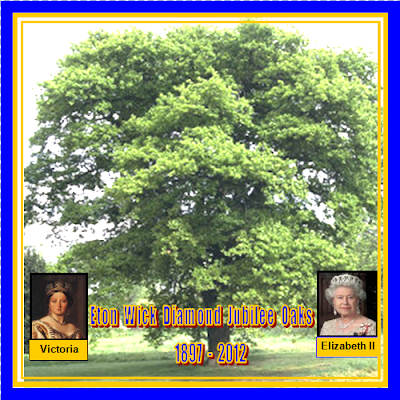
Queen Victoria Jubilee Oak Tree
image courtesy of Google maps
all things. In 1898 he planted the oak tree on The Common to commemorate Queen Victoria's Diamond Jubilee. In 1904 the old school was purchased with intent to build a purpose shop on the site for Pratt of Eton for his son. Of course, this disrupted the successful Institute and a committee explored means of building a new premise. Mr Vaughan generously offered to take a long lease on Wheatbutts where an Institute could be built or give a site on his property in the N.E. corner. In October 1905 a meeting held in the school room agreed to the loss of Lammas Rights on the proposed plat next to the allotments. By this time (1905) he was giving annual treats at the school, with pupil entertainment, tea, cakes, crackers and presents all round, at the end Buns, oranges and chocolates.

He gave the land and the very fine Institute to the village, and being on the border of the two villages it was fittingly named Eton Wick and Boveney Institute — now of course , The Village Hall.

The things that he gave were ongoing — every year a Christmas tree; school treats etc. He once claimed to know all the school childrens' names. He was President of three football club and a vice-president of the cricket club. He provided the site for the Scouts but and took a major role in the formation of the scouts and wolf cubs. On occasions he motored the Cubs and Guides to camp and would pay for the poor to go. When the football club won a cup, he gave them all a dinner in the Three Horseshoes pub.

The Horticultural show was always held in his orchard (Wheatbutts) and he usually attended, made a speech, and presented the prizes. The creation of Eton Wick and Boveney Womens Institute and the Library were due to his efforts. Not once, but several times he created a Boy's Club here.

In the mid-1930's, despite being over 80 years he urged a Les Moreley and a Guards sergeant to form another Boy's Club. He often visited himself until in 1937 Les Moreley left to work at the newly built Slough Centre in the Farnham Road.

Dorothea Vaughan

Unfortunately, most youngsters of this era were a bit intimidated by 'Toddy' and tried to avoid playing him at Shove-a‘ penny, Lexicon or draughts. He attended the village church services and always read the lessons. The services came to a halt while he hobbled back to his seat. Eton Wick and Eton College were his two loves until he married and then Dorothea was added to them. We owe him much, the village hall, the magnificent tree on the common, his many kindnesses throughout his adult life and above all his influence on the community.

Dorothea was herself an equally determine lady, and she played an important role in the village. After the war I wrote to her on behalf of the Youth Club — she was President — for permission to sell a vaulting horse and box and other gym items that were no longer used in the hall. Back came a strong letter saying "No" My husband equipped the hall for boys to use, I should see they use it, no excuses, and while I was at it I should use my influence with members to go home and educate younger brothers and sisters not to break fences (Wheatbutts) not to throw rubbish in the stream etc..

On one occasion she attended a meeting of the club (She was terribly deaf in old age) and I reported that I had been asked to represent the club at a National Boys Club meeting to be held at Aylesbury. I could not possibly attend; it was an afternoon in mid-week, and I was working on the Slough Trading estate. She made no indication of having heard a word but imagine my surprise a few weeks later when I was asked who was the frail old lady who found her way to the Aylesbury meeting and gave them all a dressing down for calling an inter club meeting at a time unsuitable for working representatives. She once said to me, I decided to buy all new chairs for the Hall, I told my husband and he replied, "Good I will tell you where to get them". She then said, "No you will not, I am paying, I am Irish and I will have them sent here from Ireland" Those two small examples give some indication of her strong nature. She was president of the Womens Institute at one time. Wheatbutts was left to Dorothea and eventually purchased by Eton College in 1953. Since then, Wheatbutts was occupied by a college master. The field was later sold as a building site around the early 1980's.

An article by Frank Bond
Saturday, 4 April 2020

Village Hall Closure - Coronavirus Covid-19

Please note that with effect from 

Friday 27th March 2020 Eton Wick Village Hall 

will be closed until further notice. 

We of course apologise for any inconvenience to our hirers, but this is in accordance with Government Guidelines. 


Easter Egg Hunt on Good Friday - We were hoping to make this an outside event only this year. Due to the Coronavirus this has now been cancelled.

Unfortunately many other events listed in this newsletter have been cancelled or postponed, with particular reference to the V.E. Day Anniversary Celebrations shown on page 14 of Our Village April 2020

Margaret Everitt 
Chairman 


Wednesday, 17 July 2019

Eton Wick: A Changing Village Before 1934


This part of the village has almost always been mainly residential, but elsewhere there 
Clifton House

were new shops and businesses being set up. One of the first additions in the twentieth century was probably the shop at Clifton House, now the post office. It has the distinction of being the first purpose-built shop in the village, and the cause of much open-eyed wonder to at least one small boy, who about 1902 watched they high sky-light going into place, and large marble slabs for counters being carried in. Before this he had only seen marble as tomb stones! The shop was 'built as a wedding present to young Mr Pratt from his father of Pratt & Sons, family grocers of Eton High Street. Unfortunately romance and business did not mix: tradition has it that the young couple were too kind-hearted so that within a few years the shop had to be sold. The next shopkeepers after this were the Harman's, after them Anderson, then Wiggington; until in 1931 the shop became Chantler's and remained so for the next forty years.


About 1907 Edward Woolhouse set up in business at 58 Eton Wick Road as a cyclemaker and repairer, though there was far more to his business than that. He hired out cycles, particularly to Eton College boys for this was the era of the bicycle. He also made and mended perambulators and many other household items. There is no doubt of his importance in Eton Wick nor his prestige when he became one of the first villagers to own a car, a De Dion. For many years the present Baron's Stores (no 62 Eton Wick Road) was occupied by William Hearn, boot and shoe repairer, saddler and even umbrella maker. Thomas Henry of Inkerman Road, on the other hand was a bespoke shoemaker. Like several other shoemakers in the village, though their names were not recorded in the trade directories, Mr Henry worked for Ganes of Eton and his customers were mainly from the College. About this period in the years before the First World War, Thomas Bond was first advertised as greengrocer of Alma Road; Albert Bond was following the same trade from his home at Ye Olde Cottage. Bert had begun his interest in business long before - while he was still at school - by selling fish to the workmen building the new lock at Boveney. When he left school he took to selling fruit and vegetables from a donkey and cart, promoting himself to a horse and cart as soon as he was able, and selling fish and rabbits as well. He was a familiar figure in the village for well over half a century, and his cart, piled high with clean and polished produce, annually took part in the Windsor Hospital Parade. North of New Town the land not built upon was a market garden known as Home Close and owned by Harry Prior. Albert Borret was a cowkeeper though he lived at Vine Cottage in the Eton Wick Road until he moved to Eton Cottage. Like the farmers he sold milk from a churn, measuring out the quantities into the customers' own jugs.

The Fly-paper Man
The long established shops continued through this forty year period, though the shopkeepers and the types of goods they sold changed. At one time there was a fish and chip shop, a fishmonger's, a confectioner's and Uneedus the draper's. All of these were advertised in the directories; but there were several small businesses that were not. Tinker' Palmer mended pots and pans, and boots and shoes at his home in Prospect Place. Mr Bolton attempted to establish a butcher's shop in Alma Road, but it was not a success. Meat could be bought from one of the grocer's shops when a carcass had been bought from Windsor market, or from one of the travelling horse-drawn shops that came into the village each week. Hendley's high-box type van was a familiar sight each Thursday until the Second World War. It carried all manner of household goods, pots, pans, baskets, tin baths, oil for lamps which were hung outside and inside of the van and piled high on top as it was so laden. Mappin's from Slough delivered cakes; the muffin man and the winkle man came in their seasons and in the summer the fly-paper man, complete with his top hat adorned with a sticky paper ribbon decorated with dead flies. How far he travelled is not known, but his song is remembered in Slough, Chalvey and Windsor: - 'Flies! Flies! Catch 'em alive! His appearance fascinated one small boy in Slough who captured his likeness on a page in his school history book.

After 1895 the launderies were rarely advertised either, though until the end of the 1920s they continued to play an important part in the working life of the village. Before the First World War there were at least five launderies operating. These were cottage launderies employing at the most about eight women as at Mrs Langridge's of Thatch Cottage. Even so not all the workers came from the village. At least a few lived in Dorney. Gradually much of the work done by these launderies was taken over by the College Laundry until there were only those of Mrs Cox and Mrs Miles left. All seem to have ceased by 1930. Many women, however, still took in washing, specialising in the items of clothing that were better hand washed such as jerseys and woollen socks.

In the village two other businesses still in existence, made their beginnings in the first decade of this century. From his home in Inkerman Road Albert Sibley, a shoemaker by trade, began his newspaper agency. It was a part time family affair, the sons collecting the local newspapers from the printer's in Windsor, and carrying them home in a home-made box on wheels. They would then distribute them if it were not too late at night. It became a full-time business when Bill Sibley set up at the corner of Alma Road in the 1940s. Rolley Bond was a smallholder, but he supplemented his income by running a cab service from his home at Palmer Place. He took College boys to the station, sick people to hospital, and regularly each holiday Miss Stearn, the village schoolmistress, to the station. Even before he left school Bob Bond, with his brothers, was helping his father with the horse and trap. Through the 1920s the business expanded to cover road haulage, becoming motorised at the end of the decade; the first advertisement is in the 1931 directory: - R. Bond & Sons, motor haulage and cartage, contractor, sand and ballast merchant. The firm was to flourish in the council building boom of the post war years, and Bob was to become one of the important members of the community. About 1935 he bought Dairy Farm and renovated the old farmhouse, and when Bell Farm no longer served as sewage farm he took over much of the land.

Other names are to be read in the directories of the 1930s - Jack Newall had taken over from Arthur Gregory as blacksmith, Miles & Sons were carpenters and undertakers in The Walk, and Scotty Hood was a coal merchant with premises in Sheepcote Road until the terrible night when his stables caught fire. There was now a chimney sweep, William Neal, and Mr Mumford had opened his butcher's shop at 31 Eton Wick Road (now Kelly's). The 1931 directory listed seven farmers and dairymen in Eton Wick; three of them were Tarrents - Alfred, George and Arthur, tenants of Little Common, Manor and Crown, and Saddocks Farms.

Perseverance House in Alma Road was the depot of the Uxbridge Gas Company. Gas had come to the village lust before the First World War; oil lamps were exchanged for gas mantles in the main rooms, and open fires and cottage ranges could be replaced by gas cookers - though this happened only very slowly. Two - or was it three - gas lamps lit the Eton Wick Road through the village. Electricity did not arrive in the village until the end of the 1930s; like gas, water and main drainage, it was brought into Eton Wick long after it was installed in Eton. Even so not all the houses were converted, several still had only gas in the 1950s, and at least one cottage in Albert Place was still without electricity when it was demolished in 1969. The only artificial light in the bedrooms was candlelight. Piped water did not come to the Boveney part of the village until the late 1920s, and only then after a campaign because the water had become contaminated.

About this time the first bus service reached Eton Wick. That was the Blue Bus which at first was no more than a converted Model H Ford van, seating six passengers and entered by steps at the back. A few years later there was competition from the yellow and brown Marguerite buses to take people to Windsor. This was the era of small bus companies and one man operations with much com-petition between rivals. The Blue Bus van was replaced by a proper bus and for several years in the late twenties and thirties Eton Wick had two bus services . Fares were only 1d and 1½d and the conductor-cum-driver would obligingly set down passengers anywhere along the Eton Wick Road. The Marguerite ceased operating before the end of the thirties, but the Blue Bus driven by Mr Cole continued well into the 1960s when his personal service was replaced by that offered by the national bus companies.
Edward Littleton Vaughan
These forty years while Eton Wick was a separate parish saw many innovations, but perhaps the most lasting has been the Village Hall. It was built by Burfoot and Son in 1906, but the land was the gift of Edward Littleton Vaughan. Known at first as the Eton Wick and Boveney Institute it was opened a year later on 22nd January 'under auspicious circumstances' according to the parish magazine. The opening ceremony was brief but impressive. The large room up-stairs was filled long before the appointed hour with parishioners and visitors'. The Institute, however, was more than just a building, it was a club replacing the old Working Men's Club which had been meeting at Wheatbutts. The new Institute, so it was explained in the speeches and reports of 1907, had been founded 'primarily for men and boys to promote fellowship and to provide whole-some recreation among these. The billiard room, a reading room and a large room suitable for concerts, the boys' room and a bar selling light refreshments and non-alcoholic drinks, all contributed to give the right atmosphere for a successful beginning to the Institute. Before the year was out, however, one note at least of dissension was being heard in the village - the women and girls were expressing their indignation and disappointment at being excluded. By December this had been altered, and the parish magazine was 'pleased to announce the formation of a Women's and Girls' Club, who thanks to the kindness of Mr Vaughan (were) now able to share in the recreation of the Institute'. Girls over thirteen years of age were eligible to become members at the cost of a 1d per week or a 1s per quarter. As well as the weekly social club there were a library, sewing class, fancy work class, gymnastics, dancing and table games.


Mr Vaughan became president of the institute and remained keenly interested in all its 
The Village Hall - 1907

activities; it was not in his character to be merely a figurehead. In 1934 he conveyed the Hall to Trustees for the use of the inhabitants of Eton Wick and Boveney. The first three trustees were all from the College and even today the Bursar by virtue of his office is always a trustee. The day to day running, however, has always been in the hands of a Village Hall Committee and various subcommittees. Over the years the range of activities and rules of the Institute have changed, and even its name as well, to the less formal 'Village Hall and Vaughan Club' , and the Boys' and Girls' Clubs have at times had no leader and had to be closed. Yet throughout the period the Hall seems to have been the social centre of the village. Dances, whist drives, concerts and debates were held there, many of them organised by the Institutes' own clubs and committees. Billiards, table tennis, darts and table games were available to its members; a billiard championship was organised in the 1930s ; Mr Vaughan presented a cup. Toddy' Vaughan, as he was affectionately known was associated with the Wick for over half a century - as president of the Village Hall, as chairman of the Parish Council and as father figure and benefactor. He took a personal interest in many of the sorrows and joys of the village, and many people still remember the help he gave them and the fun they had at his hay teas and cherry parties. It was he who bought Wheatbutts and restored it in the 1920s and who allowed Wheatbutts Field to be used each year for the Horticultural Show. He died in 1940 and the village did honour to his memory with a plaque in the Village Hall. After Mrs Vaughan's death in 1951 a stained glass window was placed in the church; it was her bequest in memory of her late husband


At last Eton Wick had become a real village and not merely a hamlet of Eton. Although it still had many connections with the town and College it had its own church and priest, a chapel, school, village hall, its own nurse and policeman, its own clubs and social life and most of the shops and services for everyday living. It seems a strange paradox then, that at this time when Eton Wick could offer its residents so much more than in any earlier period, that it should be reunited with Eton. In 1934, however, the life of the Eton Wick and Boveney Parish Councils came to an end, and all parts of the village were taken in to the Eton Urban District, while the remainder of Boveney was merged with Dorney Parish. Today Eton Wick is still part of Eton Town Council within the much larger Royal Borough of Windsor and Maidenhead.

Wednesday, 2 May 2018

Eton Wick: a newcomers story

45 Queens Road, September 1960
My husband John and I along with our daughter Amanda moved into our new home at 45 Queens Road on the first Sunday of September 1960. Our first task on Monday morning was to shop. The village parade of shops had a fishmonger, butcher, chemist grocer, newsagent and a greengrocer. Milk was delivered by local farmer Bill Cooley.

John went to the village school to enroll Andrew and Steven. The headmaster was Mr. Moss who visited us in the evening to get details before he had left the house he had enrolled John as a collector for the PTA football scheme which raised money for the swimming pool and other amenities for the school.

Later Michael joined the family at Eton Wick, having taken his eleven plus and passed. He was awarded a place at Slough Grammar School.

Betty Denham
In May 1963 I wrote an advertisement for a job to help with the family budget.

State registered nurse. Mother of 4 school age children wants to put “some jam on their bread and butter” by looking after someone else's under 5’s for-profit   By the hour, 1/2 day, all day or week.  Terms reasonable.

On Tuesday, June 18th I started looking after the three Wallington children and the cat who lived in Windsor. Mr. Wallington was a reporter and sub-editor on the Sunday Times newspaper.

I did this for about 18 months before going to train and work for Mothercare as assistant manageress at their Slough Shop. I traveled to Harrow on the Hill five days a week for three months training and then started at Slough.  Amanda was at school at Eton Wick so she went to a neighbour, Mrs. Fearn, after school until I or John got home from work. John was then working for Dow Chemical at Winkfield and often did not get home until after six thirty.  Saturday working was a problem and John would sometimes take Amanda to Winkfield with him. After one year I found family life and working shop hours did not work out.

Looking for a more suitable employment I saw an advertisement in the Slough paper for a Health Visitor Assistant mainly working in the local area schools. The hours were more suitable to fit in with my family life. Applying successfully, I started working with Health Visitor Miss Humphries and Doctor Barker who was working as a school doctor from the Surgery of Doctor Fliday at the Taplow health centre. This job was most successful. It gave me school hours and school holidays and also it brought me two very good friends. Elsie Humphries the area health visitor and Jean Barker the school doctor.

My area was Eton, Eton Wick, Dorney, and schools in the Britwell area of Slough.  My problem with this school nurse post was the traveling as I am unable to drive and had to rely on Buses to get me around the area. Fortunately, after three years or so, a vacancy arose for a full-time school nurse at the Westgate School, Cippenham, Slough. I applied for the post to the Headmistress, Mrs. McGowan giving Doctor Barker and Miss Humphries as my referees. Doctor Jean Barker phoned the headmistress, Mrs. McGowan telling her to look no further, take Mrs. Denham you will find no-one better. The school is within walking distance of Eton Wick and several Eton Wick children attended Westgate who I knew and had seen when visiting Eton Wick school for medical inspections.  Not only the convenience of getting to the school but the staff were very good and here again, I made many friends. School activities and the social life of the school made for a very happy employment.

By Betty Denham - resident of Eton Wick for 39 years from September 1960 to September 1999.

Health Visitor Assistant with visits to Eton Wick School and the Village Hall Baby Clinic.
A member of the Eton Wick & Boveney Women's Institute including being Treasure and President.


John and Betty Denham