Showing posts with label Frank Bond. Show all posts

Monday, 24 March 2025

C. A. CHEW - Royal Air Force Volunteer Reserve

Clifford Archibald Chew A.F.C. (Flight Lieutenant) - 512 Royal Air Force Volunteer Reserve

Clifford was born in 1917, the only son of Mr & Mrs A.B. Chew of "Bryanston" Moores Lane, Boveney Newtown. He had four sisters and like the rest of the family he a was a conscientious member of the Methodist Chapel. His Great Aunt, Mrs Annie Tough, was in fact the founder of the Alma Road Chapel in 1886. Clifford was a village lad who passed the entrance exam to Slough Secondary School where he completed his education, and he left the school when he was about 16 years old. He was always a keen sportsman and played rugby for Windsor Rugby Club and rowed with the Eton Excelsior Rowing Club.

When he left school he was employed by I.C.I. as a clerk in the distribution department at Slough, for a period of about two or three years, before transferring to the company's London depot. He became interested in flying and joined the R.A.F.V.R. which enabled him to undergo a course of flying instruction at White Waltham Airfield near Maidenhead. Being in the Volunteer Reserves he was called for immediate service when the 1939 threat of war became a reality. He was serving with Fighter Command and was a pilot with Spitfires throughout the Battle of Britain in 1940. He completed a full tour of duty and was commissioned in 1942.

In June 1944 he was captain of an aircraft engaged on an instructional series of flights requiring take-off from the airfield, flying circuits and landing. Four times he carried out this procedure, but on the fifth occasion the starboard engine developed a serious fault. Flight Lieutenant Chew took over the controls from the pilot under instruction and managed to gain height to an altitude of 800 feet, despite the fact that only the port engine was functioning. Violent vibrations made it impossible to maintain this height and the aeroplane lost the altitude just gained, with the starboard engine catching fire. The undercarriage failed to function and the situation became extremely hazardous. Clifford managed to avoid other aircraft as he successfully landed the blazing aeroplane on the runway. The entire crew were able to jump clear of the wreck without injury. He was subsequently awarded the Air Force Cross for his courageous action.

In March 1945 Clifford was serving in yet another capacity with 512 Squadron in support of the European offensive against Germany. On the 24th of March he was flying paratroopers across the Rhine when his aircraft was shot down. His mother received a letter from his squadron commander dated 27.3.45 notifying her of his "failure to return from the operation" and stating that any further information would be forwarded.

A newspaper reported a few days later under the heading:

Given a British Burial - Air Officer's Fate.

News of the death and burial in Germany of Flight Lieutenant A. Chew, A.EC, of Windsor, has reached his friends in Northern Ireland, where he was formerly stationed. FLT/LT. Chew was shot down while flying paratroopers across the Rhine. The other members of his crew managed to get clear of the aircraft but he was unable to bale out in time, and his body was afterwards recovered by British troops and given a fitting last honours. His mother Mrs D. Chew of "Bryanston", Eton Wick, Windsor has received news of his burial at Rees, a town on the Rhine situated between Emmerich and Wesel.

This gallant airman, who joined the R.A.F.V.R. in 1939, was awarded the A.EC. for outstanding skill and coolness in landing a burning aircraft. During his service in N. Ireland he was stationed at Nutts' Corner, Troome and at Ballymoney...

After the war Clifford's remains were taken from Rees and interred at Hotton War Cemetery in the Province of Luxembourg, 30 miles south west of Liege. Hotton Cemetery contains 666 burials: 340 from the army and 325 from the R.A.F., with one other grave.


Clifford was a single man and at the time of his death he was 27 years old. He was the only commissioned officer from Eton Wick to lose his life in either world war. His father, Archibald Chew, died in 1943 and after the war the family had electric lighting installed in the Methodist Chapel, Alma Road, in memory of the two men and a commemorative plaque placed the Chapel. He is commemorated on the Eton Wick Memorial in the church yard and on the Village Hall plaque. 

Clifford Chew's page on the Commonwealth War Graves Commission website.


This is an extract from Their Names Shall Be Carved in Stone  
and published here with grateful thanks to the author Frank Bond.


Monday, 23 December 2024

Photographic History of Eton Wick and Eton - Community Organisations and Social Life -Eton Wick Minors FC 1948


The Minors were formed in 1946 following the end of the War, when Harry Wakefield and Doug Cooper formed an Under 18's village football club. They played their home games in Eton Recreation Ground. Sports kit was still virtually unobtainable due to wartime clothing rationing, so the boys played in any light coloured/near to white shirt, and Mrs Bill Sibley (mother of two of the team) made black shorts for the team from off-coupon wartime blackout material. Village colours were traditionally amber and black, but here was born the origin of black and white for the boys team. 

In 1948 the team were able to have this photo taken in newly bought kit. They are, in the back row: Doug Cooper, Frank Bond (committee), Jim McDougall, Alan Herd, Ray Haverly, Tony Rodwell, Harry Wakefield and Cecil Thorn (committee). 

In the centre row: Ray Knight, John Grant, John Batt (captain), Dennis Phillips and John Knott. 

Bob Horton and John Newport are in the front row. 

John Grant went on to play in senior league football. In later life he opened bakers shops in Windsor and Eton Wick. 

This article was first published in A Pictorial History of Eton Wick & Eton.

Monday, 13 May 2024

R. H. HOOD - 2nd Battalion Somerset Light Infantry

Richard Henry Hood (Private No. 5385945) - 2nd Battalion Somerset Light Infantry (Formally in Oxford & Bucks L.I.) - 28th Brigade. 

Dick, as he was more generally known, was born on August 31st, 1914, the second son of Albert and Florence May Hood. His older brother was also named Albert, and he was 20 months Dick's senior. Father Albert was popularly known as "Scottie" Hood and was the village coal merchant. He and May went on to have a family of five sons and two daughters at their home in the heart of the old Eton Wick Village at 3, Albert Place. Unfortunately, the elder girl, Rosie, died of tuberculosis as a teenager. 

Dick attended the village Infant School until April 4th, 1922, when he registered at Eton Porny. He left school, nearly a month before his 14th birthday, on August 2nd, 1928. Three years later he joined the regular peacetime army, serving in the Oxford & Bucks Light Infantry. Presumably this was not exactly to his liking, for in 1933 he persuaded his father to buy him out of his army engagement. Father had been delivering coal in the village by horse and cart for many years until early one evening, in the spring of 1931, a tragic fire destroyed his stable in Sheepcote Road, and killed the poor horse trapped inside. Scottie then had motor truck, but he never really mastered its temperamental mechanics in a way which compensated for his love of the old horse. 

By the mid 1930s his two elder sons, Albert and Dick, were running the business. At this time Dick was well known and a popular villager. In his leisure time he played right back for the Eton Wick F.C. and Saturday evenings, after the matches, he often played his accordion in The Grapes public house, for the landlord, Mr Dick Whittington. 

War came in 1939 and Dick had left the business to do military service. He was duly transferred from the Oxford and Bucks L.I. to the 2nd Battalion Somerset Light Infantry. He was now 25. Without his help, Albert probably became unsettled, causing him to volunteer for service in the Royal Air Force. When he arrived at this decision, his brother-in-law, Walter Farmer, moved from Sapperton in Gloucestershire to work in the village coal business before himself joining the R.A.F. in 1941. The business was subsequently sold to R. Bond & Sons for £100. 

In April 1941 the 2nd Battalion Somerset Light Infantry became a unit of the 2nd (Gibraltar) Brigade which was formed for the defence of Gibraltar, and in consequence they served there until December 1943. On December 1st 1943 the Brigade was re-organised as the 28th Brigade and two weeks later, on the 15th, they left The Rock en route for Egypt. Other battalions effected included the 4th Devons, the 7th Kings Own, the 1st Herts, the 2nd Kings, 1st Argyle and Sutherland Highlanders and the 2/4th Hampshires. They were nine days in transit and arrived in Egypt on Christmas Eve 1943, where they served until March 10th 1944. 

Dick and Albert Hood together for the last time. 

At some time during the 10 week stay in North Africa, Dick managed to meet brother Albert. This rendezvous was very probably in Cairo and was certainly the last occasion he would see any member of his family.

The battalion sailed north to Italy, arriving there on the 15th. American and British forces had landed in the south of Italy on September 3rd 1943 and had steadily advanced up through the country. Particularly fierce opposition had been encountered at Cassino, south of Rome. On January 22nd landing barges poured more troops into Anzio. The stubborn defenders of Cassino still held on. 

On March 16th Dick was among fresh reinforcements landed at Anzio and the Battalion's first battle in Italy of note was recorded as Cassino II fought between May 11th and 18th 1944. Dick was reported as missing on May 13th and later recorded as died on that date. The Battalion took part in four more Italian battles in 1944. Cassino fell to British and Polish forces on May 18th. As with so many families whose kin were reported as missing, the hopes remained that one day their loved one would return. Most soldiers reported as "Missing" were in fact those whose bodies had no means of identification, many would be buried in graves with the headstone inscription "Known Unto God". The Commonwealth War Graves Commission says: 

Private Hood, Richard Henry, 5385945, 2nd Bn. The Somerset Light Infantry. Died 13th May 1944. Commemorated on the Cassino Memorial, Italy, Panel 5. 


Dick is commemorated on the Eton Wick Memorial and on the Village Hall Memorial Plaque. He was unmarried and 29 years old. 


This is an extract from Their Names Shall Be Carved in Stone  
and published here with grateful thanks to the author Frank Bond.

Friday, 10 May 2024

W.W. FARMER - Royal Air Force

William Walter Farmer (Sergeant Air Gunner) - Royal Air Force

Generally called by his second name, Walter, on account of his first name being the same as his father, he was born in the picturesque Gloucestershire village of Sapperton in 1922 or 1923. Sapperton is a small village with stone cottages and is about three to five miles west of Cirencester. He had two brothers and one sister, but unfortunately one of his brothers died at the age of ten. The older brother made a career m the Royal Navy, and his sister Edna married an Eton Wick man, Albert Hood, and they made their home in a newly built semi-detached house in Tilstone Avenue in 1937.

Walter attended the Sapperton School until he passed the entrance exam for Cirencester Grammar School. He was both popular and good at sports and represented his school at football and cricket. The school considered him to be the outstanding cricketer at the close of one season, and awarded Walter the much coveted "Wally Hammond" bat. He was also an accomplished snooker player. When he was 16 years old he left school and took up employment as a footman to Lord Bathurst at Park House in Cirencester. At this time his brother-in-law was running the family's coal business in and around Eton Wick. Originally the business had been operated by Albert's father, "Scottie" Hood, with a horse and cart, but since the mid 1930's it was run by his two sons, Albert and Dick.

When the 1939-45 war started, Dick was called up to serve with the Oxford and Buckinghamshire Light Infantry and Albert decided to join the Royal Air Force. Because of this, Walter left his native Sapperton to live with his sister in Tilstone Avenue, discarding his footman's clothes for those of a coal merchant. He probably arrived in Eton Wick in mid or late 1940 and Albert was able to explain the business and introduce him to the customers before himself entering the R.A.F. in early 1941. 
When the time came for going abroad, Albert sold the business to R. Bond & Sons, the village road contractors, for £100. Walter decided to join the Royal Air Force also, and left the village for preliminary training in April 1942, having been Eton Wick's coalman for about one and a half years. He was a driver attached to the Motor Transport section, R.A.F. until he decided to volunteer for aircrew duties as an Air Gunner. By this time his sister Edna had a year old son, and his parents, Mr & Mrs Farmer, had moved from Sapperton to keep her company in Eton Wick.

Walter completed the gunnery course and was awarded a trophy for obtaining 85% marks: the highest entrant at that time. Before taking up flying duties with an operational squadron, it was customary for crews to be adjusted to the hazards they would encounter when they took part in raids against the enemy. They obtained this experience from one of many operational training units (O.T.U.s). During the last week of this further training Walter was one of the crew of a Lancaster bomber which crashed into the Brecon Hills in Wales. The entire crew were killed. Had he lived he would have been posted for operations the following week.

Albert Hood returned from the middle east after the war and Dick Hood was killed in the Anzio Landings in Italy on August Bank Holiday 1944. Walter was killed on the Easter Bank Holiday of that year in April just two years after he entered the R.A.F. He was 21 years old and his grave is in the beautiful Haycombe Cemetery that overlooks Bath. He is commemorated in Gloucester Cathedral, in the Sapperton Village Church, on the Eton Wick Memorial and on the Eton Wick Village Hall tablet.


William Farmer's page on the Commonwealth War Graves Commission website.

This is an extract from Their Names Shall Be Carved in Stone  
and published here with grateful thanks to the author Frank Bond.

Sunday, 12 November 2023

A. E. PRIOR - Corps of Military Police


Albert Edward Prior (Lance Corporal No. 7689948) Corps of Military Police

Albert was born on Boxing Day 1912. He had a younger brother Thomas, and two sisters named Annie and Joan. The family home was at 7, Bell Cottages, Alma Road, Boveney Newtown. As with the majority of Eton Wick lads, he attended the village infants school until he was seven years old, and on April 13th 1920 he registered at Eton Porny School where he continued his elementary education until he was 14. On leaving school he was apprenticed to Goddards of Eton as a carpenter and cabinet maker. Upon completion of his apprenticeship he was employed by Eton College as a qualified tradesman.

Albert liked football and competed in the boys' Easter Monday five-a-side competition for sons of Discharged Sailors and Soldiers of the Great War living in Eton Wick, Boveney or Dorney. There were two other Prior families living in Boveney Newtown and in South View. All were related and all had a strong affiliation with St. John the Baptist Church of Eton Wick. Albert, his brother Tom and their cousins all sang in the church choir, and his uncle served as the church verger for many years. Albert acquired his first motorcycle, an old A.J.S. machine which caused him constant and frustrating trouble with its kick-start. Later he changed the model for a more up to date Sunbeam and his troubles were over.

With the threat of war during the late 1930s he became an A.R.P. (Air Raid Precaution) warden, and was invited to take employment in an aircraft factory at Langley. Had he chosen to accept this change of employment his skills would certainly have ensured exemption from military service. As a result of working in Eton he met and married Dorothy in 1938. They settled into their smart new semi-detached house in Moores Lane and being close to Albert's family home in Alma Road they aptly name the house "Nearome".

The following summer saw the start of W.W.II. and Albert, now 27, was soon to be in uniform. His sister said he was loathe to take up arms with intent to kill, and if in fact this was so, it may explain his decision to join the Corps of Military Police. Previously his motor cycling had been very local, but now came a period when as a military policeman he was required to escort military convoys throughout the British Isles.

In January 1941 Dorothy gave Albert a baby son to think about, and the early days were anxious ones. Fortunately a supportive family was close by. Perhaps now Albert was wishing he had taken the job offered him at Langley. Twice he made very brief visits to his wife and baby son, Christopher, before making the last farewell for overseas service. It has not been satisfactorily established whether he went direct to the Far East, to India as his sister Joan has stated, or to the Middle East as his son thinks probable. The following year he sent a telegram postmarked from Sansorigine and dated January 14th 1942, briefly saying:

"STILL OK LOTS OF LOVE BABYS BIRTHDAY AND MUMS ALBERT PRIOR"

This was probably from a transit place in the Far East, for three weeks later Dorothy received another telegram, this time post marked from Singapore and dated February 9th 1942 saying:

"SAFE WELL LOVE ADDRESS CMP MALAYA ALBERT PRIOR"

There could not have been a worse time to arrive in Singapore, for just six days later General Percival surrendered the island garrison of 85,000 men to the advancing Japanese Army. They had infamously attacked the Americans at Pearl Harbour on December 7th 1941, entered Burma on the 11th December, taken Hong Kong on Christmas Day and Kuala Lumpur on January 10th. In theory at least, the swift Japanese advance had left them with an attacking force inadequate to conquer Singapore and the early surrender was never expected. The 85,000 prisoners of war were terribly misused and ill fed, with many thousands dying of disease, sickness and malnutrition. It was 15 months later that Dorothy received the first official information in a brief letter from the C.M.P. Record Office dated May 26th 1943, reporting Albert to be a P.O.W. in Japanese hands at Malai Camp. More than two years elapsed before she received a further notification dated October 25th 1945, reporting that he had died of colitis on November 12th 1943.

Albert Prior is buried in Thanbyuzayak Military Cemetery in Burma, 116 miles south east of Rangoon. The cemetery contains nearly 4,000 graves, which include 1,700 British, 1,350 Australian, 15 Indian, 80 Malayan and over 600 Dutch. Unlike most C.W.G.C. cemeteries the graves are marked by bronze plaques. Albert's grave is No. 4, Row D, Plot B.6. 

His widow Dorothy did not marry again. She continued to live in the home they had established together for the next 40 years before moving to the West Country to be near her son, Christopher. For many years she was a Sunday School teacher in Eton Wick. Albert is commemorated on the village memorial situated in front of the church, where he had sung as a choir boy and later as a man. His name is also on the memorial plaque attached to the Village Hall.

Albert Prior's page on the Commonwealth War Graves Commission website.

This is an extract from Their Names Shall Be Carved in Stone  
and published here with grateful thanks to the author Frank Bond.

Wednesday, 28 June 2023

T. H. FLINT - Royal Army Service Corps

John Henry Thomas Flint (Corporal/Acting Sergeant T/I27600) - Royal Army Service Corps

John, often known as Tom, was an Eton Wick boy and man. He was born on August 10th 1916 to John Ernest and Dorothy Flint, who were then living at Castle View Terrace, Victoria Road, Boveney. The family later moved to Northfield Road in Boveney Newtown. John was the only child of the Flints. His mother Dorothy was one of the large Bryant family and in fact her brother, Thomas Bryant, was Eton Wick's second Great War fatality, having been killed 21 months before John's arrival, at the age of 20 years.

It is believed John attended Dorney School in the early years of his education until at the age of 11 or 12 he qualified for acceptance as an Eton College Chorister. When schooling at the College was over, he attended Pitman's College in London, where he won a book prize as the outstanding pupil. It is not surprising he found employment on the clerical staff of the London Transport Company. In his recreational time John was a keen swimmer and was a member of Eton Wick's Tilstone Tennis Club during the 1930s. The tennis club had courts behind the Institute, now known as the Village Hall. He was also a member of the 20's Club, and the Windsor Badminton Club.

When war came in September 1939 he was 23 years old and, having no intention of waiting to be conscripted into the army, he quickly volunteered. Probably he was also influenced by the Bryant family's war service in the earlier conflict. Two months after the declaration of war John was in uniform. He obtained special Christmas leave the following month, enabling him to marry his fiancée, Marjorie Brentnall, of Alma Road, Eton Wick, on December 26th 1939. The officiating curate, the Reverend David Wingate of Eton Wick, regretted having to impose a double fee for the Christmas wedding, and later graciously returned the extra charge.

After completing his military training John was sent to France with the B.E.F. A few weeks later the German Army ended the long stalemate known as the "Phoney War" by making a powerful thrust and driving the allied armies back toward the sea. The French Army collapsed and the British were evacuated from the continent by every available means in the epic of Dunkirk. John however was not near the sea at this point. In fact, he was one of several thousand troops evacuated from Brest, St. Malo, St. Nazaire and Cherbourg, two weeks after Dunkirk.

Upon returning to England he told his wife how he had seen a rescue liner bombed and destroyed at St Nazaire. He little knew he had witnessed the demise of S.S. Lancastria and that an Eton Wick man, Tom McMurray, was one of the 3,000 men on board who perished. The date was June 17th 1940. Back in England Tom served near Guildford and Swindon for perhaps the next year. In 1942 he was in the Middle East and in May and June was again facing German might during the defence of Tobruk against Rommel and the Afrika Korps. Battered, bombed and shelled, the Libyan harbour finally fell to the enemy in June.

John was among the many who were captured and shipped to Italy as prisoners of war. It was a year later, on June 28th 1943, Marjorie received a letter from the R.A.S.C. Record Office in Hastings reporting the death of her husband on May 19th, nearly six weeks earlier. John's death was given as due to suffering from nephritis and pulmonary emphycema, while being a P.O.W patient in the Masarata City Hospital. Tragically delayed letters from John arrived after the late notifications of his death. He was 26 years old. His grave is in the Ancona War Cemetery in Italy, approximately two miles south of Ancona and near the Adriatic coast. It is located in Plot 3; Row B; No. 12. The cemetery contains 1,019 British Commonwealth graves: 590 U.K., 161 Canadian, 78 Indian and Pakistani, 77 South African, 44 New Zealanders, 12 Australian and 57 unidentified.

Marjorie did not marry again and now, over 50 years later, still lives in No. 4, Snowdrop Villas, Alma Road. Obviously in error the first initial of John's name not put on either village memorial. As T.H. Flint he is commemorated on the war memorial in the Eton Wick Churchyard and also on the commemorative tablet at the Village Hall. Having been an Eton College Chorister he is also commemorated on the walls of College Cloisters.


This is an extract from Their Names Shall Be Carved in Stone  
and published here with grateful thanks to the author Frank Bond.

Monday, 29 May 2023

Photographic History of Eton Wick and Eton - The End of Arnolds and Bonds shop.


The Bonds hand over their family greengrocery business and retire after trading in the village for over 90 years. The photograph shows Bob McGrath (on the left) taking over the business from Frank Bond on July 4th, 1988. Next to Frank is his sister Edith Stacey and Joan, widow of brother Albert Bond, who died in 1986. Joan ran the Bond's Eton shop. Bob McGrath formerly managed a Burnham supermarket. 


Roy and Joan Arnold retired in 1998 from their Butchers shop opened in 1951 by Roy's father Ted in the then newly built parade of shops. With Roy and Joan is daughter Julie. 

This article was first published in A Pictorial History of Eton Wick & Eton.


Sunday, 15 January 2023

W. H. PATES - Royal Air Force Volunteer Reserve

Walter Henry Pates (Sergeant Air Gunner No. 1152080) Royal Air Force Volunteer Reserve

Walter was born on March 26th, 1922 as the only child of Walter and Dorothy Pates of "Arleigh" in Boveney. He attended the village infant school from 1927 until two years later, on April 9th, 1929, he registered at Eton Porny School. He sang in the Eton Wick Church Choir and having a good singing voice he sat, and passed, the exam to become an Eton College Chorister with effect from January 1934. The Choristers had been a long-established choir at the College, and once accepted, they provided the boys with education and training. The Choristers were disbanded in 1968 and since then the College has formed its own choir from among the fee-paying boys.

Walter was popularly known as "Ponto" Pates. He was a slightly built, smart boy with a fair and freckled complexion and reddish hair. At times he appeared quiet and rather reserved, but this was perhaps deceptive because he is still remembered for his boyishly mischievous sense of humour. The change of school, different interests and the black uniform of the Choristers all served to distance Walter from many of his former Porny school friends. He had been a member of the village Wolf Cubs but by the time he changed schools he was 12 years old and no longer a Cub. About this time the family moved to No. 16 Castle View Terrace in Victoria Road, Boveney.

It has not been established what occupation Walter pursued after he left the Eton Choristers but he presumably developed an interest in the Royal Air Force and became a member of the R.A.F. Volunteer Reserve. When war was declared on September 3rd, 1939 he was 17½ years old and being a member of the V.R. he would soon have been a serving airman -certainly by his 18th birthday six months later.

With no service record available it has been necessary to glean information from official archives. The Commonwealth War Graves Commission reported:

Pates, Sergeant (Air Gnr:) Walter Henry, 1152080 R.A.F. Volunteer Reserve, 408 (R. C.A.F.) Squadron. Died 15th January 1943 Age 20, Son of Walter and Dorothy Beatrice Pates of Manor Park Slough, Buckinghamshire. Grave (is] in the Guide] Communal Cemetery, Dept. of Morbihan France, Row 2, Grave No. 14.

It was not in any way uncommon for Royal Air Force personnel to be transferred to the Royal Canadian or other Commonwealth Squadrons or vice versa. The 408 (Goose Squadron) was the founder Squadron of the Canadian 6 Group, Bomber Command, formed on January 1st 1943. Other Squadrons joining 6 Group in January included 419 (Moose) Squadron, 420 (Snowy Owl), 424 (Tiger), 425 (Alouette), 426 (Thunderbird), 427 (Lion), and 428 (Ghost) Squadrons. Their various aircraft were Hampdens, Wellingtons, Manchesters, Halifaxes and Lancasters.

Research at the Public Record Office, Kew, suggests Walter served with 427 (Lion) Squadron which was formed with a nucleus of 10 crews from 419 (Moose) in November 1942. Due to a shortage of parachutes, flying clothing and stationery the Squadron did not become immediately operational.

On January 14th 1943 a directive was issued to attack the U-Boat bases on the French coast. The services and supply network around the bases was included, and this far-reaching decision obviously meant the bombing of French civilians along with the submarine pens. Lorient and St. Nazaire topped the list.

Lorient was the target for 6 Group's first raid, carried out on the night of January 14/15th 1943. 122 aircraft took part, including 33 Wellingtons. Two Wellingtons were lost in this raid. The following night, January 15/16th, 157 bombers, including 65 Wellingtons, attacked Lorient again. On this occasion one Wellington was lost.

RAF records at the Public Record Office, Kew indicate that it was during the second raid on Lorient on January 15/16th that Walter died. It was the 427 Squadron's first raid and six Wellingtons took off from Croft, County Durham within six minutes. Due to bad weather five aircraft turned back and landed at Tangmere, returning to their base at Croft on the 17th. The 6th aircraft flew on and took part in the raid on Lorient, but did not come back. The missing aircraft was BK364 and the crew are all buried in the Guidel Communal Cemetery.

Sergeant Pates flew with an all British crew in the Canadian Squadron, including Squadron Leader M.A. Williams, Pilot Officer A.R. Eckton, Pilot Officer E. Charlesworth and Sergeant H.D. Munro.

It is presumed Wellington BK364, ZL-G, crashed in or near the designated target area, as the Guidel Cemetery is approximately six miles north-west of Lorient and three miles from the coast of Brittany. It contains 116 graves of servicemen, mostly airmen who lost their lives while attacking the submarine base at Lorient. 85 of the graves are of U.K. personnel, 14 are Canadian, six Australian, two New Zealand and six are unidentified.

Unfortunately, R.A.F. records concerning individuals are only available to relatives and it has not been possible to find particulars of Walter's service between 1939 and his death in 1943. He may have been on flying operations before joining 6 Group or like many others he may have served as ground crew or administration and later re-mustered to flying duties. All aircrew were volunteers, and within the R.A.F. there was always an encouragement for servicemen to volunteer for flying duties.


Walter was single and 20 years old. He is commemorated on a special family plaque in the Eton Wick Church of St. John the Baptist, on the Village Memorial, on the Village Hall plaque and on the Eton College Choristers Memorial. The plaque in the Eton Wick Church was unveiled and dedicated at the Evensong Service held on Whit Sunday 1949.


The Crew of Wellington III BK364 ZL-G

Walter Pates' page on the Commonwealth War Graves Commission website.

The Forces War Records websites records that Walter Henry Pates enlisted at Cardington. He joined the RAF after April 1940 and was appointed as a Class F Reservist.

This is an extract from Their Names Shall Be Carved in Stone  
and published here with grateful thanks to the author Frank Bond.

Monday, 14 November 2022

W. GEORGE - 51st Highland Division.

William George (Gunner No. 1529768) - 44th Battery 61st Light Anti-Aircraft Regiment - Royal Artillery - 51st Highland Division.

William was born at Nethy Bridge, Inverness Shire in April 1909 as the eldest son of Alexander and Margaret George of West Culreach, Grantown on Spey, Inverness Shire. William had a sister who regrettably died when only 13 and a younger brother who served with the Royal Engineers during W.W.II. William attended the Abernethy School from five years old until he was 14. His early years of employment are not known, but he later travelled south to London where he worked as butler to Lord Glenndin. It was probably about this time he met Grace Paget of South View, Eton Wick Road, and on August 27th 1933 they were married at Nethy Bridge. Their first home was in Castle View Villas, Sheepcote Road, Eton Wick and in September 1934 a son was born in King Edward VII Hospital, Windsor. On March 15th 1936 a daughter arrived at their new home No. 12, Eton Wick Road. The children were named Dudley and Celia. William joined the Army at the outset of W.W.II in September 1939 and this meant leaving his home, his wife and two infants aged six and three years.

Following initial training he was sent to France to serve with the Royal Artillery of the 51st Highland Division as a gunner. It is possible that he also served at that time with the 44th Battery, 61st Light Anti-Aircraft Regiment, with which he later embarked for Libya.

The early months of the war were relatively quiet until, on May 10th 1940, the German Army launched a fierce flanking attack against the neutral countries of Belgium, Holland and Luxembourg, while their strong armoured columns thrust rapidly against the French forces in their drive toward the coast. On May 23rd Boulogne fell to the enemy and five days later Belgium surrendered. With widespread confusion and much of northern France overrun, the British Expeditionary Force prepared for a seaborne evacuation from Dunkirk. Between May 30th and June 3rd over 330,000 troops were brought safely back to Britain by 887 craft of all types and sizes.

Meanwhile fighting was still much in evidence south of the Dunkirk beaches. The 51st Division was withdrawn from its defensive positions at the Maginot Line and given a 16-mile front to hold in the Somme region in support of the French Tenth Army. On June 4th they were engaged in a combined attack against the enemy bridgehead at Abbeville. 65 Divisions, composed of several French Army Groups and the British contingent, were opposed by 125 German Divisions which launched an attack along a 70-mile front between Amiens and the La on to Soissons Road on June 5th. Two days later a fresh attack against the allies drove a wedge into the French Tenth Army separating the IX Corps (French), which included the 51st Highland Division, from the rest of the Tenth Army. They were cut off along the Rouen to Dieppe route and in the utter confusion of Anglo-French command most of the Scottish Division were taken prisoner of war. The French Corps surrendered and only about 1,350 of the 51st Division troops managed to withdraw hastily to St. Valery and make good their escape by sea on June 11th and 12th. 8,000 of their comrades spent the next five years as P.O.Ws.

William George was fortunate enough to sail back to England, where the 51st were re-organised and merged with the 9th Scottish. Troops evacuated from Dunkirk and, nearly two weeks later, from St. Valery and other ports, had been forced to abandon their arms and equipment. Much of the next year was spent re-equipping and enlisting more personnel, always under the threat of a German invasion of Britain.

At this time the only aggressive war Britain could wage was in the air or in North Africa. The 44th Battery, 61st Light Anti-Aircraft Regiment, are recorded as arriving back in England on June 17th and embarking for Egypt on October 5th 1941, where they arrived on November 29th. Three weeks later they were in Libya. They were involved in The Battle at Gazala from May 28th to June 21st, 1942, and again in the defence of El Alamein between October 23rd and November 4th, 1942.

William's daughter, Celia, states that he was wounded, taken prisoner of war and put on an Italian Hospital ship en route to Italy and that the enemy ship was sunk by the Royal Navy in the Mediterranean. This story was found difficult to substantiate despite much searching. The Commonwealth War Graves Commission simply stated:

George, Gnr. William, 1529768, 44th Battery, 61st Light Anti-Aircraft Regt; Royal Artillery. died 14th November 1942 age 33. Husband of Grace Ena George of Eton Wick, Buckinghamshire. Commemorated on the Alamein Memorial; Egypt. Column 35.

This seemed to be as much as could be established until Dudley, William's son, produced a newspaper article of August 1996 headed "Truth surfaces after 54 years", which then went on to report a long and diligent search by someone trying to trace his father's death in W.W.II. The Ministry of Defence had been reluctant to admit the torpedoing of an Italian ship, the S.S. Scillin, by the Royal Navy submarine P212 Sahib in the Mediterranean in November 1942. Apparently bound for Sicily, the Scillin had 800 British P.O.Ws on board. The submarine commander, Lieutenant John Bromage, had been ordered not to sink any ships but believing the Scillin to be carrying Italian troops he decided to fire torpedoes. The Scillin sank within a minute, and it was only when the crew of the submarine heard survivors speaking English that they realised their tragic mistake. Only 26 British and 35 Italians were saved. Nobody likes admitting mistakes, but there can be no justification for a cover-up of over 50 years.

William George is commemorated at Nethy Bridge and Grantown on Spey in his native Scotland and on the Edinburgh Scottish National Memorial, the Alamein Memorial in Egypt, the Eton Wick Memorial and the Village Hall plaque. He is one of four Scots named on the Eton Wick Memorial — two from each war. The two W.W.II Scots both served with the Army in France and both were among the last to get away, after France's capitulation. The other man lost his life in the sinking of the liner S.S. Lancastria at St Nazaire. Coincidentally, St. Valery is now twinned with Inverness.


This is an extract from Their Names Shall Be Carved in Stone  
and published here with grateful thanks to the author Frank Bond.

Monday, 11 July 2022

From the Parish Magazine - Eton Wick History Group Meeting - The Influence of Eton and Eton College on Eton Wick and Infant Welfare


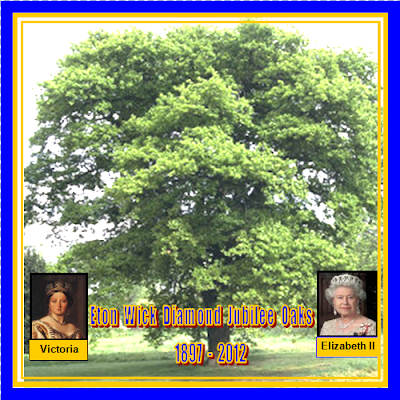
Mr. Cullum introduced the 25th June 1997 meeting of the History Group. He mentioned that plans for a visit to the Rowing Lake site had not yet been finalised; the unveiling of the Group's new plaque at the tree planted by 'Toddy' Vaughan to commemorate Queen Victoria's Diamond Jubilee was to be marked by a small ceremony towards the end of July. 

Mary Gyngell and Mr. Povey had both written to Rail Track concerning the untidy state of the viaduct and Rail Track had since removed all the old boarding and have undertaken not to re-rent the arches. After acknowledging the generosity of the ladies who provided the Group's refreshments, Mr. Cullum handed over to Mr. Bond for the topic for the meeting: 'The Influence of Eton and Eton College on Eton Wick', after which Mrs. Ballhatchet would give a brief talk on 'Infant Welfare'.

Mr. Bond opened by pointing out that both Eton and Eton Wick had been in existence for many years before the College arrived in 1440, that Eton itself may already have been 700 years old at that time; and that whilst Eton College never set out to Influence Eton Wick, it had done so, in one form or another, for 557 years. 

Mr. Bond then painted, in words, an onward-flowing picture of the area from those early times, when the sand around here would have been thickly wooded (lots of willow and oak) and boggy with more streams and an abundance of fish (1d. a bushel for young salmon!), it is apparently recorded in the Doomsday Book that Eton paid a tax of 100 eels. He pointed out how fortunate Eton Wick is to be surrounded with Lammas and Common lands and he urged the members to be on their guard against any invasion of this protected land. (Mr. Bond later mentioned that apparently two Eton Boarding Houses and houses near The Willowtree stand on Lammas land - although it should be noted that this can be permitted provided a similar area of land is freed to be registered as Lammas to compensate for the loss). 

Mr. Bond was able to tell us a great deal about the history of the College, including lesser known facts such as the King (Henry VI) allowing weekly markets and two annual fairs because of the influx of people required for the construction of the Chapel and College - and keeping the College boys in Chapel whilst the Pig Fair' was on because the boys used to cut the pigs' tails off; and Edward IV's planning to send all the goods and chattels from Eton College to St. George's Chapel but suffering a change of mind when he realised that Windsor Castle could not accommodate his 'lady friend', Jane Shore; she was then housed at Eton College and all the College possessions were returned! 

Needless to say, Mr, Bond's talk contained an abundance of information and it would be impossible to reproduce even a fraction of it here. As to the influence of Eton College and Eton on Eton Wick: The College must have hindered the growth of Eton itself, as a town, in that the spread of the College buildings resulted in demolition of town property and Eton residents moving out to Eton Wick. Against this must be balanced the opportunities for employment offered by the College over hundreds of years to both Eton and Eton Wick residents. It should be remembered, too, that many Eton masters and their wives initiated and supported local projects and that Eton Wick enjoys its Village Hall courtesy of its College benefactor, Toddy Vaughan. Another Eton master, Mark Anthony Portly (b. 1731) founded the charity which resulted in the setting up of Eton Porny School. College boys still come and help our more elderly residents and two boys help at Eton Wick School. 

Mrs. Ballhatchet continued by outlining the influence the College had on the provision of health care for mothers and children - starting (in 1915) one of the first baby clinics in [Buckinghamshire, which was run by a Nurse Orchard with a committee Including Eton masters' wives. By 1917 the 'Babies Welcome' clinic was well established, records of babies' health were kept and talks were given by the local doctor, Nurse Orchard or one of the masters' wives. Mothers were able to make purchases at the clinics of such items as baby milk and Viral, material, knitting wool and patterns, second-hand clothes - and Eton College dripping? Eton Wick's clinic always did well in County competitions and presentation of the certificates awarded was made at an annual picnic at one of the boys' boarding houses; and there was always as Christmas Party. This clinic, started 82 years ago, still meets once a month with a local doctor and nurse in attendance.

The next scheduled meeting was to be on WEDNESDAY, 10th September 1997, when a representative of Oxford Archaeological Unit will give a talk on 'THE ETON COLLEGE ROWING LAKE'.

During the 1990's the Parish Magazine of Eton, Eton Wick and Boveney reported on the meetings of the Eton Wick History Group. A member of the audience took shorthand notes in the darkened hall. This article was published in the August edition of 1997.


Wednesday, 18 May 2022

From the Parish Magazine - Eton Wick History Group Meeting - Local Entertainment Before the Age of the Telly.

The members of the Eton Wick History Group enjoyed illustrated talks from three speakers when they met on the 8th July, 1998. The topic was 'LOCAL FETES, FAIRS, CARNIVALS AND CONCERTS' and the group was entertained by John Denham, Joan Ballhatchet and Frank Bond. 

Frank was the first to take the floor; he described the various 'big' days in Eton Wick going back 200 years to when, for the 100 people who then lived along Common Road or in farm cottages, a 'big' day was simply having a day off from work. There would be traditional days of celebration; May Day for example, the day when cattle and horses were let out on to the Common; the 1st August (Lamas) which was at harvest time; there was Eton College's `Fourth of June' celebration when many of the inhabitants of Eton and Eton Wick would turn out to see the Procession of Boats. Another special day was the one reserved for `Beating the Bounds' - this was originally an ecclesiastical duty, with the civil authorities later becoming aware of the necessity to mark out the area's boundaries; the College used to provide a breakfast of ale and roast beef for those taking part. (Perhaps we could 'Beat the Bounds at the Millennium?) Less formal, but just as welcome, treats would be those such as Mr. Lovell's Concert Parties; Pelham's Funfair at Eton Wick; Sunday School and Boys' Club outings and pub outings; and the Horticultural Society's tradition of donating fruit and vegetable, taken by horse drawn cart, to King Edward VII Hospital. There was certainly no shortage of functions to prepare for, anticipate and enjoy. 

Mrs. Ballhatchet gave a vivid and fascinating description of the Horticultural Shows, which were among the highlights of the Summer. Trestle tables were laden with fruit, vegetables, flowers, needlework, and various types of craft work manufactured by men and boys; there was poultry and livestock; there was a beer tent; there were coconut shies, and races for children and adults, with prizes presented by a VIP.; and in the evening there would be dancing to a band which would have played all day. The earliest record of an Eton Wick Horticultural and Industrial Exhibition appears in the first Parish Magazine, and the event was to take place on the 21st August 1878 in the Wheatbutts orchard. Mrs. Ballhatchet read out various highlights from the Magazines' reports, which included subjects as diverse as the need for Eton Wick's Drum and Fife Band to have new uniforms (1887) to the fact that a 'Collection of English Snails' had received a special award, a swan in a lake scene was constructed entirely of fish scales; and on one occasion two live wasps' nests were displayed as exhibits. The last Horticultural Exhibition entry was in the Parish Magazine of September 1939; but after the Second World War, in the 1950s, the exhibitions recommenced under the title 'The Allotment Holders' Show and these continued until 1963 by which time there was a new entertainment in the form of the annual Wicko' Fair which, with its many star turns and celebrity attractions, eventually, grew to be so well known, popular and successful it became difficult to control, it had lost its 'Village flavour' and so was finally abandoned after 1982. 

A delight of the evening was the sight of so many photographs of Concert Parties and Pantomimes - originally these were held to raise money for the football team's kit - the team originally wore their own white shirts and black shorts made from the blackout material. The entertaining troupe was called The Unity Players' (after 'United'); and costumes for the shows were made from parachute material, crepe paper, 1/- worth of dirty muslin from Petticoat Lane and any other odd bits and pieces that came to hand; props and scenery were painted in the old mortuary; and a generator provided power from outside the building. 

John Denham was the expert on Scout Fetes, also their Gang Shows, raffles, jumble sales, whist drives, in fact anything which would bring in money. The first of the Village's Scout Fetes is recorded as being in 1952 and it was held in Wheatbutts, where the Scout Hut was then sited. This but was burnt down in 1961 - it had been hired out to a skiffle group who had suspect wiring. The fetes and gang shows (which were in true Ralph Reader tradition) were held over a period of about 45 years; there were exhibitions, and the displays were always of a very high standard. Mr. Moss of Eton Wick School introduced the boys to the game of 'Shinty' and this soon became Eton Wick's adopted sport; the Shinty finals were always played out at the Scout Fete, including men against women - it eventually became so rough that Mr. Moss pulled out! Other entertainments at the fetes ranged from Penny Rigden's dancing troupe to Guards' weapon displays and American Air Force drill exhibitions. These fetes continued until interest waned in 1973. 

Earlier in the evening Frank Bond had pointed out that this was the end of the 7th year of the Group; and he thanked Mary Gyngell who had provided cakes for every meeting over that period; and thanks, were also given to the Committee, particularly Joan Neighbour, Zena Redhunt, Rene Thompson, Mrs. Jean Tyler and Brenda Irvine. The programme for 1999 was issued in September, suggestions for subjects welcome. 

During the 1990's the Parish Magazine of Eton, Eton Wick and Boveney reported on the meetings of the Eton Wick History Group. A member of the audience took shorthand notes in the darkened hall. This article was published in the August edition of 1998.

Monday, 31 January 2022

From the Parish Magazine - Eton Wick History Group Meeting - Old Photographs of Eton and Eton Wick

At the meeting on the 29th October the Group was saddened to hear of the deaths of Miss Banham and Ernie Gyngell. We shall miss them both and our sympathies go out to their families, particularly to Mary Gyngell who has not only to cope with her bereavement but also is to have a hip operation - despite an of which she still produced her usual trays of home-made cakes for the evening's tea interval.

So it was in sombre mood that the Group settled down to hear Frank Bond take them through some of his collection of old photographs of the area. However, spirits were soon lifted as he dealt with each photograph in some depth, producing a history in pictures which commenced with a slide of a picture of Eton High Street dating back 150 years. Some of the photographs were taken at the turn of the century and it was fascinating to register the changes which have taken place over the years; interesting, too, to have Mr. Bond identify so many of the people in the photos; and not just his own family, as in the 1895 snap of boys (one of whom was his father) on the footpath to Chalvey carrying huge bunches of dog-daisies to be sold at Dorney Gate or Boveney Lock but also others such as Alf Quarterman, Hammer Stannett - perhaps the last real Hayward, and John Henry Kemp the lockkeeper.

Henry "Hammer" Stannett the last real Hayward.

Many of these older photographs were taken by Mr. Lovell, who ran the local combined Post Office, bakery, and hardware shop; others were by Mr. Hearn who came from Sunbury to Eton Wick in 1908. He was a saddler, his shop sign said he also repaired umbrellas, and when his wife died, he finished with the shop and set up an engineering works in Victoria Road; he also started a taxi business with a Model T Ford.


We heard how the original (1840) school, at the top of The Walk, was made into an institute for men and boys when the present school was built; and how the institute was turned into a shop in 1902 by a Mr. Pratt - whose painted sign can still be seen on the side wall 95 years later; the shop then passed through the hands of a succession of owners: Harman from 1908, Anderson from 1913, and then various others until 1988/89 it was converted into the flats we see there today. 

Villagers reminisced over photos of our two old village ponds, including one of the 'big' pond taken in 1920 with Mr. Bond's sister, Eva (now 83) standing by the fence. This big pond was deep enough to swim in, and it existed until the 1930's after which it was filled in. In yet another shot we could see the ten houses which made up Prospect Place: these houses were mainly 'one-up-one down' with shared toilet facilities, and one at least of them housed a family of eight! And it is hard to believe that the 'modern' houses at the end of Common Road closest to Bell Lane contain the structures of the original old properties, which simply had an external skin and roof built over them to modernise and increase the size of the accommodation. One of the lady tenants had this work carried out around her whilst she remained in the property: she would not move out for fear of losing her Lammas grazing rights. Unfortunately, she suffered such hardship during the course of the work that she fell ill and died soon afterwards.

There were happy photographs of haymaking and of children running races during what must have been a celebration of either Empire Day or the Coronation of Edward VII; and there were the sadder ones as of the unveiling of the War Memorial at the Parish Church. But what the evening brought home to the Group more than anything else, was the importance of keeping a photographic record of our ever-changing surrounds - whether it be new construction it the removal of an old 'landmark' like the old air raid siren. All should be recorded for posterity with details on the back of each print giving the date, the location and the names of any people captured in the frame.


The next Meeting will be on the 10th December when the topic will be 'THE OLD CHRISTOPHER INN (opposite Eton College Chapel) with punch and mince pies to follow. 

During the 1990's the Parish Magazine of Eton, Eton Wick and Boveney reported on the meetings of the Eton Wick History Group. A member of the audience took shorthand notes in the darkened hall. This article was published in the September edition of 1996.


Sunday, 21 November 2021

O. A. BROWNE - XXX Corps - Eighth Army

Omar Alfred Browne (Lance Corporal No. 6912447) - 2nd Battalion The Rifle Brigade - 7th Armoured Division - XXX Corps - Eighth Army

At the time Omar was born, on February 26th 1916, his father Alfred was serving on the Western Front with 2nd Battalion, Grenadier Guards. In fact Alfred was destined to be killed the following year and it is unlikely that he ever saw his baby son. When he had married Esther they made their home in Violet Villas, Boveney Newtown. He was killed on July 31st 1917 during the Third Battle of Ypres in Belgium and left a widow with an infant daughter named Hetty and baby Omar. Esther married again and as Mrs Wicks had another daughter, Gladys, in 1922.

Omar attended the Eton Wick Infant School when he was five, and on April 10th 1923 he registered for school at Eton Porny. Because his father had been a professional soldier Mrs Wicks decided he should complete his education at an army school. He left Eton Porny on January 21st 1927 and six days later, one month short of his 11th birthday, he went to the Duke of York School in Kent. It was here Omar joined the band, and it was here he developed a dislike of brass buttons. The band was to result him becoming an accomplished musician and able to play six different instruments. With his stated dislike of brass polishing he decided against a career in the Grenadiers, as his father had chosen, and instead joined the Rifle Brigade as a bandsman. On April 1st 1931, when he was 15 years three months, he reported to Devonport, as number 6912447, 2nd Battalion, Rifle Brigade.

Omar Browne (foreground, centre) in a funeral party at Halm between the Wars.

In September 1933 the Battalion sailed from England for Malta where they served for more than four years, until in December 1937 they embarked for Meerut in India. In 1939 they sailed to the Middle East, and as part of the 23rd Infantry Brigade served in Palestine and Trans Jordan. By this time Omar had grown from a, boy into a fine soldier, who loved many sports, including football, hockey, cricket and swimming. With the threatening upset of war the Battalion moved to the Egyptian frontier. Italy entered the war with Germany against the British, and with possessions in Libya, immediately struck east toward Egypt and the Suez Canal.

To counter these moves the British entered Libya, and the important harbour of Tobruk, situated along the strategic coast road, fell to Australian forces in January 1941. Cyrenaica fell to British troops, and Tripoli itself was threatened. With the rapid collapse of the Italian army the Germans dispatched strong armoured units under the command of Erwin Rommel, to halt the British advance. At this time a political decision was taken in London to send many of the much needed troops from the Middle East in support of Greece and Crete. The German drive to take Tobruk and ultimately the distant prize of Suez was sustained and very determined. The harbour garrison held out against the enemy although the Germans did become established in the desert and along the coast at distances as advanced as up to 70 miles east of Tobruk, effectively isolating the British garrison there other than by sea.

Omar was now in the Support Group, with the 7th Armoured Division, XXX Corps, of the Eighth Army, and as a bandsman was almost certainly serving as a stretcher bearer or other medical service assistant. On November 19th 1941 the 7th Armoured Division and Support Group struck north from the desert to take Sidi Rezegh, approximately 30 miles south east of Tobruk, while other Eighth Army units attacked Sollum and Bir el Gobi. Sidi Rezegh was captured a couple of days later but changed hands yet again the following day. Fighting was particularly fierce, involving tank battles and many casualties, as the Germans strove to take Tobruk and the British strove to relieve it. The 21st and 22nd November was perhaps the climax of the battle, when the XXX Corps was obliged to disengage, having lost two thirds of its armour.

Omar died in the Sidi Rezegh battle on November 21st 1941 at the age of 25 and is buried in the Knightsbridge War Cemetery, Libya, which is situated 15½ miles west of Tobruk and a few miles from Acroma. The cemetery contains 3,649 burials, including 10 soldiers whose graves could not be positively identified. The Knightsbridge War Cemetery was so named because a strategic point of the "box" desert defences in the area had been known as Knightsbridge. Graves and small battlefield burial places were concentrated at Knightsbridge after the war.

At the time of researching Omar (1995) the cemetery was not very accessible on account of strained diplomatic relations between our respective countries. Consequently a recent photo of the grave obtained through the C.W.G.C. looks tidy but lacking the customary beauty of plants.

Omar Browne was the only serviceman of W.W.II from Eton Wick whose father had been killed in the previous world conflict. Both were professional soldiers, and both are commemorated on the Eton Wick Memorial. Omar also commemorated on the W.W.II plaque on the wall of the Village Hall. In each instance his name is spelt as Browne (with an "e"). His father, Alfred, is commemorated as Brown (without an "e") except at Eton where he Browne.

Omar Browne's page on the Commonwealth War Graves Commission website.


This is an extract from Their Names Shall Be Carved in Stone  
and published here with grateful thanks to the author Frank Bond.