Showing posts sorted by date for query 1897. Sort by relevance Show all posts

Saturday, 1 June 2024

A History of Windsor Bridge

Windsor Town Bridge

This is part of the script for the talk History of Local Bridges given by John Denham on 15th April 1998.

Perhaps it should be called the bridge of aggravation. For 900 years the bridge has been plagued with problems which at times has given rise to heated debate between the citizens of Eton and Windsor. 

A Royal presence and officialdom plus the changing moods of the Thames when influenced by the weather have all contributed to the history of the Windsor Town Bridge. 

Invasion by the Normans was not welcomed by many Anglo Saxons who at times could be most unfriendly towards the new rulers. To secure their position after occupying London, a defensive ring comprising of nine forts which became more permanent as castle s was set up. Windsor was one of the nine.

The original fortress built of wood was started in about 1070, The attraction to build on that site, apart from the view of the valley was the fact that they would have the protection with the chalk cliff at their back and the river a barriet from which any frontal attack would have to cross and climb up. The occupants of the fort required military supplies, goods and services giving rise to New Windsor, the tourist town of today. 

At some time during the next hundred years, it became necessary to bridge the river. This may have been for access to the farmland around Eton and Eton Wick or to reach the London-Henley Road for easier and quicker passage to London.

It is known that a bridge existed in 1172, for that year the Kings tax collector, Osbert de Bray, accounted for £4-6s-6d collected from vessels passing under the bridge. 

Over the following years the fate of the bridge depended on its importance to the monarch using the castle.

Being of wooden construction, the early bridge was always in need of repair, perhaps due to collision by passing boats, or debris that built up around the bridge supports, especially when the river was in flood.

It is noted that Henry III gave permission in 1236 for six oaks from the royal forest to be felled to prop up the collapsing bridge and more six years later.

Edward 1st had little interest in the castle or the citizens and allowed the bridge to fall into decay leading to a petition by the ‘Poor Inhabitants' of Windsor for permission to charge tolls for its repair.

Edward had his sights on adding Wales and Scotland to his kingdom and sought a way out of the problem by granting pontage for eight years from 1277, and by charter, appointing the Fraternity of the Holy Trinity, also referred to as the Burgesses of Wyndesore, responsible for the government of Windsor and the upkeep of the bridge. But as is often the case things did not turn out quite as Edward envisaged.

The Brethren soon realized that the bridge was vital to local trade and as a route to London. This knowledge encouraged the Brethren who became quite skilled petitioners, cajoling gifts of trees and pontage grants from successive monarchs every few years.

Only tolls could be charged for traffic over the bridge, the more lucrative collection for vessels passing under the bridge going to the King.

Tolls were based on the cargo and its weight, for instance in 1367 the freight of coal between London and Windsor is noted at 1 shilling per chaldron. A chaldron, a unit of dry measure as for coke coal or lime equal to 32 to 36 bushels, today that would be approximately 56 cu yards (42.8 cubic metres). This toll on a barge carrying maybe 200 tons brought complaints from the watermen at this exaction. 

Because of the unsatisfactory state of the bridge the ferry continued to give a satisfactory if not always reliable service.

Royal Family quarrels in 1387 brought more trouble for the bridge Richard II, who believed in his divine right to rule, was a bad judge of men and his domineering attitude upset many people. When his uncles, the Dukes of Gloucester and York tried to dispose him, he ordered the bridge to be broken down as a defence against his unwelcomed visitors.  

Ten years were to elapse before he made amends with another pontage grant. 

He was disposed in September 1399 and killed in February 1400 aged 33 

James was followed by Henry IV who in 1411 gave two more grants, after which a bridge keeper was appointed at an annual salary of 6s. 8d. 

During this same year the Borough of Windsor carried out repairs to the bridge at its own expense, thereby sowing the seeds for future trouble.

Although housing and business had developed along the road which is now Eton High Street the founding of "the Kings College of Our Lady of Eton beside Windsor", (Eton College) by Henry VI for poor scholars in 1440-1 gave a new importance to the town. 

One of the first advantages given to his college was the free passage over and under the bridge. Two years later Windsor, apparently in accordance with annual custom, elected two bailiffs, and two bridge keepers.

 As the years passed the later Tudors preferred the comforts of Hampton Court Palace to the austerity of Windsor Castle and therefore having no use for the Bridge saw no reason to maintain it. Hence within ten years of the founding of Eton College, the Windsor Chamberlain in 1551 was compelled to sell two silver chalices for £15 to help pay for very urgent repairs to the unsafe structure of the bridge.

The bridge was a dilapidated affair and risking the king’s horses and the heavy waggons with the Royal baggage to the bridge was not an option. Therefore, the rickety state of the bridge may account for King's Stable Street in Eton, where the horses could be stabled and the waggons off loaded to lighter carts or even taken across the river by ferry.

Dr Osborn in his records of Datchet states the magnificent cavalcade of Henry VIII passing from London to Windsor in May 1520 went by way of Eton and Windsor Bridge; but Queen Catherine of Aregon diverged from the route near Colnbrook and crossed at the Datchet ferry. The Datchet ferry was used by Monarchs as a short cut and an inconspicuous back door to the castle.

As stated earlier the bridge was always in need of repair due to the heavy loads crossing on a structure whose supports had poor footings. 

The Windsor Corporation records for 1520 have the entry, 'Andrew Bereman was allowed for Reperacions don Upon the bridge as in pylyng Joistyng Rayleing and other Workmanship as it apperyth by his boke. The account was for £32 0s 5d.’

Toll concessions brought in as little as £5 and we find that the Chamberlain was having to meet regular bills for essential repairs to the wooden structure. Accounts show that charges in 1606 were £25.14s.5d.; 1609 - £5 13s. 10d.; 1612 - £12 19s.

Other charges not connected with repairs to the bridge were brought about by the punishment of wrongdoers. Public whippings were carried out on the bridge and when a new whipping post was needed in 1636, Robert Gill charged 5s. 6d. for supply and fixing thereof. He also charged 6d. for fixing the chain that closed the roadway over the bridge. 

Other fixtures of torture and death required no maintenance such as a tree at the foot of the bridge used in 1536 for the execution of a priest accused of treason, whilst the other a butcher also accused of treason was hung on the new gallows at the end of the drawbridge in front of the Castle gate. 

Throughout the centuries the bridge played its part in Royal Pageantry. 

James 1st had great interest in the pageantry of the Order of the Garter and emulated the custom of his predecessors.

The custom had been in times past for the Knights elect to proceed from London to Windsor in grand procession, in order to be installed.   

Having gathered in the city they thence rode on horseback to Windsor. Accompanying them would be a large party of friends and attendants.

A dazzling sight for those days which brought throngs of citizens to see the colourful cavalcade as it passed. A Duke would be accompanied by sixty horse escort whilst a Marquess would have fifty and so down the line in accordance to the knights degree of seniority.

Some were prone to go over the top in their display of gorgeous apparel with plumes of feathers so James 1st put a limit on the extent of the procession enacting an order that every one of the Knights-companions should have fifty persons to attend him unto the annual solemnities of the order and no more.

The escort of the Earl of Morton proceeding to Windsor is an example that would apply to the 13 Knights of the Garter proceeding to the ceremony.

 Grooms in coats two and two

 Trumpets two and two

 Yeoman two and two

 Gentlemen two and two

 Secretaries

 Stewards

 Gentlemen of the Horse

 Pages

 Four Officers of Arms

 Gentle Usher, bare

 Lancaster Herald, covered

 Earl Morton, supported between two chief lords

 Footmen on each side, in rich coats

 Noblemen and Gentlemen, according to their degrees

On reaching Slough, the procession gathered to place themselves in order to proceed to Eton, thence across the town bridge to the Castle. 

About thirty years on repairs were again required to the bridge structure.

An entry from the Chamberlain’s accounts for the year Michaelmas 1641 to Michaelmas 1642 refers to a payment for 2 loads and 35 foote of Tymber for the pyles belowe the bridge of £3-15-0. 

Again, from the Chamberlain's accounts for the following year Michaelmas 1642 to Michaelmas 1643 there is a charge connected with the military government of the place by Colonel Venn.

The entry reads "layd out for laying downe the bridge by Colonel Venns Appoyntmente.......£6-0-0.

Parliamentary forces occupied the castle on the 28th October 1642. Colonel John Venn, rated number one enemy by many Royalist, was appointed Governor of Windsor Castle. Upon being appointed he gave orders for the defence of the Castle. 

One of the defence measures was replacing several sections of the bridge with drawbridges. Following a report that the Earl of Essex and his levy of London apprentices were marching by Windsor to Newbury orders were given to destroy Windsor Bridge. This only left bridges at Staines and Maidenhead. 

On the 7th of November 1642 the Royalist under the command of Prince Rupert attacked the Castle with five pieces of ordnance firing from the grounds of Eton College, more damage was done to Windsor town than to the stout walls of said castle. The bombardment lasted seven hours but eventually the Royalist withdrew.

At the time the parliamentary army lodged in Windsor was approximately 16,000 foot soldiers and about 3000 horses. The population of Windsor at this time approximately two thousand. Many of these troops would have been encamped in the surrounding villages, whose population would have had to feed and shelter the soldiers and hope they would be paid.

The first Civil war ended in 1646, 

On the 24th of November 1648 the headquarters of the Commonwealth army was transferred from St Albans to Windsor and from then on until the King was taken to London in the January, Windsor was the centre of events.

Having spent Christmas as a prisoner, on January 19th 1649, King Charles was taken from Windsor Castle to board his coach near the Keep.... a guard being made of musket and pike soldiers. At the great gate a party of horse was drawn up in the marketplace at Pease-cod-street end commanded by Colonel Harrison. Harrison's cavalry closed around the coach and with its six horses the coach with its lonely passenger clattered down the hill beneath the Castle walls along the Kings Highway as they called it, then across the old timber bridge into Eton and so over the frost bound roads towards London. By dusk Charles was at St. James Palace.

Having been found guilty he was beheaded on the 30th January on the scahe river Thames.

The hard frost at the end of January 1649 had froze the River Thames again as a disguised boat was secretly borne down the river repeatedly encountering ice flows on the journey from London to Windsor. In the boat was the decapitated body of Charles I who had been beheaded for treason. 

Snow and ice mad it difficult journey and progress was slow. At Chersey the small party was `poled off' ice flows by local fishermen. At Datchet the party were challenged by Parliamentarians, who upon receiving a satisfactory answer allowed them to proceed.  

Under the cover of the flurries of snow all the obstacles were evaded, and the secret hearse moored safely at Windsor whence the coffin was borne to the castle. 

To make good the ravages of war the Council of State in 1649 issued a warrant for the repairs to the bridge. The Surveyor-General of H.M. Woods and Forests issued an order to fell 25 loads of timber from Windsor Forest for the repairs.  

The bridge was replanked, trebled railed and supplied with new piles and a drawbridge.

February 26th 1666, King Charles II visited the castle, having travelled via Staines, crossed the bridge to visit Eton College where he remarked on the names cut into the shuts of the windows by those who had left for Cambridge. His wife remained waiting in the coach.

Whilst staying at Windsor in 1674 Charles II granted double the number of trees for repairs but on being told that that the borough had mended the bridge at its own expense 200 years before -withdrew his offer. 

After allowing Robert Frith £50 for immediate works the corporation set about persuading the king to take a more lenient view of its predecessors' folly and in October 1676 they were rewarded with twenty five loads of timber.

More financial problems followed when the Queen Anne bridge at Datchet was opened in 1706 free of tolls. To this some Windsor council members reacted sharply being as bold to say that the corporation was not twopence better for the Queen's coming to Windsor. Eventually £55 in compensation was awarded to the corporation.

By the March of 1707 the tolls at Windsor had declined and the corporation was relieved to lease the bridge in its ruinous state to John Herring for forty years. His rent was £5 per annum because he had to meet all the cost of repair. Fourteen years later Herring appealed to the Corporation for help, who in turn advised him to petition the treasury for a grant of oaks. Much to his surprise Herring was awarded twenty loads of timber the next year.   

This gift did not relieve him of worries as an increasing number of people were challenging the right of the corporation to charge Tolls.

The situation became serious and with the help of the two Windsor M.P.'s Parliamentary confirmation of Tolls was sought, the said promoted bill receiving Royal Assent on 5th April 1736.

The ownership of the bridge was reaffirmed but the corporation was obliged to repair and maintain the Great Bridge' from the prescribed tolls including 6d. on each barge going up stream.

The new powers resulted in much higher takings, so John Herring's rent was increased to £10 the following year and then to £60 in 1766.

The increased traffic over the old bridge was more than the decayed timbers could take and it was declared not safe for His Majesty's subjects to pass.

The respite from repairs was short for on Saturday July 31st 1773 the council carried out a hurried inspection, the bridge being in so dangerous and bad condition with a great quantity of earth falling into the river, that every load that went over also ran great hazard of falling in.

What work was absolutely necessary was done immediately but on several occasions the bridge was closed for repairs and those crossing had to resort to the ferry.

More repairs must have taken place as it was forty six years on before the corporation applied to build a new bridge.

Perhaps this enthusiasm to build a new bridge resulted from the introduction of mail coaches, one of the first had passed through Slough on its way from Bath to London in 1774. This no doubt stimulated interest in fast passenger coach services to Slough and London from Windsor. By the year 1839 there were as many as 30 stage coaches a day running between Windsor via Eton to Slough. The rivalry between the owners, such as Gray, Moody and Lillywhite was intense.

It is to be wondered if the passengers of those days consider their safety when passing over the bridge?

The family of Lillywhite also farmed at Manor and Crown farms in Eton wick. This increase in frequent fast traffic plus the increasing carrier traffic must have put quite a strain on the bridge structure. 

The year 1775 the Corporation applied to build a new bridge at an estimated cost of £3000, but fearing much higher tolls the people of Windsor objected and the petition was thrown out. 

In a survey of the Thames by Robert Mylne it was noted that Windsor bridge was 165 ft. long with twelve or more spans was much obstructed by rubbish. 

Proposals were put forward included building of the lock at Romney which opened in 1797. This so increased the flow of the river that the bridge foundations were soon undermined.

By 1811 it was a tottering, completely rotten unsafe structure that even the poor residents of Windsor had come to the conclusion that something had to be done and raised no objections when the corporation invited Charles Hollis to submit plans. Thomas Telford was engaged as consulting engineer.

Hollis was an engineer working with Jeffrey Wyatt, the architect engaged on the restoration of the castle.

His submission for the new bridge in 1819 was for three cast iron arches resting on granite piers, and a roadway of gravel laid on cast iron plates.

Estimated cost, for this bridge design of 260ft length and 26ft. wide were £13,000 for erecting toll houses, the bridge and completing the roads. Purchase of premises on either side of the approaches, £2,500, expenses of obtaining the Act £500- total cost £16,000 If built on the same line as the existing route it could be opened in two years. 

Based on this estimate the corporation borrowed up to £16,000 by mortgaging the tolls. 

The wording of Clause 37 of the Act would prove very significant in years to come. The Act stated quite clearly that the toll income could only be used for the upkeep of the bridge, payment of loan interest and repayment of the loan and for no other purpose.

The provisions of the loan allowed the corporation to complete the bridge in five years, commencing March 21st. 1820. 

Twenty one years was allowed from that date to recover the cost with the provision of another thirty years if necessary.

The purchase of properties for approach roads and the removal of the old bridge took longer that estimated.

On 10th. July 1822 the new corner stone was laid by Frederick, Duke of York. The work proceeded steadily the two side spans of 43ft and 55ft. taking twenty three months.

During this time the citizens of Windsor and Eton as well as other travellers had to endure the inconvenience of the ferry of which they became thoroughly weary.

Because of the never ending complaints the corporation called a meeting on March 31st, 1824, with the two iron masters, Mr Baldock and Mr Fowler, to explain the delay.

At length the iron founders explained that the ribs had to cast in Wales, shipped to London, and transported overland to Windsor. 

A promise of delivery of the final rib during the first week of April was not met, the rib did not arrive until the 12th April. Disaster struck during the unloading at Windsor and the rib got broken. This raised the anger of the councillors and Fowler undertook to recast the rib in his London foundry and return it to the bridge site within three weeks, which he successfully achieved.

The new bridge opened on June 1st 1824 and the Windsor and Eton Express wrote, ` Any ceremony of splendour was considered unnecessary and therefore the Mayor and Corporation, having gathered at the nearby Swan Inn, walked in procession about noon accompanied with other senior officials, the Architect and the bridge Contractor to the centre of the bridge.

The toll gate was then closed behind the party and the Architect handed the silver key to the Mayor for him to open the gate.

The bridge was declared open by the Town Clerk and after three cheers the party returned to the Swan where lunch was taken. Tolls were levied from the next day and so began a new chapter in the troubled life of Windsor Bridge. This, the first iron bridge over the Thames, would be the centre of much legal argument over the next seventy three years. 

Twenty fours years on the bridge was to lose some of its importance as the Great Western and the London South Western Railway Companies brought their services to Windsor.

The Stagecoach companies went out of business as citizens turned to the speed of the trains although some struggled on with horse bus services to Slough and outlying districts. and perhaps the stage coach service from Windsor to Brighton which plied on Tuesday, Thursday and Saturday returning the following the following day survived for a while.

The pricing of tolls for crossing this Great Bridge had one anomaly in so much it was cheaper to cross alive than dead. It cost only 2d. to cross in a hackney carriage but 6s. 8d. in a hearse.

During 1895 the corporation erected a new tollgate much to the dissatisfaction of Eton residents especially Mr Joseph Taylor.

Mr Joseph Taylor of Eton commenced a campaign to abolish the system under which `tolls were being taken for a timber bridge since passed away, on a stone bridge built and paid for by the public of today'.

Signing himself `Don Quixote' with a letter to the Windsor and Eton Express on 3rd September 1895, Mr Taylor demanded to know by what right the corporation continued to charge tolls asserting that perhaps no right existed if this was so, then more than £12,000 had been collected. illegally over the last 23 years.

He maintained that the Act of 1736 authorizing a table of tolls had been repealed by the act of 1820 which expired in 1872. To force the issue he informed the Town Clerk that on Tuesday 30th September he would drive onto the bridge and refuse to pay the toll. 

A resolution passed at a meeting of the corporation on 27th September ordering the collector to insist on payment and close the gate against anyone who refused to pay the requisite toll. Mr Taylor was sent a copy of the resolution who wrote to the Chief Constable of Buckinghamshire inviting him to send a police officer on the appointed day to witness the illegal closing of the bridge. 

 An Inspector and sergeant were sent, Mr Taylor upon arriving at the bridge asked to see the table of tolls and was shown the schedule of charges from the 1736 Act not those which has been in use for the previous twenty years. Mr Taylor refused to pay, where upon the gate was locked and he was forced to drive the long way home.

Taylor took counsel advice and was advised by Mr J. Witt and Mr W.Dankwerts that he was in his rights not to pay the toll. To give strength to his belief he and his friend, Mr Cecil Howlett drove over the bridge and paid the 2d. toll and obtained a receipt. Taylor then applied for a writ to recover what he contended was an unlawful levy and also applied for a writ to restrain the corporation from barring the bridge.

The Windsor and Eton Express dated 21st September 1895 published a letter headed `Barring of the Bridge' in which he gave guidance to those from whom tolls were demanded by the corporation for passage over the bridge. Another letter from an Eton resident referred to the dilapidated state of the bridge which needed cleaning and painting in spite of the corporation having benefitted from £500 a year tolls.

The case was heard in the Queens Bench on 13-14 May 1897,the Lord Chief Justice giving judgement to the corporation with cost but adding that this peculiar case would no doubt go to the Court of Appeal. The Corporation felt their victory worth celebrating and the Mayor gave the corporation a champagne lunch. Mr Taylor did not give in easily and immediately lodged notice of appeal. 

In October 1897 Lords Justices Rigby, Smith, and Hen Collins after listening to the case for another two days and reserving judgement. 

On November 8th with an unanimous decision they announced that the bridge tolls were illegal and must cease at once, Taylor was awarded cost. At mid-day the collector on the bridge received a telegram ordering him to stop the charging of tolls. This decision was not to the corporations liking and they took the case to the House of Lords.

The hearing before the Lord Chancellor and others began on the 25th November 1898, ending three days later with a verdict in favour of Mr Taylor. 

The toll gates were removed on December 1st 1898. 

The toll collectors cottage remains part of the Old House Hotel.

A poem written at the time of the lifting of the toll convey the feelings of the citizens.


The task is o'er, the work is done

The gate is lost, the bridge is won!

No Tax or Toll shall the Counties part;

Thus Berks and Bucks unite in the heart;

Windsor and Eton from blight are free,

Joined by the English Gift of Liberty!


After World War I the increasing production of, buses, lorries and cars which opened the way to freedom to visit the places of interest. Windsor with its castle became a magnet for day trippers by car and coach although the majority in the 1930's still arrived by train. 

The rise in car ownership from the 1950's which would become a flood also put more load onto the bridge for which it was designed.

The strain on the structure aggravating the crack in the iron work which was first noticed during an inspection by the county council surveyor in 1938. 

In 1946 a survey of the bridge led to frequent checks to monitor the cracks and to the Windsor Council investigating the possibility of repairing and widening the bridge, but no decision was taken and it was not proceeded with. 

Weight restrictions had been in force for some time, buses being the heaviest vehicles allowed onto the bridge. The cracks had become more prominent in 1969 which resulted in a single line traffic system, but after later inspections in 1970 by the Berks County Council Surveyors department, it was decided at an emergency meeting of the highways committee that the 146 year old bridge would have to close due to the rapid deterioration and the accelerating cracks in the cast iron. 

Over 11,000 vehicles a day used the bridge with the number increasing to 22,000 or more in the summer. This is an annual average of five million vehicles. A sample census for October 1845 at the toll gate on the Slough Road, gave a figure of 649,411 persons for a full year with an additional 35,000 for Ascot week. The design of the bridge was well within the limits for this traffic and the sound construction allowed it to carry the increasing traffic volumes for 146 years.

It was fortunate that in 1966 the Windsor - Eton relief road had been opened. The decision to close the bridge was not accepted readily by all. Eton and Eton Wick protested strongly and called for a new Windsor bridge to be built. 

A public meeting held at the Eton Wick village hall on Monday 5th October 1970 when nearly 200 villagers attended to vote overwhelmingly to send a deputation to Shire Hall Reading to lobby the Berkshire County Council for a new bridge.

A committee was formed by Mrs Florence Wilson, President of the Womens Institute, to organise a lobbying party. Nearly 40 people agreed to go to Shire Hall to confront the County Council. The Highways Committee recommended that the bridge should be rebuilt, but the planning committee recommended that the bridge should be closed permanently. 

Bucks County Council had offered £250,000 to the cost of a new bridge, Eton - Eton Wick came under Bucks County Council in 1970.

The Eton U.D.C. held the meeting to tell the village what action had been taken since the closure of the bridge. A questionnaire at the time showed that Eton Wick was in favour of having the bridge re-opened or putting a Bailey bridge across as a temporary solution. 

Mr Glibbon, who was Chairman of the Council, told the meeting that even if a temporary bridge was not possible, the thing that must be achieved was the reopening of the bridge as a matter of absolute urgency to the people of Eton and Eton Wick.

The feeling at the time was that the only people to benefit from the closure of the bridge were the people of Eton High Street, but the closure did effect trade in the high street. 

Private enterprise, suicides, romance, and Hell's Angels have all had their moments on or in sight of the bridge.

September 1730 Daniel Beaumont a starch maker by trade thought it would be profitable to sell wine from a ship moored on the Eton side of the bridge. This was frowned upon by the college authorities as it was feared it would entice the scholars to spend their time in idleness aboard the vessel. As he had no licence to retail the liquor his enterprise was short live for three years later he was petitioning against nine years in jail.

The new town bridge was the scene of a fatal accident due to a hard frost. A sixteen year old boy carter from Ascot leading his team pulling a heavy waggon across the bridge.....slipped and fell under the waggon wheels and was fatally crushed under the wheels.

Decoration of the bridge for royal occasions has featured archways for Queen Victoria's Jubilee of 1887 and 1897. 

The years spanning the world wars brought many tired marching feet over the bridge as troops from the barracks came to the end of those route marches. Added to these was the heavy military transport all putting strain of the cracked iron beams. Apparently one military incident did close the bridge for a short time during the war. 

A soldier driving a heavy transporter loaded with a battle tank having negotiated Eton High Street only to have the road collapse beneath the wheels as the transported approached the bridge. With little room to manoeuvre the long vehicle at that juncture, a lengthy hold up occurred in the high street. It took a several hours to extricate the exceptional load from its predicament. Rumour at the time was that he had gone that way to see a girlfriend in Brocas Street, If so the soldier must have been a little red faced.

A suggestion in 1946 by a correspondent to the Windsor & Eton Express that a permanent arch should be erected on the bridge similar to the Victorian arch as a gateway to the Royal Borough received no official support. 

Marathon race Windsor to London 1904 one of many sporting activities that have passed over the bridge.

The proclamation of George V as King in 1910 was a little upsetting for the loyal citizens of Eton when the Mayor of Windsor crossed the bridge to the Buckinghamshire side to announce the new monarch. To the fore were the Provost and Fellows of the College whilst the Chairman and members of Eton Urban were ignored. There was probably a reason but I have found none.

George V passed through Eton and over the bridge on his way to the Castle after his coronation in 1911.

And do you remember among the many other activities passing over the bridge?

Hell's Angels in their leathers and powerful motorbikes that roared across the bridge to meet at the Cellar cafe on the Windsor side of the bridge where the chairs and tables were chained to the floor and often fights took place. 

The bridge has suffered more indignity being now, unsafe for pedestrians to use the whole width of the structure. 

The other two bridges within Eton are Barnes Pool also known as Baldwins Bridge and Beggars Bridge at the Junction of Pocock’s lane both with a Norman History. 

There is further information about the Windsor Town Bridge on the Thamesweb site.


Monday, 28 August 2023

Old Days of Eton Parish - APPENDIX II. - ORNAMENTS IN THE PARISH CHURCH.

THE following particulars of the various ornaments in the Parish Church may be of interest, especially to strangers.

In 1864 the north-west window was filled with stained glass, representing St. John in old age, and St. John writing the Book of Revelation.

About the same time subscriptions were collected to fill the great east window in memory of the Prince Consort, who had died in 1862.

This was carried out by Mr. O'Connor in 1865. The principal subjects of the window are our Lord's appearances after the Resurrection to Mary Magdalene, to the Disciples by the lake, and to the women in the garden. In the lower panels are represented the Bearing of the Cross, the Crucifixion and Burial, and in upper tracery our Lord in glory.

In the same year the south-west window was inserted. This represents St. Peter and St. John at the Beautiful Gate, and the confirmation of the Disciples at Samaria.

The window in the chancel aisle, put in by Bishop Chapman in 1866 in memory of his daughter, depicts the raising of Jairus' daughter and the meeting of Martha after the death of Lazarus.

The other windows on the south side represent, 1st, the call of the sons of Zebedee (in memory of T. and A. Ingalton), 2nd, ' the surnaming them Boanerges,' 3rd (in memory of the eldest son of Thomas and Ann Ingalton), 'the raising of the widow of Nain's son.' On the north side nearest the tower the window represents 'St. John at the Cross receiving the charge of the Lord's mother.' It was given by Rev. N. L. Shuldham, formerly Conduct of Eton.

All the above windows were executed by Mr. O'Connor.

The other windows are the work of Buriison and Gryll. The one in the sanctuary represents our Lord as the Great High Priest and Melchisidek ; the panels beneath, the Institution of the Eucharist and Melchisidek meeting Abraham.

The second is Mary and Martha, with works of mercy below. This latter was executed in memory of Mrs. Forbes, wife of Colonel Forbes of Willowbrook, who for many years was an active and generous worker among the poor of Eton.

The brass near is in memory of a son of theirs, a young officer killed in the Afghan campaign.

In the nave, north aisle, are windows presented by Mr. Ingalton Drake : Christ walking on the water, and Christ as the Good Shepherd.

The reredos in alabaster was designed by Mr. Woodyer and executed in 1868. The sanctuary wall was decorated and the arcade work carried out in 1875.

In the same year the tenor bell was hung in memory of John Wilkinson, cast by Messrs. Warner, weighing 9 cwt., and the organ was built by Messrs. Hill with swell and pedal at the cost of ‘549. A second manual was added ten years later.

The oak chancel screen was designed by Mr. A. Y. Nutt and erected in 1883 at the cost of £121.

The funds for the brass eagle lectern executed by Barkentin and Kraal, Regent Street, were collected by a member of the St. John's Communicant Guild.

The altar candlesticks were given by the Rev. John Wilder.

The altar cross was presented in 1890.

The colouring of the nave pillars and walls, carried out by Burlison and Gryll, was done by degrees 1892-1897.

The lowering of the nave roof and removal of the clerestory windows took place in 1893. In the same year a handsome brass alms dish was given.

In 1895 a silver-gilt chalice and paten of beautiful work and set in jewels, executed by Barkentin and Kraal, was presented by Mrs. Layard and Rev. E. B. Layard in memory of Mrs. Shephard.

In 1896 the corona was given by the parishioners in memory of the same lady. It was designed by Mr. T. B. Carter. The niches contain the figures of the Twelve Apostles, carved in Italy, St. Paul taking the place of Judas Iscariot.

The litany desk was given also in 1896 in memory of the Rev. Thomas Dalton.

The chancel was repaved in black and white marble by Farmer and Brindley. Stalls for the choir were also provided in 1897.

In 1899 the organ loft and an approach to it was arranged by Messrs. Wheeler, and the organ was reconstructed and enlarged.

The clergy stalls were also given, and the altar rails were replaced by altar kneelers. In 1903 a sanctuary carpet was presented by the Guild, and in 1904 an oak pulpit was placed in its original position at the chancel arch.

Most of these additions or alterations were affected by free-will offerings, and without any appeal to the public.


OLD DAYS OF ETON PARISH by The Rev. John Shephard, M.A. was published in 1908 by Spottiswoode and Co Ltd. The text has been copied from the original book that is now out of copyright.

This is the final chapter from the Rev. Shephard's book. The complete book can be found by following this link.

Monday, 3 July 2023

Old Days of Eton Parish - CHAPTER XVII - THE LAST.

THE census of the town and parish in 1871 shewed a population of 3261; in 1881, 3169; in 1891, 2986; in 1901, 3154. In all cases the boys in College are excluded; the varying numbers may be largely accounted for by the time chosen for the census. The last two returns indicate some decrease of population. This is partly explained by the pulling down of cottages to make room for College houses, and the reduction in the town of in-habited houses from 635 before 1891 to 494 in 1901. 

The last twenty years of the nineteenth century were also marked by the migration of a considerable number of tradespeople from their shops in the High Street to more commodious homes in Windsor or Slough. This of course caused a corresponding decrease in the attendance at the Parish Church and left many gaps in seats formerly occupied by large families. The building of the Lower School Chapel also drew away some who hitherto could find no room in the College Chapel. 

The working class population, during those twenty years, was also driven for want of cottage accommodation to seek it elsewhere, and many regular workers in Eton lived in Slough, Windsor or at Eton Wick. A fresh opening for the artisan class was made just beyond Eton Wick. 

This came about indirectly by the action of the Eton Urban Board. More space was required for the Sewage Farm, and they accordingly purchased land in Boveney, and then finding that they had on their hands more than was needed, they offered the rest for sale. 

The purchaser saw his opportunity and soon covered the land with villas and cottages, which were equally soon filled with tenants, most of whom were working in Eton. A considerable population was thus created, and being far distant from their Parish Church of Burnham and. Burnham schools, the people found their way to Eton Wick Church and schools. This, and the general unsuitability of the Eton Wick school for modern requirements, brought about the erection of Girls' and Infants' schools close to the Church on ground granted by the Crown. The change was effected in 1888 at the cost of £1237. 

In 1881 the Eton School Laundry at Willowbrook was opened. Although inaugurated in the interests of the College, it has proved in many ways beneficial to the homes and lives of many of the working people in the parish. 

In 1894 the College Watermen were re-organized--a much needed reform, which has also contributed to the better interests of the parish. 

In 1887 was Queen Victoria's jubilee. 

The rest of the events up to the death of the Queen may be very briefly chronicled. 

In 1892 the old Porny school-room, which for some years had been a carpenter's workshop, was secured as a Parish Room, for holding meetings, classes and entertainments. This was carried out largely by the energy of the Rev. G. S. Clayton, Assistant Curate 1892 to 1897. 

In December 1894 the Urban District Council for Eton was elected, and superseded the old Local Board. 

At the same time the out-district of Eton Wick was constituted a parish for civil purposes, and five parish councillors were elected to manage their business. 

In 1892 a temporary arrangement was made with the Vicar of Burnham, by which the Vicar of Eton undertook the spiritual care of the growing population in New Boveney. 

In 1895, at Easter time, there was a large muster of volunteers, who were quartered in the various school buildings in Eton and the College. A special service was held for them on Easter morning. 

A year later, the Cemetery Chapel was newly floored, and the east end of it enriched by some marble work and a beautiful stained window. 

In the course of 1898 a piece of ground, presented by the College, was added to the cemetery and consecrated by the Bishop of the Diocese. 

A branch was started of the Mothers' Union in 1890, and a Company of the Church Lads' Brigade in 1899. Both of these have proved of signal value in the parish. 

In 1900 the parish sustained a severe loss by the death of the Vicar's Churchwarden, Mr. J. P. Carter. A processional cross was presented to the Cemetery Chapel in his memory, and a churchyard cross was erected by parishioners and friends, and placed just between the old and the new part of the cemetery. 

The outbreak of the Boer War, and the call of many Eton soldiers who were in reserve to leave their work and serve their country, marked the year 1899, and led to the raising in the district of a fund for the maintenance of the soldiers' wives and children, and to a pathetically memorable Christmas party given to them by the Queen at Windsor Castle.

A few months later, Victoria the Good had passed away, and Eton took its part in paying its last sad homage to a revered memory, and then in the year following (1902) there was the busy preparation for King Edward's Coronation, his unlooked for illness and happy recovery. 

In 1901 Bishop Stubbs also died, and Bishop Paget became Bishop of the Diocese. 

The only parish event of these years which needs to be added to our record was the inauguration in Eton of a representative Church Council to consider Church matters and advise the Vicar. 

With this we must close the last chapter of this story of the ups and downs of the town and parish of Eton. Many smaller incidents in these later years might have been included, and the names of many individuals, lay and clerical, might have been mentioned, to whose devoted work and example the parish owes a debt of gratitude, but to do so with due discrimination of worth would be a difficult and invidious task. Their labours of love will meet a full reward. We need only express the hope that those who read in these pages of the inheritance derived from the centuries past, will follow in their steps and bestir themselves in good earnest to uphold all Eton's best traditions, and will take their part in handing on to generations yet to come even larger benefits, and greater opportunities for good than they have themselves enjoyed. 

OLD DAYS OF ETON PARISH by The Rev. John Shephard, M.A. was published in 1908 by Spottiswoode and Co Ltd. The text has been copied from the original book that is now out of copyright.


Monday, 1 May 2023

From the Parish Magazine - Eton Wick History Group - 100 Years 1897 -1997 Queen Victoria's Jubilees

Frank Bond introduced the April meeting of the Group with a request for suggestions for marking the Millennium; he thanked the donors of the raffle prizes and also those kind members who provide the refreshments for every meeting. Mr. Bond gave a special welcome to Eddie Wilkes; it was "lovely to see him back again"; also, he drew the members attention to the copies of Norman Oxley's book about Arthur Young Nutt, who fulfilled a period of service at Windsor Castle from 1867 to 1912, engaged initially as a draughtsman and attaining the position of Surveyor to the Dean and Canons of St. George's Chapel, Custodian of the Royal Mausoleum and Head of the Office of Works at the Castle. 

Examples of A.Y. Nutt's work were to be seen in the photographs and illustrations of the talk which followed Mr. Bond's introduction: John Denham spoke of "100 Years 1897-1997 (Queen Victoria's Diamond Jubilee)" In fact, the talk drifted back even further to 1887 and covered Queen Victoria's Gold and Diamond Jubilees when Eton and Eton Wick both joined with Windsor for the celebrations. 

The Jubilees provided a wealth of proof of the tremendous loyalty and enthusiasm which the public held for Victoria and the Royal family, and the ingenuity of people like Mr. Nutt with his ceremonial arches at the College end of Eton High Street and on Windsor Bridge, the parties, the processions, the military bands and the street decorations. 

Mr. Denham was also able to entertain with anecdotes about more local everyday matters, such as the savings bank, which was introduced for local children in 1897, their increasing numbers which resulted in pupils being refused from Boveney Newtown; the licensing for marriages of Eton Wick Parish Church and its first marriage between Ann Deverill and Alfred Seymour. 

Eton Wick's Football team's game against the Eton Temperance team on 20th November 1887, when Eton Wick lost 2-0: We heard how Toddy Vaughan had planted the oak tree on the green in Common Road - this could have been in either 1887 or 1897 and the History Group are going to fix a plaque to the tree, with due celebration, later on this year. 

We look forward to our next meeting, scheduled for 25th June, when the topic for discussion will be °THE IINFLUENCE OF ETON AND ETON COLLEGE ON ETON WICK", 

Perhaps those who have not yet returned their questionnaire to Mr. Bond could do so before that meeting.  


Monday, 10 April 2023

Old Days of Eton Parish - CHAPTER XV. - CHIEFLY ABOUT THE PARISH SCHOOLS.

ETON had several opportunities in the nineteenth century of showing its loyalty to the Royal Family. 

One memorable occasion was after the marriage of Queen Victoria, when she and Prince Albert drove through from Slough on their way to the Castle. Eton street was adorned with triumphal arches, and the royal pair was enthusiastically welcomed. 

So again in 1863, on the occasion of the Prince of Wales' marriage, the whole town was likewise decorated. Mr. Thomas Hughes gave a fat sheep, which was roasted whole in the Brocas, and zoo children were regaled with hot roast and boiled beef, pudding and beer. After-wards each child was presented with a cup of wine and retained the cup in memory of the event. This was before the days of the Temperance Movement!

A tree called the Alexandra Elm was also planted in Brocas meadow by Mr. Hughes, but has since dis-appeared. A nut tree planted the same day stands in the grounds of the Crown and Cushion Inn. 

But the crowning festivities were on the occasion of Queen Victoria's Jubilee in 1887, when for a whole week both Eton and Windsor kept up continual festival in splendid weather. In spite of the excitement and the enormous crowds, the general behaviour was all that could be desired ; good humour, good temper, and good manners marked this genuine rejoicing. 

But to return to matters which directly concerned the parish. In October 1858 a further step was taken to meet the wants of the increasing population. The Porny Schools, built in 1813, only afforded accommodation for thirty-three boys and thirty girls, and there was but a small Infant School which held twenty scholars. It was accordingly arranged to exchange the school premises for a site belonging to Mr. Penn, then Lord of the Manor, and on this to erect a complete set of suitable buildings. The plans were prepared by Mr. Street, and the building was carried out by Mr. Hollis of Windsor at a total cost of £3000.

Hitherto all measures for the education of the poor had been carried out, here as elsewhere, solely by the voluntary efforts of the Church-people. Now for the first time the State was open to an appeal. The Educational Committee of the Privy Council, which at this time had assumed the care of elementary education, made a grant of £554; the rest was raised by local subscriptions including £250 from Eton College and £100 from Baldwin's Bridge Trust and the National Society. The new schools were placed under the management of a Committee of thirty-two which was to include the existing Porny Trustees. These schools were opened in 1863, their trust deed being drawn in accordance with the regulations of the National Society for the Education of the Poor in the principles of the Church of England. It is on that ground that they are termed the Eton National Schools. The title implies that they are Church Schools under Church management. 

In these new schools the seventy Porny Scholars continued to receive their education free: for the rest of the children weekly payments were made by their parents at varying rates from twopence per child. 

It will be convenient here to recount briefly the nature of the changes introduced since. 

In 1864, these schools were placed under Government Inspection, but no grant was made, on the grounds that the Porny Endowment of £156 a year was sufficient without Government aid.

In 1865 the Porch to the Girls' and Infants' departments was built, in memory of Mark Anthony Porny. 

In 1866 the Infants' School, as not covered by the endowment, was allowed a small Government Grant—and in 1871 the grant was extended to all the departments. 

In 1870 under Mr. Forster's¹ guidance the State made its first serious effort to extend the school system, and Board Schools were started, where required, at the ex-pense of the rates, and in these no catechism or distinctive religious truth was to be taught. This is known as the Cowper-Temple clause.² The Voluntary Schools were to be maintained, side by side with the Board Schools³, under state supervision receiving certain state aid, on the condition that any parent might withdraw a child from religious teaching under a conscience clause. 

No grant was to be given for a child who had not made 250 attendances in the year. 

In 1870 to 1875 while Board Schools were growing and drawing largely on the rates, increased demands were made on Voluntary Schools for improved buildings, better apparatus and smaller classes. 

In 1876 school attendance was made compulsory, and arrangement was made for the payment of school fees for poor parents, without thereby depriving them of the franchise. 

In the same year restrictions were placed on the employment of children, before they had reached a certain age. 

In 1883, in the Eton schools, a new classroom to accommodate sixty pupils was added to the. Boys' department. 

In 1889 a new code was introduced, by which individual examination was abolished, and increased expenditure in school buildings was enforced; in the following year our school buildings were repaired throughout, and a block floor laid in the Boys' school. 

In 1891 admission to schools became free from October 1; and, in lieu of the children's pence, the Government gave a Fee Grant of 10s. a head. The introduction of free schooling proved of doubtful advantage to the Eton children. Many parents being relieved of payment were less careful to keep their children regular, and a still further loss to the finances of the schools was entailed by the withdrawal of part of the Porny Endowment from the ordinary income of the schools. It was to be devoted to the instruction of the children in cookery and such like subjects, and towards evening classes, prizes and exhibitions. A portion how-ever was reserved for Sunday school purposes, and for the repairs of school buildings. 

In 1895, to carry out the scheme of the Charity Commissioners, three representatives of subscribers of 5s. and two representatives of parents, and two of the local authority, were elected and added to the old body of Trustees. 

Cookery classes were established in 1897, and the first Porny Scholars under the new scheme were elected. In 1898 a considerable sum was raised by a voluntary rate and both the Boys' school and Infants' school were enlarged, and the playgrounds extended and re-fenced, and better offices arranged. The Lord of the Manor gave the additional ground. 

In 1900, the attendance necessary to earn a grant was raised to 35o; and other stringent regulations were also made. 

The Act of 1902 brought about greater changes still. Under that Act the terms Board' and Voluntary' were discontinued, and henceforth schools were distinguished as ' provided or Council schools,' and non-provided.' The former were those built and maintained entirely by rates and taxes. By the same Act the supreme control of the Eton non-provided schools was vested in the County Authority, whose business it became to settle the number and quality of the teaching staff and to provide for all other working expenses out of the rates. 

In consequence of this, the large body of managers, which under the trust deed had carried on the schools, was superseded, and its place taken by the small body of six persons. This included four foundation managers, the Vicar being ex-officio, and three churchmen to be elected by the subscribers to the schools, and two others representing the ratepayers generally, one being chosen by the Urban District Council, and the other by the County Council. 

The duty of this body was to carry out the instructions of the County Authority, to select teachers subject to its approval, and to see that the interests of both teachers and scholars were duly cared for, and the schools kept in good order. 

By what was known as the Kenyon-Slaney clause,' this body was to assume control of the religious teaching, instead of the responsibility, as in the trust deed, resting on the Incumbent only. An amendment, made in the House of Lords, secured that the authority of the Bishop should decide whether the religious instruction given was in due accordance with the trust deed. While the expenses in all secular matters were to be met by the county rate, the Church was still to be responsible for keeping the fabric of the buildings in good repair, and for any structural alterations which the County Authority might deem necessary. 

Several improvements were ordered by the Authority, one of the chief being better cloak rooms for the girls, and the schools started on their new career on October I, 1903. The new Foundation Managers were the Vicar, Messrs. Ainger, Devereux and Walls. The Manager elected by the County was Mr. R. I. Drake, and by the Urban District, Mr. Heygate. 

A similar board of Managers was appointed for Eton Wick schools. 


Notes

1 Mr. W. E. Forster was Vice-President of the Committee of Council on Education when Mr. Gladstone was Prime Minister. 

2 It was left to each Board to decide whether there should be any religious teaching at all. 

3 The object, as expressed by Mr. Forster, was "not to supplant but to supplement" Voluntary Schools. 

OLD DAYS OF ETON PARISH by The Rev. John Shephard, M.A. was published in 1908 by Spottiswoode and Co Ltd. The text has been copied from the original book that is now out of copyright.

Monday, 13 February 2023

From the Parish Magazine - Eton Wick History Group Meeting - 'The Changing Face of Eton'

'The Changing Face of Eton' was the topic explored by Dr. Judith Hunter at the History Group's Meeting on the 12th March; and, as is always the case with Dr. Hunter, the Group was treated to a fascinating blend of interesting and amusing facts and on this occasion, she covered a time span from the 16th to the 20th Century. We were told of wharfs which no longer exist, of tolls on bridges (the Turnpike Trust Act); and have you ever noticed the stone memorial outside Baldwin's Be which commemorates the death in a fire of two boys at that house? 

Some of had no idea that Eton had a thriving pipe making industry for 200 years; but were not surprised to hear that The Cockpit is the oldest surviving house in Eton, dating back to 1442, although the stocks outside came from Clever in 1920. We also heard of the various celebration archways and colonnades designed by Alfred Young Nut for Queen Victoria's Diamond Jubilee - on which there will be much more at the next meeting on Wednesday, 30th April, a evening devoted to '100 YEARS 1897-1997 'Queen Victoria's Jubilee. This topic was previously scheduled for the 25th June but the June and April meetings have been reversed. 

Mr. Bond was pleased to announce that the Group is to award a book and certificate to pupils of Eton Wick School; it will be known as the "Eton Wick History Group: The James Kinross Award". 

During the 1990's the Parish Magazine of Eton, Eton Wick and Boveney reported on the meetings of the Eton Wick History Group. A member of the audience took shorthand notes in the darkened hall. This article was published in the April edition of 1997.


Tuesday, 9 August 2022

From the Parish Magazine - Eton Wick History Group Meeting - History of the Council

The meeting of the Eton Wick Village History Group on 4th September 1996 commenced with a surprise: the most welcome announcement from Mr. Kinross that he was going to hand over, for the benefit of the Group's funds, £2,000 which he had received as unexpected compensation as a result of his successful claim (via the local Borough Ombudsman) that the Royal Borough and the Royal County of Berkshire were guilty of maladministration in the matter of industrial development on Common Land in this area. 

Mr. Kinross felt that as, in his opinion, this History Group was the only body which had taken an interest in our Commons (and he referred to the restoration of The Pound) the Group's bank account was the obvious home for this money, which had come in from the Council coffers. He thanked Mr. Frank Bond and his team and asked that they accept the cheque for £2,000 to further the aims and successes of the Eton Wick History Group. 

Mr. Bond thanked him profusely and suggested that perhaps the first purchase from these new funds could be audio equipment, which could be made available to certain other groups in the community. 

Councillor Ronald Clibbon

Mr. Bond then introduced Mr. Ron Clibbon, who was to talk about the 'History of the Local Council'. Mr. Clibbon had served on the Urban, District and Bucks Councils. He said that he had experienced great difficulty in finding any early records, but eventually Bucks County Council found minutes of Eton Council dated 6th May 1897, when the Chairman was Mr. Austen Leigh and another Council was Mr. Somerville.

138 High Street: Council's offices 1890-c. 1957

He told the group that Eton Wick was part of Eton Rural district until 1934 when it was transferred to Eton Urban District Council. At that time Eton Wick had no main drainage, no electricity and no street lighting; electricity wasn't installed until after the Second World War and we had 'open lagoon' sewage until 1954! 

102 High Street: Council's offices after c. 1957

Mr Clibbon took the group through the history of not only the local councils but also the construction of the various Council properties in the area; and he told of the considerable discussion which took place in deciding which trades should have shops in the parade, the terms of their leases and what their rents should be; they decided on a fish shop, butcher, chemist, baker, grocer, newsagent and greengrocer. 

We learned that the Duke of Edinburgh came to open the Stockdales Road Recreation Ground on 14th October 1952. The last major development was Haywards Mead, which was to provide dwellings for older people. 

Mr. Clibbon's talk encompassed considerable information, not only about the running of the Councils but also about the many local people who have done so much for the area in so many ways_ The meeting ended with a show of slides which included many reminders of the past such as the boys' clubs, the Scouts (formed in 1932) and Guides (1933); Harry Wakefield's football club which he formed in 1946, and the cycling club which went round Cornwall in 1949. 

The next meeting of the History group in be on the 23rd October, when John Coke, the Chairman of the Slough & Windsor Railway Society will talk on The Rail Connection into Windsor'. 

During the 1990's the Parish Magazine of Eton, Eton Wick and Boveney reported on the meetings of the Eton Wick History Group. A member of the audience took shorthand notes in the darkened hall. This article was published in the September edition of 1996.


Thursday, 2 June 2022

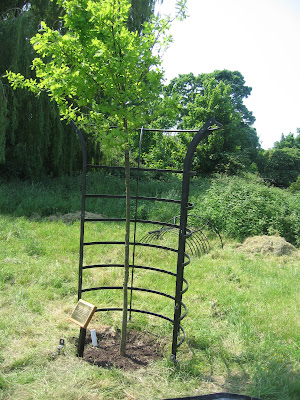
A Diamond Jubilee Oak on the Common - A Royal Gift from Prince Philip


In 1897, a sapling oak was planted on Common Road, Eton Common (in Eton Wick) to commemorate Her Majesty Queen Victoria's Diamond Jubilee; the oak, which thrived and is now a splendid specimen, came from the forestry department of Windsor Great Park.

In 2012, the Eton Wick History Group commemorated Her Majesty the Queen's Diamond Jubilee by planting a young oak some seventy yards from the one referred to above; and His Royal Highness, The Duke of Edinburgh, kindly agreed to let us have a 10' 0" (3 metres) sapling from the Crown Estate.

The Oak Tree planted to commemorate the
Diamond Jubilee of Queen Elizabeth II in June 2012


As I write this, I know that the oak has been set aside for us and we have only to make arrangements to collect it at an appropriate time for planting; but before obtaining suitable transport and agreeing the date for planting, we have first to acquire a steel fence guard to protect the young tree from cattle (it will be planted just inside an area where cattle graze). Our local Councillor, Peter Lawless, has kindly authorised a grant to cover the cost of the heavy-duty metal tree guard. We hope that shortly we will be in a position to announce the date of a formal planting ceremony. 

John Reid Chairman — Eton Wick History Group 


Lord Waldegrave of North Hill, Provost of Eton College
with the Mayor and Deputy Mayor of Eton Town Council

Lord Waldegrave undertook the ceremonial planting of the Jubilee Oak.


Wednesday, 5 January 2022

Old Days of Eton Parish - The Eton Bridges

CHAPTER III

FROM matters connected with the Church we turn for the present to other points of local interest. 

Eton seems to have been always subject to floods, and even at ordinary times the crossing of so many intersecting streams must have made the bridges not merely a con­venience, but in some cases an absolute necessity. The first mention of any of the Eton bridges occurs in a docu­ment called the Hundred Rolls, dated 1274, i.e., 167 years before the College was founded. In this it is stated: "The whole township of Eton from Baldwin Bridge to Windsor Bridge was accustomed to give toll of fuel in vessels and all the royalties appertaining thereto.1" This toll was probably in the form of blocks of wood or faggots cut from the copses in the parish. It was given in aid of the royal revenues, which were much impoverished in the time of the Crusades. Baldwin Bridge, for it was originally called, is again mentioned in the Founder's plans for the College.

1.         This was probably the earliest of the bridges and was naturally required to connect the town with its farms and woods in other parts of the parish.

At an early period several houses seem to have sprung up along Baldwin Shore,some of them of a substantial size, and from thence they extended along the right side or the long walk' to what is now Savile House in Weston's Yard.

Who Baldwin was is unknown, but it may be presumed that he was founder of the bridge and its endowment.

It is not called Barns Pool Bridge till the latter part of the sixteenth century. Barns Pool may have been a landing wharf. It has been suggested that it was so named from the barns in which goods were stored.

In Queen Elizabeth's reign steps were taken to secure, for the maintenance of the bridge, the title to certain property, consisting of a house adjoining the bridge, and other land. This, in 1592, was conveyed to thirteen Feoffees or Trustees, being inhabitants of Eton, "for erecting or repairing and from time to time amending and maintaining for ever the said bridge."

By the terms of the trust, the Feoffees are empowered, after spending what is necessary on this purpose, to bestow the remainder "in such ways as seem to be the best, and to the most advantage of the inhabitants and parishioners of Eton."

They are instructed to meet yearly at Pentecost at the Bridge House and appoint two of their number, called the Bridge Master and the Bridge Man, to carry out the objects decided by the majority.

In accordance with these instructions, we are told that in the year 1658 "the bridge called Barnspool Bridge, alias Baldwin Bridge, was pluckt upp and new built." In 1676-9 the house adjoining the bridge is described as the Town House, and the land all round, Town land. A commodious room was built in 1793 for the meeting of the Feoffees, also for the meeting of the inhabitants on the common business of the parish.

In 1687 the last mentioned bridge, which was made of wood, was superseded by one of brick, and in 1884 the present iron bridge was constructed.

By a careful improvement of the Bridge Estate property, its annual value has been considerably increased. In 1676 it was £4 10s; in 1876 it had become £311 10s. 6d., and in 1901 produced a rental of £554 11s., and many persons and institutions have received considerable benefit thereby.

II. In (303 a flood demolished Spitelbrigge, now known as Beggars' Bridge, close to Willowbrook.

In consequence of this an injunction was issued to the Sheriff of Buckingham reciting that the

A History of the
Baldwin's Bridge Trust
by F.I. Wilson
Published 1977

bridge was broken down and destroyed "to the injury of the adjacent country and manifest danger of travellers," and an enquiry was held at Eton, before two commissioners and a jury of twelve persons, to ascertain to whom the duty of repair belonged.

The bridge would seem to have been built about fifty years before by one Walter de Teb, with voluntary gifts collected in the town and neighbourhood, and the commissioners made return upon oath that the said bridge being one half in Eton and the other half in Upton, no obligation lay on the people of Eton to sustain it. It must be rebuilt by begging for contributions. Hence the name it now bears.

III. Long Bridge or Fifteen Arch Bridge is said to have had once fourteen narrow arches of brick, and one central arch of stone. Six of the centre arches were destroyed by flood in 1809 and replaced by three only. The present bridge dates from 1843.

IV. Windsor Bridge perhaps should not properly come into a history of Eton, as it has been always the exclusive property of the Windsor Borough, but for three reasons a short summary of its history can hardly be omitted altogether.

1. The opening of this means of communication with the Castle must have contributed very considerably to the trade and convenience of Eton.

2. Eton must always have helped largely, by the tolls taken from its inhabitants, towards the maintenance of the bridge.

3. The final freeing of this bridge was due to the determined and self-sacrificing efforts of an Eton townsman.

As far as can be ascertained, no bridge existed before the reign of Edward I. Previously to this, communication was by means of ferry. The river was most likely crossed ►se days from what is now River Street on the Clewer side to Meadow Lane in Eton, whence a road ran towards Cippenham, once an important place, and Burnham. On September 18, 1281, King Edward I. granted a charter for a bridge to the Burgesses of 'New Wyndesore,' as the town which had been rising for fifty years under the Castle walls was now called.

This charter carried with it the control and profits of certain waters and fisheries on the Thames, which in later days became the property of Eton College. It also gave the Burgesses the right to take pontage or toll for the upkeep of the bridge.

This latter right was renewed from time to time, and certain other grants were made by Henry VI. in the twenty-third year of his reign, when a new bridge was built.

In the time of the Great Rebellion (1642), which was largely supported by the County of Bucks, the then existing bridge was broken down to hinder the march of the Parliamentary Army.

In 1707 the Burgesses leased the bridge to John Herring, requiring him to repair and renew it whenever needed, but owing to complaints as to the heaviness of the tolls, and the dangerous state of the bridge, an Act was obtained in 1734 for a fixed schedule of tolls, with the power to enforce them and to use them for the purposes of keeping up the bridge. This was renewed in an Act, July 1819, George III., when power was given to build a new bridge of stone and iron, in place of the timber bridges built hitherto, and to continue and levy certain tolls for twenty-one years. This permission was subsequently extended and did not finally come to an end till 1872. Under this Act, tolls were only to be paid by the same vehicle once in the day and were to be diverted to no other purpose or use whatsoever than the necessary expenses of the bridge.

When the right expired in 1872, the Corporation was advised by Counsel, either to go back on the prescriptive right of the first charter, or to apply for a fresh Act of Parliament. They chose to take a course of their own, and adopted a modified scale of charges without applying for an Act, and meanwhile farmed the bridge and made about £500 a year, which was used to the relief of the rates. A few people disputed their claims, but no one was bold enough to oppose them till 1895, when Mr. Joseph Taylor took up the matter, and obtained Counsel's opinion to the effect that the Act of George III. finally destroyed the old prescriptive right.

In September that same year Mr. Taylor drove up to the bridge, and, refusing to pay the toll, it was barred against him.

On January 30, 1896, he renewed his attempt, and paid the demanded toll under protest. This led to a trial at Queen's Bench in May 1897, when the Lord Chief Justice gave judgment in favour of the Corporation.

Just when Windsor was congratulating itself on its victory, it was announced that Mr. Taylor had decided to appeal.

The case came on in the High Court of Appeal in October, and a unanimous judgment was given in favour of Mr. Taylor's contention. Whereupon the Corporation appealed to the House of Lords, and in November 1898 another unanimous judgment was given, and the case was finally won, and the bridge freed from toll for ever.

The bridges not on the high road are as follows: In the Playing Fields Sheep's Bridge, built 1563 to replace one of wood. On the river towing path Bargeman's Bridge and Cuckoo Weir Bridge, both over streams from Cuckoo Weir. Higher up the river at Upper Hope is Long Bray Bridge—and higher still, opposite Eton Wick, Boveney Bridge, which crosses the stream separating Eton from Boveney.

Note 1 Hence, in Lysons' Magna Britannia, 1813, the town is designated ‘Eton Gildables,' or more correctly ‘Geldable,' or liable to tribute, as distinct from some land which was free from taxation.

OLD DAYS OF ETON PARISH by The Rev. John Shephard, M.A. was published in 1908 by Spottiswoode and Co Ltd. The text is has been copied from the original book that is now out of copyright.


Tuesday, 28 December 2021

From the Parish Magazine - Eton Wick History Group Meeting - History of the Churches of Eton Wick.

The Eton Wick Village History Group was treated to a trio of presenters at their last meeting on 26th June 1996, each of the trio representing one of Eton Wick's places of worship.

1930's Chapel Plan

Neville Thorman spoke first, about the newly extended and refurbished Methodist Chapel, which was built in 1886 entirely as the result of the vision of Frances Annie Tough, a young woman who had come to Eton Wick in 1877 from Rotherhithe, on her marriage to Charles Tough who had been appointed manager of Bell Farm. Annie Tough, with her sister, had become very much involved with the Methodist Church in Rotherhithe and when she came here she soon saw the need to encourage a religious approach locally, and she spent part of her first Sunday in the village delivering tracts. She found travelling to the Primitive Methodist Church in Windsor inconvenient and was rebuffed when she asked them for money to help build a chapel here; she tried Maidenhead and they decided to support her by sending a Mission Band to Eton Wick; she went to the Windsor Congregationalists' services in 'The iron Room' on the Common but, initially at least, found them uninspiring. Annie Tough's mission was to build a chapel and eventually the present site was obtained, through a certain amount of bargaining with a developer, James Ayres, who gave her the land as a reward for her perseverance. The small, congregation of Primitive Methodists set to and found the £300 that it cost to construct the Chapel, some by paying one shilling per week as a pew rent, and it opened. in October 1886. Frances Annie Tough died in 1930 aged 76. The first extension to the Chapel cost £519; and this most recent refurbishment (the 2904 Project) has cost £130,000. Many of the people who have done a lot for the Chapel are commemorated with plaques on the walls of the Chapel Mr. Thorman concluded his most interesting talk with slides showing the refurbishment in progress and also how the Chapel serves the community.

St Gilbert's 

The Roman Catholic Church of St. Gilbert was built in 1964 and Chris Stevens was able to tell the Group where the clergy for this Church came from and how it is only in the last five years that St. Gilbert's has had a secular clergy_ There is no recorded Catholic Church between Windsor and Boveney until 'Our Lady of Sorrows' was built in Eton in 1915 (Lord Bray - an Old Etonian thought that the Catholic boys at the College were lacking in instruction and so had the church built), although there may have been a 'Chapel of Ease' or Chantry for the groups who would go on pilgrimage, tracking along the river. For some years prior to the building of St. Gilbert's, Mass was celebrated on Sunday mornings in the Village Hall - hired for the princely sum of four shillings per week. Chris Stevens told the Group how an original and attractive design for the church was rejected by the Diocese but was later used for the church at Wargrave. St Gilbert's was built, at a cost of £16,000, to a different design on land which was purchased for £1,500. The church was blessed but not consecrated - perhaps it could be consecrated on a appropriate anniversary? St Gilbert, the son of a rich man, wanted to be a priest but initially was turned down because he was a cripple, but. he persisted and became one of the great teachers of religion_ St. Gilbert's is in the Parish of Burnham.

St John the Baptist

Finally, Peter Kreamer told the Group how the Church of St John the Baptist was built in 1866 and so is the oldest church- in Eton Wick. Peter regards himself as the Church's odd-job man. The Church of England became interested in Eton Wick in the 1830's when one of Eton College's chaplains, Henry Harper, encouraged the building of a school room on the corner of Eton Wick Road and The Walk, which doubled as a church. However, by the 1806's the local worshippers needed a larger building, this was recognised by the Provost of Eton College who still then had responsibility for Eton Wick, and by 1867 St John the Baptist, had been built and consecrated, with a lot of the financing contributed not only by Eton College, but by the people of Eton and Eton Wick - the site itself was given by Queen Victoria and she also gave £100 towards the construction costs. The architect was Sir Arthur Blomfield, whose son went on to do many designs for the War Graves Commission. The cost of the construction of the church was E1,573, and the church remained under the auspices of Eton College until 1875 when the Church of St. John the Evangelist was built in Eton. In 1891 the 'Children's Window' was installed - paid for by offerings collected at the children's services In 1892 the first licensed burial took place in the new ecumenical churchyard -that of a six week old child of the Langridge family, who were at Manor Farm at that time. In 1897 the church was licensed to conduct marriages. Mr. Kreamer then went on to speak of when the church was flooded in both 1894 and 1947, of the installation of gas lighting (1935) and subsequently electricity (1951); and of the many local activities prompted by the Church, often in competition with other local organisations.

But it is good to note that there are times when all three Churches work together; just to give two examples: all are represented at the Remembrance Day Service at St. John the Baptist; and the ladies all get together in one of the churches for the Women's World Day of Prayer.

Mr. Frank Bond thanked the speakers. He mentioned that The Pound was to be officially locked with ceremony on 12th July. The next meeting of the group will be on Wednesday, 4th September, when Mr. R.J. Clibbon will speak on 'The History of the Local Council'.

During the 1990's the Parish Magazine of Eton, Eton Wick and Boveney reported on the meetings of the Eton Wick History Group. A member of the audience took shorthand notes in the darkened hall. This article was published in the September edition of 1996.