Thursday, 21 December 2017
1897 - 1997 Centenary of Victoria's Jubilee
Monday, 1 May 2023
From the Parish Magazine - Eton Wick History Group - 100 Years 1897 -1997 Queen Victoria's Jubilees
Frank Bond introduced the April meeting of the Group with a request for suggestions for marking the Millennium; he thanked the donors of the raffle prizes and also those kind members who provide the refreshments for every meeting. Mr. Bond gave a special welcome to Eddie Wilkes; it was "lovely to see him back again"; also, he drew the members attention to the copies of Norman Oxley's book about Arthur Young Nutt, who fulfilled a period of service at Windsor Castle from 1867 to 1912, engaged initially as a draughtsman and attaining the position of Surveyor to the Dean and Canons of St. George's Chapel, Custodian of the Royal Mausoleum and Head of the Office of Works at the Castle.
Examples of A.Y. Nutt's work were to be seen in the photographs and illustrations of the talk which followed Mr. Bond's introduction: John Denham spoke of "100 Years 1897-1997 (Queen Victoria's Diamond Jubilee)" In fact, the talk drifted back even further to 1887 and covered Queen Victoria's Gold and Diamond Jubilees when Eton and Eton Wick both joined with Windsor for the celebrations.
The Jubilees provided a wealth of proof of the tremendous loyalty and enthusiasm which the public held for Victoria and the Royal family, and the ingenuity of people like Mr. Nutt with his ceremonial arches at the College end of Eton High Street and on Windsor Bridge, the parties, the processions, the military bands and the street decorations.
Mr. Denham was also able to entertain with anecdotes about more local everyday matters, such as the savings bank, which was introduced for local children in 1897, their increasing numbers which resulted in pupils being refused from Boveney Newtown; the licensing for marriages of Eton Wick Parish Church and its first marriage between Ann Deverill and Alfred Seymour.
Eton Wick's Football team's game against the Eton Temperance team on 20th November 1887, when Eton Wick lost 2-0: We heard how Toddy Vaughan had planted the oak tree on the green in Common Road - this could have been in either 1887 or 1897 and the History Group are going to fix a plaque to the tree, with due celebration, later on this year.
We look forward to our next meeting, scheduled for 25th June, when the topic for discussion will be °THE IINFLUENCE OF ETON AND ETON COLLEGE ON ETON WICK",
Perhaps those who have not yet returned their questionnaire to Mr. Bond could do so before that meeting.
Wednesday, 4 February 2015
Eton Wick Church of St. John the Baptist
This article was first published in Our Village, Eton Wick's own village magazine.
Monday, 28 August 2023
Old Days of Eton Parish - APPENDIX II. - ORNAMENTS IN THE PARISH CHURCH.
THE following particulars of the various ornaments in the Parish Church may be of interest, especially to strangers.
In 1864 the north-west window was filled with stained glass, representing St. John in old age, and St. John writing the Book of Revelation.
About the same time subscriptions were collected to fill the great east window in memory of the Prince Consort, who had died in 1862.
This was carried out by Mr. O'Connor in 1865. The principal subjects of the window are our Lord's appearances after the Resurrection to Mary Magdalene, to the Disciples by the lake, and to the women in the garden. In the lower panels are represented the Bearing of the Cross, the Crucifixion and Burial, and in upper tracery our Lord in glory.
In the same year the south-west window was inserted. This represents St. Peter and St. John at the Beautiful Gate, and the confirmation of the Disciples at Samaria.
The window in the chancel aisle, put in by Bishop Chapman in 1866 in memory of his daughter, depicts the raising of Jairus' daughter and the meeting of Martha after the death of Lazarus.
The other windows on the south side represent, 1st, the call of the sons of Zebedee (in memory of T. and A. Ingalton), 2nd, ' the surnaming them Boanerges,' 3rd (in memory of the eldest son of Thomas and Ann Ingalton), 'the raising of the widow of Nain's son.' On the north side nearest the tower the window represents 'St. John at the Cross receiving the charge of the Lord's mother.' It was given by Rev. N. L. Shuldham, formerly Conduct of Eton.
All the above windows were executed by Mr. O'Connor.
The other windows are the work of Buriison and Gryll. The one in the sanctuary represents our Lord as the Great High Priest and Melchisidek ; the panels beneath, the Institution of the Eucharist and Melchisidek meeting Abraham.
The second is Mary and Martha, with works of mercy below. This latter was executed in memory of Mrs. Forbes, wife of Colonel Forbes of Willowbrook, who for many years was an active and generous worker among the poor of Eton.
The brass near is in memory of a son of theirs, a young officer killed in the Afghan campaign.
In the nave, north aisle, are windows presented by Mr. Ingalton Drake : Christ walking on the water, and Christ as the Good Shepherd.
The reredos in alabaster was designed by Mr. Woodyer and executed in 1868. The sanctuary wall was decorated and the arcade work carried out in 1875.
In the same year the tenor bell was hung in memory of John Wilkinson, cast by Messrs. Warner, weighing 9 cwt., and the organ was built by Messrs. Hill with swell and pedal at the cost of ‘549. A second manual was added ten years later.
The oak chancel screen was designed by Mr. A. Y. Nutt and erected in 1883 at the cost of £121.
The funds for the brass eagle lectern executed by Barkentin and Kraal, Regent Street, were collected by a member of the St. John's Communicant Guild.
The altar candlesticks were given by the Rev. John Wilder.
The altar cross was presented in 1890.
The colouring of the nave pillars and walls, carried out by Burlison and Gryll, was done by degrees 1892-1897.
The lowering of the nave roof and removal of the clerestory windows took place in 1893. In the same year a handsome brass alms dish was given.
In 1895 a silver-gilt chalice and paten of beautiful work and set in jewels, executed by Barkentin and Kraal, was presented by Mrs. Layard and Rev. E. B. Layard in memory of Mrs. Shephard.
In 1896 the corona was given by the parishioners in memory of the same lady. It was designed by Mr. T. B. Carter. The niches contain the figures of the Twelve Apostles, carved in Italy, St. Paul taking the place of Judas Iscariot.
The litany desk was given also in 1896 in memory of the Rev. Thomas Dalton.
The chancel was repaved in black and white marble by Farmer and Brindley. Stalls for the choir were also provided in 1897.
In 1899 the organ loft and an approach to it was arranged by Messrs. Wheeler, and the organ was reconstructed and enlarged.
The clergy stalls were also given, and the altar rails were replaced by altar kneelers. In 1903 a sanctuary carpet was presented by the Guild, and in 1904 an oak pulpit was placed in its original position at the chancel arch.
Most of these additions or alterations were affected by
free-will offerings, and without any appeal to the public.
OLD DAYS OF ETON PARISH by The Rev. John Shephard, M.A. was published in 1908 by Spottiswoode and Co Ltd. The text has been copied from the original book that is now out of copyright.
Monday, 27 July 2015
Trades men and women of Eton Wick in 1887 & 1897
Businesses operating in Eton Wick in 1887 |
||
| Arthur Bennett | Shop keeper | |
| Henry Elkins | Carpenter | |
| John Langridge | Farmer | |
| Thomas Lovell | Baker and Post Office | |
| Charles Nottage | Dairyman | |
| Henry Powell | Dairyman | |
| Frederick Smith | Farmer | |
| William Stacey | Beer Retailer | |
| James Tarrant | Farmer | |
| Mrs Trotman | Laundress | |
| William Underwood | Publican Three Horseshoes |
|
Businesses operating in Eton Wick in 1897 |
||
| Charles Ayres | Shopkeeper | |
| James Ayres | Market Gardener | |
| William Cartwright | Builder | |
| Edward Collins | Dairyman | |
| John Cottrell | Florist | |
| Mrs Isacc Crabb | Shopkeeper | |
| Henry Elkins | Carpenter & Smith | |
| Edward Ellwood | Plumber & Beer Retailer | |
| William Hanns | Builder | |
| Mrs Georgina Haverly | Laundress | |
| Thomas Henry | Boot & Shoe Maker | |
| George Howell | Cabinet Maker | |
| Mrs Teresa Lanfier | Laundress | |
| John Langridge | Farmer | |
| William Langridge | Carman | |
| Frederick Lovell | Draper & Boot Dealer | |
| Thomas Lovell | Baker & Grocer, Post Office |
|
| William Middleton | Shopkeeper | |
| Sarah Ann Miles | Laundress | |
Thursday, 2 June 2022
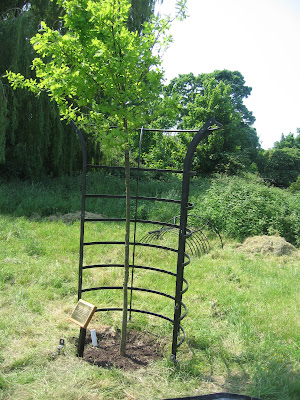
A Diamond Jubilee Oak on the Common - A Royal Gift from Prince Philip
![]() |
| The Oak Tree planted to commemorate the Diamond Jubilee of Queen Elizabeth II in June 2012 |
As I write this, I know that the oak has been set aside for us and we have only to make arrangements to collect it at an appropriate time for planting; but before obtaining suitable transport and agreeing the date for planting, we have first to acquire a steel fence guard to protect the young tree from cattle (it will be planted just inside an area where cattle graze). Our local Councillor, Peter Lawless, has kindly authorised a grant to cover the cost of the heavy-duty metal tree guard. We hope that shortly we will be in a position to announce the date of a formal planting ceremony.
John Reid Chairman — Eton Wick History Group
Tuesday, 24 March 2015
Getting to Eton Wick in 1929
Monday, 26 July 2021
From the Parish Magazine - Eton Wick History Group Meeting - The Original Christopher Inn
A report on the December 1997 meeting held at the Village Hall.
The 1998 programme of talks was issued at the Group's meeting on the 10th December, promising yet another year of interesting topics; the Committee never seems to run short of subjects, despite the fact that this meeting marked the end of the 7th year of the Eton Wick History Group. The 1998 programme appears separately in this magazine. Mary Gyngell has had her hip operation and is home - we wish her well. (Needless to say, she made the cakes again!). Congratulations to Vi Millis and her husband who celebrate their 60th Wedding Anniversary and Vi's 90th Birthday last month. A man in Canada had sent Frank Bond an 1897 map of Boveney New Town and one of Windsor and a £1 note!
Tony Cullum then entertained the Group with a talk on the original 'Christopher" Inn, which was situated opposite College Chapel in Eton. Mr. Cullum used the opportunity to take us on a journey through history, commencing with the Inn at Bethlehem at which there was no room and easing us through time, touching on maps of the 6,000 miles of excellent Roman roads in Britain, Hadrians Wall and the other wall from the Clyde to the Forth.
Soon we had left Augustus, Tiberius, Caligula and Claudius behind and were into stage-wagons, drawn by six or eight horses; and then the spring suspension stage coach, high-perch phaetons, cabriolets and landaus - a trip from London to Bath would probably have been a three to four day journey - hence the need for coaching inns like the "Christopher".
And, did you know the difference between a tollgate and a turnpike gate? (A turnpike gate is sturdier and had spikes on the top!).
There was talk of Thomas Telford and also of john Macadam - who found that the secret of a good, lasting road was to dig down to a depth of 12" , fill with granite chippings and leave it to the horses" hooves to grind it down into a solid base. And there were plenty of horses hooves pounding away, with over 1,000 vehicles leaving London every day in the early 1800s.
Stagecoaches would leave Windsor at 7 a.m., 9 a.m. and 3 p.m. and, in good conditions, would take about 4 hours to get to London. There is mention of 'The Christopher' in 1511, when it was a shown as a large complex of buildings with land leased with it "contained within 1 acre and occupied by Ruth Cox". The Inn has held various landlords including in 1636 Francis Dickin, from 1753 to 1775 a George King and, when the Inn finally closed, the landlord was a Jack Knight.
For some time it was the only ale house in Eton which could offer bedrooms. In September 1803 a Baldwin's Bridge Trust dinner was held there at a cost of £5.6s.6d. plus 10/- for extras.
In 1665 College boys were forbidden to go there, but it later became very popular with them and they would claim that they had to go there to meet friends coming from London, or to collect parcels from the mail. Eton's 'Pop' boys used to enjoy the food and ale there, particularly a drink (a bit like punch) called 'Bishop' at 12 shillings per barrel.
Under the then Head Master, Dr. Hawtrey, the College obtained possession of the site in 1842 and it was used first as a French Pupil Room and then as a boarding house. Jack Knight, the former landlord, moved into 131 High Street and set up shop selling drinks to the boys; in 1871 his lease and goodwill were taken over by a Mrs. Emily Brown and in 1872 it was moved o the present Rowlands/Tap. The present 'Christopher' was opened in 1846 at 110 High Street and owes its existence to the closure of the old 'Christopher' - now called Hodgson House.
![]() |
| Extract from John Denham's index of Eton Traders |
For the remainder of the evening, the Group repaired to the Small Meeting Room to enjoy a splendid buffet meal and Christmas punch.
The next meeting took place on 21st lanuary when the topic was the 'HISTORY OF SALTERS STEAMERS' and the speaker, Keith French.
During the 1990's the Parish Magazine of Eton, Eton Wick and Boveney reported on the meetings of the Eton Wick History Group. A member of the audience took shorthand notes in the darkened hall. This article was published in the first edition of 1998.
Monday, 2 July 2018
I. SPRINGFORD - ROYAL GARRISON ARTILLERY
and published here with grateful thanks to the author Frank Bond.
The 1911 Census records Isaac's father, William Isaac working as a Fly Driver. Isaac is recorded as being an Errand Boy.
Isaac Springford signed his Attestment document on December 2nd 1915 at the Cavalry Barracks in Windsor and his age is given as 19 years and 18 days. This would indicate his date of birth as November 14th 1896. His Army service records are held in the National Archive and they show that he transferred to the Royal Garrison Artillery on December 20th 1917. After more than two years of home service, he was transferred to France at the beginning of April 1918, he was a Gunner in the 521st Siege Battery. On June 24th 1918 the Battery suffered several casualties due to gas.
| Add caption |
Monday, 3 July 2023
Old Days of Eton Parish - CHAPTER XVII - THE LAST.
THE census of the town and parish in 1871 shewed a population of 3261; in 1881, 3169; in 1891, 2986; in 1901, 3154. In all cases the boys in College are excluded; the varying numbers may be largely accounted for by the time chosen for the census. The last two returns indicate some decrease of population. This is partly explained by the pulling down of cottages to make room for College houses, and the reduction in the town of in-habited houses from 635 before 1891 to 494 in 1901.
The last twenty years of the nineteenth century were also marked by the migration of a considerable number of tradespeople from their shops in the High Street to more commodious homes in Windsor or Slough. This of course caused a corresponding decrease in the attendance at the Parish Church and left many gaps in seats formerly occupied by large families. The building of the Lower School Chapel also drew away some who hitherto could find no room in the College Chapel.
The working class population, during those twenty years, was also driven for want of cottage accommodation to seek it elsewhere, and many regular workers in Eton lived in Slough, Windsor or at Eton Wick. A fresh opening for the artisan class was made just beyond Eton Wick.
This came about indirectly by the action of the Eton Urban Board. More space was required for the Sewage Farm, and they accordingly purchased land in Boveney, and then finding that they had on their hands more than was needed, they offered the rest for sale.
The purchaser saw his opportunity and soon covered the land with villas and cottages, which were equally soon filled with tenants, most of whom were working in Eton. A considerable population was thus created, and being far distant from their Parish Church of Burnham and. Burnham schools, the people found their way to Eton Wick Church and schools. This, and the general unsuitability of the Eton Wick school for modern requirements, brought about the erection of Girls' and Infants' schools close to the Church on ground granted by the Crown. The change was effected in 1888 at the cost of £1237.
In 1881 the Eton School Laundry at Willowbrook was opened. Although inaugurated in the interests of the College, it has proved in many ways beneficial to the homes and lives of many of the working people in the parish.
In 1894 the College Watermen were re-organized--a much needed reform, which has also contributed to the better interests of the parish.
In 1887 was Queen Victoria's jubilee.
The rest of the events up to the death of the Queen may be very briefly chronicled.
In 1892 the old Porny school-room, which for some years had been a carpenter's workshop, was secured as a Parish Room, for holding meetings, classes and entertainments. This was carried out largely by the energy of the Rev. G. S. Clayton, Assistant Curate 1892 to 1897.
In December 1894 the Urban District Council for Eton was elected, and superseded the old Local Board.
At the same time the out-district of Eton Wick was constituted a parish for civil purposes, and five parish councillors were elected to manage their business.
In 1892 a temporary arrangement was made with the Vicar of Burnham, by which the Vicar of Eton undertook the spiritual care of the growing population in New Boveney.
In 1895, at Easter time, there was a large muster of volunteers, who were quartered in the various school buildings in Eton and the College. A special service was held for them on Easter morning.
A year later, the Cemetery Chapel was newly floored, and the east end of it enriched by some marble work and a beautiful stained window.
In the course of 1898 a piece of ground, presented by the College, was added to the cemetery and consecrated by the Bishop of the Diocese.
A branch was started of the Mothers' Union in 1890, and a Company of the Church Lads' Brigade in 1899. Both of these have proved of signal value in the parish.
In 1900 the parish sustained a severe loss by the death of the Vicar's Churchwarden, Mr. J. P. Carter. A processional cross was presented to the Cemetery Chapel in his memory, and a churchyard cross was erected by parishioners and friends, and placed just between the old and the new part of the cemetery.
The outbreak of the Boer War, and the call of many Eton soldiers who were in reserve to leave their work and serve their country, marked the year 1899, and led to the raising in the district of a fund for the maintenance of the soldiers' wives and children, and to a pathetically memorable Christmas party given to them by the Queen at Windsor Castle.
A few months later, Victoria the Good had passed away, and Eton took its part in paying its last sad homage to a revered memory, and then in the year following (1902) there was the busy preparation for King Edward's Coronation, his unlooked for illness and happy recovery.
In 1901 Bishop Stubbs also died, and Bishop Paget became Bishop of the Diocese.
The only parish event of these years which needs to be added to our record was the inauguration in Eton of a representative Church Council to consider Church matters and advise the Vicar.
With this we must close the last chapter of this story of the ups and downs of the town and parish of Eton. Many smaller incidents in these later years might have been included, and the names of many individuals, lay and clerical, might have been mentioned, to whose devoted work and example the parish owes a debt of gratitude, but to do so with due discrimination of worth would be a difficult and invidious task. Their labours of love will meet a full reward. We need only express the hope that those who read in these pages of the inheritance derived from the centuries past, will follow in their steps and bestir themselves in good earnest to uphold all Eton's best traditions, and will take their part in handing on to generations yet to come even larger benefits, and greater opportunities for good than they have themselves enjoyed.
OLD DAYS OF ETON PARISH by The Rev. John Shephard, M.A. was published in 1908 by Spottiswoode and Co Ltd. The text has been copied from the original book that is now out of copyright.
Wednesday, 18 February 2015
Common Road, Eton Wick
Looking East
Looking West
Thursday, 26 October 2017
Cyril Ashman Hon Artillery Company
Artillery Company 22nd Brigade - 7th Division
Cyril was born on April 17th, 1897 at about the time the family is believed to have moved to Eton Wick from Tidworth in Hampshire. In September 1910 he left the Eton Porny School to complete his education at the Windsor County Boys' School. During his school years he frequently helped on his father's farm until April 1914 when he left school to become a banker's clerk for Barclays at Southall. He joined the Army in April 1916 when he was just 19 years old and served with The Honourable Artillery Company.
He was a very likeable lad and probably more outgoing than his older brother, Douglas. Eight months before Cyril enlisted, his 23-year-old brother was killed in the Gallipoli offensive. It is not known whether this loss influenced his own decision to join the army, but it is not difficult to understand the apprehension of his parents as their one remaining son went off to war.
![]() |
| Edwin and Alice Ashman with their children Dorothy, Cyril and Douglas |
He was wounded on October 7th and suffered Trench Fever, but was soon back in the front line. It was late Autumn and the battle had raged for three months with the aim of breaking out from the Salient and capturing the distant high ground known as the Passchendaele Ridge. Intense shelling had destroyed all the network of drainage ditches and the heavy rains made the terrain a glutinous, oozing quagmire.
The name of Passchendaele became synonymous with mud and slush, mud that drowned both men and horses. From the beginning of August 1917, the army had pressed painfully, slowly onward, until on
November 10th the ridge was finally taken at the appalling price of an estimated 250,000 casualties of whom 42,000 were never to be recovered. Cyril was killed here at Gheluvelt on October 26th, 1917, while trying to rescue a wounded comrade. Unlike his brother, he has a grave and is buried in the nearby massive military cemetery known as Tyne Cot. The cemetery is situated five miles northeast of Ypres and it contains 11,000 graves. Memorial walls there name nearly 35,000 other soldiers, who have no known graves. This total of approximately 46,000 British men were all killed in the Ypres Salient between August 1917 and the Armistice of November 1918.
Cyril's grave is number 21; Row C; plot 55. Mr and Mrs Ashman received a letter from their son's commanding officer which read: It is with the greatest regret that I am writing to inform you of the death of your son, Private Cyril Ashman of this Company, who fell on the 26th October while performing his duty under heavy shell fire. His officers regret the loss of a good soldier and his comrades mourn one of their most popular comrades, and it is the wish of all that I should convey to you their deepest sympathy in the great loss which you have sustained.In little more than two years, Edwin and Alice Ashman had lost both their sons in the Great War.
They left Eton Wick and the farm to live in Lansdowne Avenue, Slough. Their one remaining child was Dorothy. She lived until 1956 and was buried in the Eton Wick Churchyard. Her grave headstone bears the names of her two lost brothers along with her own.
Cyril's name is the second on the village memorial. He is also commemorated on the Eton Church Gates and on his old school memorial in Windsor. Cyril was single and 20 years of age.
and published here with grateful thanks to the author Frank Bond.
Cyril Ashman is also recorded in the Barclays Bank WW1 Roll of Honour. Private Ashman was one of 645 Barclays employees who died in the service of the country during the First World War.
Documents from the Commonwealth War Graves Commission website