
The 1950s were good years for the chapel. The number of children attending the Sunday School grew, and within a few years numbers had returned to pre-war strength. Unfortunately, the youth club closed in 1952, partly at least because of its own success which had kept the club a rather closed entity. As the teenagers grew up boyfriends and other new interests and activities brought this part of their lives to an end. The club had failed to attract new younger members. A few years later, however, a junior club was started by Margaret Drake and Edna Harris. The first report suggests it was very a successful venture with a membership of nearly thirty -though an insistence on 'too much' time for prayers and devotional activities was suggested as the reason why membership dropped a little in 1957! The club did not close however, and with a slight adjustment of programme struggled on into the 1960s.
Meanwhile other ideas were being tried. Caravan missions to
children in the village met with mixed reactions. Sunday morning breakfasts in
the garden at Bryanston, however, were a great success for a few years. A
creche was begun in 1954 enabling several mothers of young children to join the
sisterhood meetings on Thursday afternoons. A toy service was held in December
1955 -the first of many such services - and the gifts received were taken to
Fraton's Nursery at Maidenhead. The following year every child in the nursery
received a birthday card and a chocolate egg at Easter.
A party was held for boys from one of Dr Barnado's home and
the money collected by chapel members carol singing round the village was given
to the National Children's Home Organisation. Cradle Roll services were begun
and in 1953 the Sunday School children were taken to London to attend the JMA
Golden Medal Meeting. It was a proud day for the chapel and Jean Drake when she
received a medal for collecting for ten years. The chapel became the proud
possessor of a slide projector bought from the funds of the defunct youth club
and this was put to good use by all sections of the chapel. The new Circuit
magazine, 'The Link' was an innovation reflecting the regular activity of
church business. But perhaps the most important fresh activity of the 1950s for
Eton Wick was the revival of class meetings under the name fellowship meetings.
Four class leaders were elected -Mrs Chew, Harry Cook, Marjorie Morris and
Sylvia Chew -to 'act as "shepherds" to a proportion of the members'.
The fortnightly meetings, held in leaders' homes, were chaired by the Minister.
They took the form of discussion groups and these meeting became an integral
part of chapel life in the 1950s. A few people, of course, did not find them to
their liking and later in the decade, when the Rev. Leslie Hall was Minister,
the fellowship meetings alternated with mid-week services.

In 1952 the debt incurred by the redecoration of the chapel
was at last paid off, a donation from Mr Russell Smith of Cricklewood, London,
clearing the final outstanding amount. It was then resolved that the
redecoration of the Tough Memorial Hall should go ahead. Two years later
thoughts of the trustees turned to the possibility of connecting the chapel to
main drainage and at the same time enlarging the schoolroom once again. Work
began the next year. The wall between the toilets at the rear of the Hall was
demolished and the kitchen extended. New toilets were built. It was a far more
modest extension than that of 1935 and much of the necessary money was raised
through grants and donations. St Mark's Womens Fellowship of Maidenhead
presented a pageant, raising £11 which was donated to the extension fund. Queen
Street Church, Maidenhead gave some £30 and amongst those that generously gave
grants were the Joseph Rank Trust, the General Chapel Fund and Her Majesty the
Queen.
At the end of the decade optimism stood high. Membership had
now jumped to thirty-five and the Sunday School to an unprecedented 92 (except
when the evacuees children swelled the numbers). The chapel now had three of
its own local preachers - Daphne Hogg, who had moved to Eton Wick from Windsor,
Tom Dally, who also became the organist, and Helen Banham. The chapel was
especially proud of Helen for she had first found her faith in the Sunday
School. She recalled her days as a toddler in the infant class to the
fascination of the children in the present Sunday School when she preached at
the opening of our centenary year.
The Eton Wick History Group is most grateful for the kind permission given by the Eton Wick Methodist Chapel to republish this history, Tough Assignment on this website.
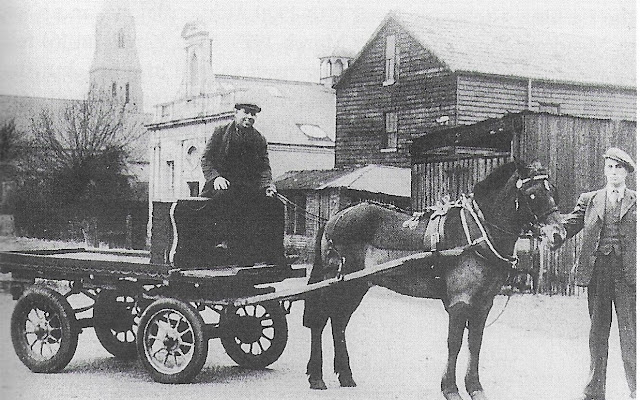
George used his horse and cart to trade in greengroceries, removals and other odd jobs. He also ran pony and trap trips for tourists, operating from the Windsor Castle taxi rank. George and his horse-drawn trans-port appeared in several films, which included the 'Carry on' series. George served in the Western Desert Army during the Second World War.
Chris
owned the Cockpit Restaurant in Eton High Street before taking over the
Barksfield Bakery in Dorney. In the 1960s Chris regularly waited each night at the
Burning Bush bus stop for the last Green Line coach of the evening, bringing
his step-daughter Penny home from her leading role in the 'Black and White
Minstrels' show at London's Victoria Palace Theatre. The photograph, taken in
the late 1940s shows the now removed Eton Parish Church spire, the Roman
Catholic Church and the 'Well's' timber built shed, now replaced with an office
block.
This article was first published in A Pictorial History of Eton Wick & Eton.
9th February
 |
| Ration Book courtesy of the Imperial War Museum. |
The issue of new ration books this month required a trip from the village to the Food Office at 39 Eton High Street. Ration books were issued in alphabetical order for collection on specified days as advertised on posters and in newspapers by the Ministry of Food. Generally, the system worked if people could get to the Food Office at the specified times, but this was not always convenient for the housewife engaged in war work in a factory, public service or managing her family with additional billeted evacuees as was shown by the later reminders to people to collect their new books. Shipping losses and military requirements put the supply of many goods in very short supply. A monthly ration of soap for each person was a 4oz block of household and 2oz tablet of toilet soap. Washday was difficult as the soap often failed to produce a lather in the local hard water and housewives were advised to add a little soda to the water. Soap flakes and powders of the time such as Persil, Rinso and Oxydol were also rationed, and some laundry companies now refused to accept new customers. A standard tablet of Lifebuoy soap was 2d. per tablet whilst scented toilet soap cost 4d. Including tax and 1 coupon.
This is an extract from Round and About Eton Wick: 1939 - 1945. The book was researched, written and published in 2001 by John Denham.
For an insight to how corner shops managed wartime rationing The View from the Corner Shop, a diary of a Yorkshire shop assistant in wartime is a very good place to start. It is based on the Mass Observation Diary written by Kathleen Hey edited by Patricia & Robert Malcolmson. The book covers the period between July 1941 and July 1946.
At the meeting on the 29th October the Group was saddened to hear of the deaths of Miss Banham and Ernie Gyngell. We shall miss them both and our sympathies go out to their families, particularly to Mary Gyngell who has not only to cope with her bereavement but also is to have a hip operation - despite an of which she still produced her usual trays of home-made cakes for the evening's tea interval.
So it was in sombre mood that the Group settled down to hear Frank Bond take them through some of his collection of old photographs of the area. However, spirits were soon lifted as he dealt with each photograph in some depth, producing a history in pictures which commenced with a slide of a picture of Eton High Street dating back 150 years. Some of the photographs were taken at the turn of the century and it was fascinating to register the changes which have taken place over the years; interesting, too, to have Mr. Bond identify so many of the people in the photos; and not just his own family, as in the 1895 snap of boys (one of whom was his father) on the footpath to Chalvey carrying huge bunches of dog-daisies to be sold at Dorney Gate or Boveney Lock but also others such as Alf Quarterman, Hammer Stannett - perhaps the last real Hayward, and John Henry Kemp the lockkeeper.
 |
| Henry "Hammer" Stannett the last real Hayward. |
Many of these older photographs were taken by Mr. Lovell, who ran the local combined Post Office, bakery, and hardware shop; others were by Mr. Hearn who came from Sunbury to Eton Wick in 1908. He was a saddler, his shop sign said he also repaired umbrellas, and when his wife died, he finished with the shop and set up an engineering works in Victoria Road; he also started a taxi business with a Model T Ford.

We heard how the original (1840) school, at the top of The Walk, was made into an institute for men and boys when the present school was built; and how the institute was turned into a shop in 1902 by a Mr. Pratt - whose painted sign can still be seen on the side wall 95 years later; the shop then passed through the hands of a succession of owners: Harman from 1908, Anderson from 1913, and then various others until 1988/89 it was converted into the flats we see there today.

There were happy photographs of haymaking and of children running races during what must have been a celebration of either Empire Day or the Coronation of Edward VII; and there were the sadder ones as of the unveiling of the War Memorial at the Parish Church. But what the evening brought home to the Group more than anything else, was the importance of keeping a photographic record of our ever-changing surrounds - whether it be new construction it the removal of an old 'landmark' like the old air raid siren. All should be recorded for posterity with details on the back of each print giving the date, the location and the names of any people captured in the frame.

During the 1990's the Parish Magazine of Eton, Eton Wick and Boveney reported on the meetings of the Eton Wick History Group. A member of the audience took shorthand notes in the darkened hall. This article was published in the September edition of 1996.
The village Billeting Officer, Archibald Chew, reluctantly had to resign the post due to ill health. He had excelled at this time-consuming job and always went to great lengths to make sure that evacuees were happy in their new homes and the successful village salvage drives were all due to his efforts.
Mr. Chew died in 1943 after a prolonged illness.
 |
| Photograph originally published in Tough Assignment A History of the Eton Wick Methodist Chapel 1886-1986 |
 |
| Scholars Scripture Certificate presented to Dorothy Banham in 1938 |
The war years undoubtedly brought change and strain to the
chapel as it did to the rest of the village and the country as a whole. But
nothing of this is apparent from the minutes of the trustees' and class
leaders' meetings, which merely continues to record with monotonous regularity
the election of officials and committee secretaries, the annual payments of
contributions to circuit and national funds, and the acceptance of reports. Yet
the chapel did play a vital, if minor, part in the war effort. The people of
Eton Wick, like those of many another village, accepted numerous evacuee
children into their homes during the 1940s. Mr and Mrs Chew were the billetting
officers. Many of those sent to Eton Wick were Jewish children from London's
East End, yet one of the most enduring memories of those days is of the chapel
and school room crowded to bursting point with Sunday School scholars - Jews
and Christians. There were still only about ten classes, but over a hundred
children, and when they all joined together in hymn singing, the sound could be
heard at the far end of Alma Road. When they all poured out at the end of
Sunday School it was more reminiscent of the closing time at the cinema. In
spite of the large numbers, a Summer Outing was still contemplated though all
plans to take the scholars to the seaside had to be abandoned. Instead in 1940
the coach took the children to Burnham Beeches, but there were no more outings
until after the end of the war. Scripture exams were still held but new
arrangements had to be made for prize giving. Attendance prizes were given only
to those who came to Sunday School more then ninety times a year, and the value
of the prizes was reduced for 'those whose conduct was not good'. A New Year,
rather than Christmas, Party was held - but not until February since there were
several parties being given in the village and by that date it was thought 'the
days would be longer and the air raid alerts later'.
The chapel account book reveals a little more of life during
the war. The insistence by the authorities that no chink of light be allowed to
alert the enemy can be seen in the purchase of three lots of blackout material
whilst fear of danger from bombs and flying glass and masonry prompted the
construction of a 'blast wall' in front of the door in 1941.
A Windsorian coach was hired at the cost of £1 to take
chapel members and friends to Slough during 'Wings for Victory Week'. Soldiers
were billeted for two nights in the Tough Memorial Hall during November 1943
at a profit of 18s (90p) to the chapel. Inevitably, however, the war brought
losses. Christian Endeavour petered out soon after 1939 as members, such as
Joyce and Clifford Chew and Harry Cook, joined the forces and other members
were caught up in other war time activities. In 1943 Archibald Chew died, not
as a result of the war but of an illness, and the chapel lost a very able
leader. Two years later, and only a few months before hostilities ceased,
Clifford Chew died, shot down by enemy action as he flew on a mission to
Germany.
In many ways the war was a watershed separating two very
different decades. It had widened the horizons of many village families and the
construction of new houses and roads soon after the war in both Eton Wick and
Boveney New Town altered the whole balance of the village community. Just before
the war in 1934, the parish councils of Boveney and Eton Wick were abolished
and both Boveney New Town and Eton Wick were brought within the boundary of the
Eton Urban District. There was little space for house building in Eton town,
and so the energies of the Council were now directed towards land of the old
Boveney Parish. The first houses built were the prefabs on Bells Field, but
soon the pink fletton bricks and yellow rendering of council houses transformed
the face of the Eton Wick Road and Moores Lane. By the early fifties council
houses had spread over much of the Tilston Fields and the name, Boveney New
Town, was relegated to that of one of the new roads. The chapel now stood much
nearer the centre of the enlarged village, the whole of which was now thought
of as Eton Wick.
In 1946, however, the chapel was not in very good shape.
Membership had not yet risen appreciably and the Sunday School, with only
thirty two scholars, was smaller than it had been for many years. The building
itself needed a general overhaul and work started on this in 1947. It wasn't
completed until 1950, but by this time electricity had also been installed in
memory of Archibald and Clifford Chew. The interior of the chapel was repainted
and the old combustion stove replaced by gas heating. These in turn were to be
replaced in the 60s by the more even warmth produced by portable electric
fires.
The chapel officers also took a straight look at the
problems of decreased numbers in the Sunday School. Since the war years (if not
before) there had been a Circuit Youth Committee with Sylvia Chew its Eton Wick
representative, and now in 1948 Sylvia and Marjorie Morris started a youth club
at the chapel. It was a very lively club catering for teenagers. It met weekly
and sometimes twice weekly and its varied programme included country dancing,
debates, hiking, swimming and dramatics. Even now the success of some of its
productions are remembered with pride, but perhaps the most treasured memories
of its one-time members are the summer holidays at Llangollen, the Isle of
Anglesey and the Lake District.
 |
| A Cradle Roll Rose |
The Eton Wick History Group is most grateful for the kind permission given by the Eton Wick Methodist Chapel to republish this history, Tough Assignment on this website.
The Methodist Chapel held it final meeting on 9th January 2022 more than 135 years after its first service in October 1886.

