Showing posts with label Common Land. Show all posts

Friday, 15 August 2025

World War 2 Eighty Years On - Wednesday August 15th. Victory over Japan Day - The end of World War Two

 Wednesday August 15th.  V.J.Day

The announcement of an end to the war with Japan caused some local confusion. Many had waited for the declaration of the end to the fighting on Tuesday evening and failed to hear the early news on the radio the following morning that a two day holiday was granted for the occasion  Many people went off to work only to find the factory or office closed.   Bakers shops that did open for a short time were soon sold out as no extra supplies of flour had been allocated.  Mothers called it a ‘Q’ holiday. Late night celebrating revellers were witness to the fire at the Palace cinema, Slough, which was gutted in spite of the efforts of the firefighters.

Over one hundred men and women from the village served in the armed forces of whom twelve died on active service. The acute shortage of houses when the war ended made any suitable empty building attractive to the homeless. Vacated military camps  in the Slough / Windsor area became occupied by returning servicemen with their families to be referred to as squatters. The disastrous floods of 1947 covered the Dorney Common with several feet of water from which the camp occupants were rescued by boat.

This is an extract from Round and About Eton Wick: 1939 - 1945. The book was researched, written and published in 2001 by John Denham.


Monday, 20 November 2023

Development of Eton Wick

Map of 1797
copied from The Story of a Village: Eton Wick 1217 - 1977
From its origins as a farming area of the Manor of Eton the earliest dwellings were built on the highest land north of the Great Eton Common. From the 14th century to the 18th century the six farmhouses continued that development. The 1797 map indicates houses on the southern side of Common Lane including the Three Horseshoes.

The first half of the 19th century brought further house building including the Parsonage, Bell Farm Cottages, Harding Cottages and Prospect Place. Most of these were rented to working class tenants. As the century progressed more houses were built some on the gardens of the cottages facing the Great Common. These included Hope Cottages, Palmers Place and others. 

The largest development began in 1880’s on some of the land of Bell Farm where Boveney Newtown grew with Alma, Inkerman and Northfield roads, and Moores Lane. The development was beyond the western edge of the Parish of Eton which at that time was Bell Lane. As recorded in the 1881 census when there were there household it grew and grew. By 1911 there were 125 households, two more than Eton Wick.


Ordnance Survey Map 1899 courtesy of National Library of Scotland

By 1899 there were two distinct communities with the land south of Alma Road and west of the Eton Parish mostly undeveloped. A few houses were on the south side of the Eton Wick Road including the Shepherds Hut and Victoria Road was outlined. The 1925 map shows further development south of Alma Road.


Ordnance Survey Map 1925 courtesy of National Library of Scotland


Ordnance Survey Map 1932 courtesy of National Library of Scotland

The inter war years saw some development south of Alma Road including a few houses in  Tilstone Avenue and Close.

Map showing rights under the Commons Registration Act of 1965 
copied from The Story of a Village: Eton Wick 1217 - 1977

This map indicates that there were six registered Commoners under the 1965 Act. These included Crown Farm, Dairy Farm, Little Common Farm, Manor Farm and Saddocks Farm.


Ordnance Survey Map 1968 courtesy of National Library of Scotland

The 1968 map reveal the limits of the village development with Haywards Mead, Princes Close, Queens Road and Cornwall Close filling the remaining available land on the south side of the Eton Wick Road. The final major development in the village was on the wheatbutts in the 1970's.


Ordnance Survey Map 2023 courtesy of National Library of Scotland

The latest OS map of 2023 show how the village development has been restrained by the Lammas Land and Commons. The number of households was also limited by the single road that restricts potential for evacuation in the case of flooding. The experience of the Thames floods of 2014 showed that the Jubilee River did protect the village. There has been more house building allowed including particularly in Princes Close, Queens Road and Victoria Road.


Enclosure Map courtesy of the Berkshire Records Office.

Both Slough to the north and Windsor to the south have both grown as enclosure acts were passed for the Manor of Upton cum Chalvey, 1819 and the Manor of Windsor Forest, 1817. If the 1826 Bill to enclose the Manor of Eton cum Stockdale and Colenorton had not been rejected Eton Wick would probably have become part of Slough.

Wednesday, 11 October 2023

The 18th Century Village of Eton Wick – Part One - Why Eton Wick is surrounded by open fields

The Village landscape was like the majority of Berkshire and Buckinghamshire in years leading up to the 18th century one of open fields, commons and other waste land with small tenant farmers, cottagers and squatters utilizing a rented un-enclosed strip of land from the Lord of the Manor or exercising a common right to graze their pigs, geese or maybe a cow upon the common land. During the late 17th and early 18th century improvements in animal husbandry and the harvest of arable crops gave impetus to enclosure of land by landlords and the Government. These changes in farming practice at that time could have led to later developments that would have made Eton Wick Urban in the late 20th century, an urban sprawl but for the opposition of the villagers and the influence of Eton College in the Houses of Parliament. 


For at least 700 years Eton Wick was administered through the Vestry of Eton but in 1894 this came to an end through the Civil Parishes Act. Eton Town became an urban District and Eton Wick became a Civil Parish in the Eton Rural District. The decision by Henry VI to build Eton College whose presence over the last six centuries has influenced the lives of those living in Eton and Eton Wick immensely, whether through the purchase of property or the employment of services and labour. 

Queen Anne, King George 1st, King George 2nd and King George 3rd
The first four monarchs of Great Britain after the Union of England and Scotland in 1707

The 18th Century had commenced and closed with England at war with France. Queen Anne succeeded to the throne in 1702 to be followed by George 1st in 1714, George 2nd in 1727 and George 3rd in 1760. Technical innovation during the century brought vast changes to the way of life. The introduction of the flying shuttle to speed the pace of handloom weaving, followed by the efficiency in the use of steam power but some of the main advancement during the century was in agriculture. One Historian calculated that in the early 1700's each person engaged in farming fed 1.7 persons and by the end of the century one agricultural worker fed 2.5 persons. The late 1600's and early 1700's saw improvements in use of the soil which gave increased cereal and root crops leading to better fed cattle to produce more dung thereby increasing more yield from the land, also the improved yield of grain and the introduction of the turnip root crop allowed cattle to be winter rather than slaughtered for lack of winter feed. 

This together with new agricultural tools, like Jethro Tull's development of his seed drill, were

publicized in books such as the Annals of Agriculture by one Arthur Young in 1784 to be read by the progressive farmer and landowner. It also led to the birth of the agricultural engineering industry which also spawned the industry's catalogues for seeds, plants, and machinery. Similar books were published by Eton Printer and Bookseller, Joseph Pote, one title being 'Gentleman's Farriery, (or, a practical treatise, on the diseases of horses). The book was written by J. Bartlet and first published in 1753.

Landowners realised that to achieve higher output and returns from the land, enclosure of the open fields and the abandonment of the strip as the fundamental unit of tenancy, together with the common lands would be a necessary part of these improvements. No doubt news of these technical developments and the expanding international and local trade were talked of and marvelled at here about as like today, but for the village tenant farmer and cottager it was still the sweat of his brow that tilled the ground, sowed the crops and husband the animals for much of the century, but the threat of enclosure must have been an increasing worry, probably being the main talking point for the tenant farmer and commoner of Eton Wick. The implications for those who leased their land from an absence landlord, would see it as having a disastrous effect for their livelihood with no redress and no-one to stand up for them. 

Creeping enclosure of pasture had been practised since Tudor times with the widespread enclosure of Sheep ranges and with the penning of flocks to manure the land to sustain fertility. By rationalization of scattered inefficient holdings and their transfer as compact commercially viable units to farmers with expertise and a forward outlook on the market economy, enclosure of holdings gathered pace during the century either with the connivances of the Landlord or perhaps strong-arm influence. 

At first legal enclosure was obtained by a Chancery Degree but this was superseded by the introduction of acts of Parliament in the eighteenth century. 

The procedure for an Enclosure Act did not require the agreement of tenants but did require enough money to pay lawyers' and surveyors' fees, and for the planting of hedges and fences, roads etc. after the bill was passed. 

This was generally a formality as the Enclosure Commissioners surveying the land generally favoured those wishing to enclose and Parliament followed their recommendations. A general Enclosure Act was passed by Parliament in 1801 but by then more than 1,300 enclosure acts had been passed since 1760. 

The Parish plan showing field names.

The common fields, meadows and The Commons.

The strips on common fields.


The Hamlet of Eton Wick 1797 showing strips, ownership, tenants and acreage.

How and Why did this play an important role in the history of Eton Wick? 

Apart from the two commons, Eton Little and Eton Great there are Lammas lands which influence what can and cannot be done with the land within Eton and Eton Wick. The Lammas rights over much of the meadow and cultivated land in Eton and Eton Wick are a legacy from the Saxons and are a rare survival in this age. It was the right of those entitled householders to graze so many head of cattle in the fields once the corn had been gathered thereby fertilizing the land in the most natural way possible , from August 1st to October 31st. 

How many Commoners with these rights and residing in the village at the time is not known.

Lammas Day was the first day of August (the Gule of August) until 1752.  With the change to the Gregorian Calendar in September 1752 Lammas day 1753 fell on the 13th of August on which it was customary to consecrate bread made from the first ripe corn of harvest. (In Scotland it is one of the QUARTER DAYS.). Lammas Land (also Half Year Land) was common meadow on which manorial tenants were allowed to graze their livestock from Lammas Day until the next sowing.

Lammas Day: August 1st until 1752

 Lammas Day: August 13th from 1753

The strip was the fundamental unit of cultivation and tenancy in the open field system. Information from Collier's map of 1743 shows that Lord of the Manor, Abraham Wessell was the largest landowner in the parish with College, second. There were four open fields, the Hyde, North Field, South Field and West Field, the latter so named apparently because It lay west of Eton rather than on the west side of the parish; in later centuries it appears to have been renamed Stonebridge Field. Each field was divided into strips, and these grouped Into furlongs or pieces with distinctive names such as Long Furlong, Middle Furlong, Stone hul (hill), Long Wythebedde, Broken Furlong and Rossey piece. There was also land known simply as Village land'. No hedges or fences divided these strips and furlongs but, although each open field was planted with the same crops like cereal, beans etc. The different alignment of the furlongs gave the fields a patchwork appearance. The holdings of each man or woman, either owned or rented, were scattered throughout the fields and meadows. It is thought that originally each strip could be ploughed in one day and that the strips of land had been shared between the fields and its furlongs. Within the parish of Eton/ Eton Wick but mostly in Eton Wick there were six small holdings of only one strip each and two holdings of three strips possibly by cottagers, who are named as Oakley and Widow Griffin.

The rights of pasturage and to subsistence farm the land was crucial to the village householder and his family, therefore an ever a watchful eye was kept for any encroachment by those wishing to increase the small land holding around their farmstead or home. A complaint was brought against Henry Bell of Bell Farm in 1605 for enclosing several pieces of the King's waste including so pieces of Lammas Land. He also built eight cottages that did not go well with the parishioners. They claimed that the buildings took away privileges and benefits of the common. It appears that Bell got away with his transgression. 

There were some wooded areas especially around Saddocks Farm with fully grown trees and coppice. The use of the timber seems to have been controlled by the crown as a later tenant of Saddocks Farm was given the right to take timber for the repair of farm carts and buildings. An elm tree was supplied from Eton Wick in the mid 1400's for the refurbishment of the Eton church tower. 

The large open expanse of land without fences except where necessary, on the outer edges was divided into many strips. Exchanging ones worked strips with others so as to make one’s parcel of land larger and more convenient to work did take place as is shown by a detailed description of eighteen scattered acres owned by Sir William Stratton, exchanged for sixteen acres with John Jourdelay thus giving both more compact and manageable units. In the closing years of the eighteenth-century Crown Commissioners overseeing the enclosure of land showed interest in the enclosure of Eton's common and Lammas lands. estimated to cover three quarters of the parish. They did not consider it of any urgency taking no action until John Penn, Lord of the Manor of Stoke Poges bought the Manor of Eton in 1793. 

He, having succeeded against heavy opposition over the enclosure of Stoke Common then denied many poor families their right by custom of using the Common to gather wood for fuel which provoked more resentment against him. Bearing this in mind and wishing calm the situation Penn sought a compromise, in his planned bill to Parliament for enclosure at Eton, he specifically excluded the Eton Great Common from his proposed Bill. However, his Bill presented to Parliament did not take account of his oversight of not having consulted with the Crown or giving them an opportunity to appoint their own Enclosure Surveyor. Problems arose when trying to fairly rearrange and adjust strips and plots of land to formed compact blocks, such a difficulty occurred with the rearrangement of the land bordering Manor and Saddocks Farms. 

This hic-cup in the proceedings may have delayed Penn's plans a little because Officers of the Crown belatedly became aware of Penn's plans and realized it was too late to do any-thing except oppose the Bill. 

Enclosure not only drew battle lines between landowners; but also, townsfolk and villagers took up the fight as they became worried at the prospect of losing their rights of pasturage, eventually therefore they took the only course open them, they presented a petition to Parliament. They protested that the Bill would diminish the livelihood of the inhabitants by depriving them the use of the Lammas lands, thereby increasing the burden on the Poor Rate.

Over one hundred and eighty people signed the petition or made their mark if they could not write, and among who were Joseph and Phillip Tarrant, John Atkins and Thomas Goddard and others from Eton Wick.

Other parishes had presented petitions, often in vain, as Parliament was made up of powerful land-owning families together with the new industrial magnates and Ecclesiastical gentry who tended to think in terms of protecting their own interests. As tithe- owners the Provost and Fellows of Eton College had shown interest in John Penn's proposed Bill, but it is possible that at the last moment they had considered the fact that being considerable leaseholders from the Crown their loyalty maybe called into question. As many old Etonians were Members of Parliament there is the possibility that College had some influence in managing the vote, but this is speculation, and cannot be proven as the records were lost when the Houses of Parliament were burnt down. 

The opposition by parishioners to Penn's plan for enclosure led to a standoff that lasted until the Bill was defeated on 1st May, 1826: With much rejoicing the town and village celebrated with bonfires and feasting no doubt helped along with beer and homemade wines of the day. A blue silk banner emblazoned with the words ' May Eton flourish free and ever protect her rights’ was paraded triumphantly through Eton proclaiming the feelings of farmer and cottager. No other Bill for the enclosure of Eton was ever presented to Parliament. The people of the parish continued to be vigilant in preserving their rights, even to the extent of taking a man to court around the year 1840 for building two houses on part of South Field near the village. 

It was his own land: yet when the case was tried at Aylesbury, he was ordered to pull them down because they were built on laminas land. When in the middle of the nineteenth century the Crown once more became interested in enclosure, the College was opposed to it and the Penn estates were 'in circumstances that rendered it difficult’. 

in 1902 seventy-six years after the rejection of John Penn’s Enclosure Bill the Crown negotiated with the Lord of the Manor to overcome the inconvenience of the scattered strips and holdings. Lammas and pasturage were also exchanged, but rights were untouched. Some householders still exercised their rights to graze a horse or cow on the common or on other peoples' field into the 1920's from August 1st to October 31st. 

The Hayward— 1930's 

The cattle would have been in the charge of the village Hayward. It is recalled that the Hayward would lead one cow across the South Field each Lammas Day to lay claim to the Lammas rights. as they existed right up to the second half of the 20th century. Today there is no longer a Hayward as each farmer now looks after his own cattle.

The rights still exist though most people lost theirs through the Commons Registration Act of 1965. To some people the rights have become an inconvenient anachronism, while to the majority it is just something that has nothing to do with them but the lammas lands and the two commons were registered under the Commons Registration Act of 1965. This should mean that only by another Act of Parliament can this land be released for building thus protecting the village from speculative property developers and urban sprawl. 

This was part of the script for a talk given by John Denham at a meet of the Windsor & District University of the Third Age in 2003.


Tuesday, 9 August 2022

From the Parish Magazine - Eton Wick History Group Meeting - History of the Council

The meeting of the Eton Wick Village History Group on 4th September 1996 commenced with a surprise: the most welcome announcement from Mr. Kinross that he was going to hand over, for the benefit of the Group's funds, £2,000 which he had received as unexpected compensation as a result of his successful claim (via the local Borough Ombudsman) that the Royal Borough and the Royal County of Berkshire were guilty of maladministration in the matter of industrial development on Common Land in this area. 

Mr. Kinross felt that as, in his opinion, this History Group was the only body which had taken an interest in our Commons (and he referred to the restoration of The Pound) the Group's bank account was the obvious home for this money, which had come in from the Council coffers. He thanked Mr. Frank Bond and his team and asked that they accept the cheque for £2,000 to further the aims and successes of the Eton Wick History Group. 

Mr. Bond thanked him profusely and suggested that perhaps the first purchase from these new funds could be audio equipment, which could be made available to certain other groups in the community. 

Councillor Ronald Clibbon

Mr. Bond then introduced Mr. Ron Clibbon, who was to talk about the 'History of the Local Council'. Mr. Clibbon had served on the Urban, District and Bucks Councils. He said that he had experienced great difficulty in finding any early records, but eventually Bucks County Council found minutes of Eton Council dated 6th May 1897, when the Chairman was Mr. Austen Leigh and another Council was Mr. Somerville.

138 High Street: Council's offices 1890-c. 1957

He told the group that Eton Wick was part of Eton Rural district until 1934 when it was transferred to Eton Urban District Council. At that time Eton Wick had no main drainage, no electricity and no street lighting; electricity wasn't installed until after the Second World War and we had 'open lagoon' sewage until 1954! 

102 High Street: Council's offices after c. 1957

Mr Clibbon took the group through the history of not only the local councils but also the construction of the various Council properties in the area; and he told of the considerable discussion which took place in deciding which trades should have shops in the parade, the terms of their leases and what their rents should be; they decided on a fish shop, butcher, chemist, baker, grocer, newsagent and greengrocer. 

We learned that the Duke of Edinburgh came to open the Stockdales Road Recreation Ground on 14th October 1952. The last major development was Haywards Mead, which was to provide dwellings for older people. 

Mr. Clibbon's talk encompassed considerable information, not only about the running of the Councils but also about the many local people who have done so much for the area in so many ways_ The meeting ended with a show of slides which included many reminders of the past such as the boys' clubs, the Scouts (formed in 1932) and Guides (1933); Harry Wakefield's football club which he formed in 1946, and the cycling club which went round Cornwall in 1949. 

The next meeting of the History group in be on the 23rd October, when John Coke, the Chairman of the Slough & Windsor Railway Society will talk on The Rail Connection into Windsor'. 

During the 1990's the Parish Magazine of Eton, Eton Wick and Boveney reported on the meetings of the Eton Wick History Group. A member of the audience took shorthand notes in the darkened hall. This article was published in the September edition of 1996.


Thursday, 2 June 2022

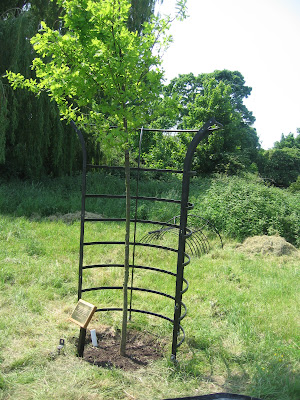
A Diamond Jubilee Oak on the Common - A Royal Gift from Prince Philip


In 1897, a sapling oak was planted on Common Road, Eton Common (in Eton Wick) to commemorate Her Majesty Queen Victoria's Diamond Jubilee; the oak, which thrived and is now a splendid specimen, came from the forestry department of Windsor Great Park.

In 2012, the Eton Wick History Group commemorated Her Majesty the Queen's Diamond Jubilee by planting a young oak some seventy yards from the one referred to above; and His Royal Highness, The Duke of Edinburgh, kindly agreed to let us have a 10' 0" (3 metres) sapling from the Crown Estate.

The Oak Tree planted to commemorate the
Diamond Jubilee of Queen Elizabeth II in June 2012


As I write this, I know that the oak has been set aside for us and we have only to make arrangements to collect it at an appropriate time for planting; but before obtaining suitable transport and agreeing the date for planting, we have first to acquire a steel fence guard to protect the young tree from cattle (it will be planted just inside an area where cattle graze). Our local Councillor, Peter Lawless, has kindly authorised a grant to cover the cost of the heavy-duty metal tree guard. We hope that shortly we will be in a position to announce the date of a formal planting ceremony. 

John Reid Chairman — Eton Wick History Group 


Lord Waldegrave of North Hill, Provost of Eton College
with the Mayor and Deputy Mayor of Eton Town Council

Lord Waldegrave undertook the ceremonial planting of the Jubilee Oak.


Monday, 4 January 2021

From the Parish Magazine - Eton Wick History Group Meeting - An Everyday Story of Farming Folk

On the 16th September 1998, the Eton Wick History Group heard how, at one time, four of the farms in the village were farmed by Tenants. Peter Tarrant, who worked not on a farm but at the Airport, was the guest speaker - he had spent much time researching his family's history and was able to tell his audience that his family had been associated with farming since the late 18th Century. The origin of the name 'Tarrant' was De Trent' (c.1100); and early Christian names were often Reginald and ralph. His family tree diagram clearly showed links between the various Tarrants.

It was most interesting to see maps showing the original layout and names of fields in the area, and to see 'turn of the century' photographs of various farms and cottages and compare them and their surroundings (many Elm trees then) with the way they look today. There were photographs of haymaking in the 1920's; and how nice to see the beautifully thatched round ricks; to see the old threshing machine by the Dutch Barn (in 1948) when the threshers would move in at the appropriate time and sleep in barns wherever they happened to be working. To the non-farmers in the audience, it was perhaps a surprise to hear that, in the past, every tenant farmer had to scour his ditches by 30th November, hedges had to be trimmed or layered by 1st November, animals had to be branded (no substitutes allowed), and farmers were allowed to grow 5 acres of turnips in every 20 acres they farmed.

Hammer Stannett - the last Hayward.

We all know now about the Hayward - he was paid 6d. when the cattle were turned out (apparently not until after 6.00 p.m. on 1st May each year) and 4d. per week after that, and no-one was allowed to stop the cattle from grazing. There were about a dozen dairy farmers up until the 1930's and we heard tales of cattle eating wild garlic and subsequent complaints about garlic-flavoured milk!

Mr. Tarrant was able to outline the history of many of the farms in the area; and not just the farms but also the tracks which run through them. For example, the one from our Common Road through the fields to Common Lane at Eton is called 'The Meads'. If you follow the Meadow Lane track right through to Boveney - where it reaches Boveney it is/was referred to as a turnpike.

During the War, prisoners of war used to work on farms in Eton Wick; and, as a reminder of those times, Mr. Tarrant had brought with him some memorabilia including the head of an anti-aircraft shell, part of an incendiary bomb and some brass cannon cases. He described the posts and trenches in the fields - constructed to prevent glider landings.

We saw pictures of the 1947 floods and the severe snow of1963; and heard about Bob Bond's haystack burning down; and the barn which was blown down in 1987, which was also when the roof was blown off Mr. Tarrant's father's cottages.

Then there were the chickens; Mr. Tarrant senior had bred chickens for show as well as for egg production - specialising in Buff Orpingtons and Silver Lace Wyandottes. The final photograph was a beautiful sunset - seen beyond some Elm trees.

Frank Bond thanked Mr. Tarrant for his fascinating talk and highlighted the 9th December meeting when each member is asked to bring one item of interest for a 'MEMBERS' EXHIBITION'. The Committee invited suggestions for the 1999 programme.

During the 1990's the Parish Magazine of Eton, Eton Wick and Boveney reported on the meetings of the Eton Wick History Group. A member of the audience took shorthand notes in the darkened hall. This article was published in the November 1998 edition.

Tuesday, 15 December 2020

World War 2 Eighty Years On - December 1940


Wednesday December 4th.

At about 8 pm. bombs fell on the G.W.R. goods yard at Windsor. Damage to coal wagons scattered timber, coal and trucks over a wide area. One wagon thrown into the air was propelled with its contents onto the roofs of the neighbouring buildings. Shops in the Goswells and Bridgewater Terrace, Windsor were damaged, also windows in Thames street were shattered by the blast. Two bombs fell on Eton College buildings, one on Savile House in Westons Yard, the home of the College Music and Choirmaster Dr. Henry Ley. The other bomb fell just outside the entrance to the Headmaster’s room. This bomb was of delayed action, its presence not being discovered until several hours later. The first bomb exploded on impact causing severe damage to Savile House, one of the finest college buildings. It was fortunate that Dr. Ley had been detained on some minor business which had delayed him going to dinner as the dining room was completely destroyed.  

Two residents of Eton Wick, Eva Bond, and Mr Cox were at the college during the evening. Frank Bond describing the bombing said his sister Eva was employed by Dr. Ley as a servant and was working at Savile House that evening. Several bombs had dropped around the district but on hearing of the Savile House bomb I cycled furiously to Eton only to be forbidden to venture past college corner. Unable to get any information as whether there were casualties, I return home to Eton Wick. Long after my returned Eva, covered in filthy brick and plaster dust with matted hair came home in a very disturbed state. Also in the house was a young girl evacuee who, fifty years on, wrote to Eva recalling memories of the night of near disaster (Frank Bond)

Reporting later on the bombing of Eton College said that a high explosive bomb had fallen in the front garden of Savile house, residence of Dr. Henry Ley, the College Presenter. Adjoining property was damaged and windows were broken in in the buildings in Westons Yard. Fire also broke out in Savile house. Sometime later a time bomb was discovered by Mr E. Bendell, the school clerk, outside his office in the colonnade. After the alarm was raised, staff salvaged many valuable papers, books, and important records. Everyone in the vicinity were evacuated. Later when the bomb exploded stained glass windows in the chapel were broken or damaged. Damage was also sustained to the school office, the roof, and an outside wall of Upper School. Upper School built in the reign of Charles II by Christopher Wren had the names of many Etonians carved on its walls and efforts were made to collect as many pieces as possible with the view to restoration later.

Mr Cox was doing fire watch duty that evening at Walpole House, where he witnessed the following incident involving a boy who had gone for extra tutoring to another house. Returning late from this tutorial after lock up, he found his House Master, H.K. Marsden, waiting in the boys’ entrance as he entered. Within Mr Cox's hearing, the boy was given a severe dressing down. He was covered in dust but just replied “I have just had a very bad shock, Sir”, which was putting it mildly for he was on his way back and just passing the Memorial Hall when the bomb fell in Westons Yard demolishing part of the Music Master’s house and school office near the Chapel. Needless to say that once it was realized what the boy had been through he was taken care of. Mr Cox said how much he admired the young boy for the way he handled his ordeal. (Daphne Cox.)

Chapel. Needless to say that once it was realized what the boy had been through he was taken care of; Mr Cox said how much he admired the young boy for the way he handled his ordeal. (Daphne Cox) 

Evacuated to Eton Wick, George White remembered vividly the night Eton College was bombed. "I was cycling home in the dark from the cinema at Slough; suddenly, when about a half a mile from Eton, the air raid siren sounded and within a very short space of time huge high explosive bombs fell in the direction of Eton. I threw myself into a ditch at the side of the road and after possibly a minute I looked around me and saw dozens, maybe hundreds, of incendiary fires from incendiary bombs all across the fields and in the roads etc. (George White) 

December 5th. 

The unexploded bomb (UBX) which fell in the College Colonnade caused several difficulties necessitating parts of College to be evacuated and the main road to Slough closed to traffic. Later in the evening the bomb exploded causing much damage to Upper School fortunately there were no casualties. Following the bombing of Eton a letter to A.A. Command from the College Provost expressed the view that the method of A.A. defence was unskilful. There was anxiety that College buildings would be destroyed by the Anti-aircraft guns firing at enemy raiders that were merely passing over head and he was sure that falling shrapnel would cause damage to the buildings as well as being dangerous. It was of no importance where the guns were positioned as long as they did not fire, as the firing of the guns could scare the German pilots into dropping bombs on Windsor and Eton. 

Throughout December the bombing onslaught continued on London and other towns and cities throughout Britain. Whenever enemy aircraft ventured over the district came within range the anti-aircraft guns at Datchet, Burnham, Windsor Great Park and Dorney went into action. The barrage of exploding shells and occasionally exploding bombs drove some household pets and farm animals wild. Mrs Miles recalled having to take her dog to the vet to get tranquilizers for him as he would tear madly around the house madly when the guns on the common were firing. Village residents had a fear of shrapnel from the exploding shells causing casualties as well as damage to their homes, but none were ever reported from this source. 

21st. December

During the evening of the 21st. December two high explosive (H.E.) and one delayed action bomb dropped on Kinross's farm in the Windsor road Eton, causing no damage or casualties. The bombs had dropped close to the College tennis courts, one of which exploded leaving a crater 22 yards across; this was filled in with rubble by Alf Cook and Amy Armstrong, the College carters also included from previous bomb damage, utensils from the boys bedrooms. The second H.E. bomb failed to detonate and was listed as an U.X.B. (unexploded bomb). This bomb became the subject of a request from the army to the farm foreman to pull it out with the tractor. His reply in no uncertain terms, told the Army what they might do with it, and for all that is known, it might be still be there - future golfers might get a surprise!. An incendiary device also burnt out the rick yard (Jim Kinross)

A legacy from the late Sir Sydney Herbert, an old Etonian, enabled Eton College to purchase Manor Farm at Eton Wick with all its buildings, including the rights of the Manor of Eton including the Manor and its lands. This completed the package of lands bought by the college in 1929 with the help of the Eton Land Fund. Lands of the farm are scattered over South Meadow, Athens fields near the river and land near to the railway arches. With the requirement of Manor farm and the ownership of the other lands there about, it was professed that the amenities of the surrounding district would be preserved the history of the Manorial Rights and Customs of Eton gives protection as to the use of the Little Common and the Large Common that stretches from Common Road to Eton Wick. A number of fields, including the Eton College playing fields of Mesopotamia, Racket Court Field and South Meadow are subject to Lammas Rights. This gives the right to those freeholders and tenants to graze their cattle on those fields from 1st. August to the 31st. October.

Under the emergency powers given to the County War Agricultural Committees some of the common and lammas lands were taken for arable crops. The demand for food production on the home front became urgent as an increasing number of merchant ships bringing food supplies were lost to attacks by German U-Boats. Conscription and membership of the Territorial Army had taken some farm labourers from the land before it became a reserved occupation. Land Army Girls, Prisoners of War, Service personnel, Eton College boys and other volunteers were employed or gave help on local farms and horticulture holdings in the drive to produce more home-grown food.

Towards the end of the year 262 Battery left Dorney Common to be replaced by another battery and the relieving troops were probably from the London Scottish Territorial A.A. Regiment as the skirl of Bagpipes through the early morning mist is a memory of Peter Morris whilst picking mushrooms on the common.

The pipers were a complete contrast to the Burglar of 262 battery whose reveille awoke those living near to the camp. The change to the so-called skirl of the pipes had Daphne Cox as a child, asking what the horrible noise was. On occasions a column of troops from the camp with the pipers in the lead would march through the village en route to Windsor.

The tented troop accommodation of the Dorney Camp was being replaced with more permanent buildings in the form of Nissen Huts enabling the resident battery to invite the village children to a grand Christmas party. This was due to the kindness of the Commanding Officer, Major Highton, and Captain Sawyer. The party was organised with military precision, each child having a label attached to their coat and arm. The battery chefs laid on a tremendous feast. One child on seeing all the good things to eat declared to the Major, "Sir, I can hardly wait". The N.C.O.s, Officers’ wives and other lady helpers became the waiters for the feast that had been laid out on two large tables. A decorated Christmas tree, Punch and Judy Show and singing with musical accompaniment entertained the young guest. To the sound of Bugles everyone left the hut to greet Father Christmas who arrived by army lorry accompanied by the blackest clown playing a banjo and the children all received a present and a silver coin from Father Christmas.     

Air raids on British cities culminated in a heavy incendiary attack on London on December 29th. 1940 and these fires in the City area lit the sky with a red glow that was visible from Slough. The damage wrought to the buildings by the firebombs during this raid brought a Defence Order for men of 16 to 60 years to register for fire watching amounting to forty-eight hours a month. All factories, shops and offices were to station firewatchers to combat the serious threat from incendiary bombs. Men from the village working on the Trading estate were expected to do fire watching at their place of employment. Firewatchers and plane spotters were also stationed on the roof of factories to ensure that as little interference to production as possible occurred during air raid alerts. Warning to take shelter being given to those working when danger seemed imminent. Married men often entices the young single men to do their turn of night fire watching with an inducement of three shillings (15p).

This is an extract from Round and About Eton Wick: 1939 - 1945. The book was researched, written and published in 2001 by John Denham. 


Monday, 5 October 2020

The Eton Wick Newsletter - August 2018 - `Our Village' Magazine


Village roads, tracks and vehicles

Increasingly it seems our public services are finding it difficult to meet their purpose. Almost daily our so-called news is not in any way news, but a demand for more money to be poured into Health Services, Schools, Police, rail and roads. In many respects I think we are fortunate in Eton Wick: we are still surrounded by countryside; have pleasant walks; and still within a convenient distance of towns, rail stations and airports. At times there is a traffic build-up along the road to Eton, which is probably more of a nuisance to Eton than to the village.

There had been rumoured talk, and maybe suggested plans, to divert some of this traffic away from Eton College, but probably nothing more than wishful thinking at present. If this did become a reality I personally think it could be detrimental to Eton Wick, as more 'through traffic' would consider today's present deterrent of congestion through Eton to be no longer relevant. Be that as it may, the future is not ours to see, and at my age not to get bothered about. A bit like the bungalow in Sheepcote Road named 'Byjia' meaning "B.... you Jack, I'm alright!' 

Let us then look back on early Eton Wick roads. I know of very little written about them, so using what we know, and a common sense of deductions, we can conclude that roads locally often originated as tracks, were often very muddy, and at best used by pedestrians, horse riders and horse traffic — most frequently farm carts. There were four of these routes East to West and West to East, and three others North to South and vice versa. Additionally, there were probably two others; the present named Moores Lane to Cippenham, and another from the Great Common to Chalvey. The through roads East to West were our present main road variously known as the Eton Wick Road, or the Dorney Road (now B3026).

Secondly, we have the track Dr. Judith Hunter described as the King's Highway. Undoubtedly old, this track is from the village hall, then south past Hayward Mead houses, past the Scout H.Q. and on past Cuckoo Weir; Eton's Meadow Lane; and terminates at Brocas Street for Windsor Bridge. Interestingly about 200 —300 metres from the village hall this track is diagonally met by another track that starts in Boveney Village, passing north of Boveney Lock and crossing the Boveney Ditch at Splash Bridge, then on to join with the aforementioned South Field track. Given the age of Boveney, this route to town may well be our oldest. In the 20th Century this was indeed a 'splash bridge': horses or horse vehicles would be led through the stream, and rider or carter could hold the bridle and keep control while walking across the plank himself. Many villages will remember floods sweeping away the plank crossing, and today's bridge replacing it in 1993. 

Our third west to east road was perhaps only ever much used by farmers, and like the South Field track just mentioned was never given a modern road surface;. destined for ever to be a relic of bygone times, being then seasonally dusty, muddy and very rural. Number three then is 'Inner Wards' and extends from Common Road, north of the Common stream, to Eton College's Common Lane. This route to town would have served Saddock and Manor Farms, and of course give access to the open land between Eton Wick and Chalvey. 

The fourth west to east road is quite different, as it is not a through road, but a village road along which most of the early village was developed for homes. This of course is Common Road, probably only 600 to 800 metres in total length and for much of its length immediately south of the Common stream, which undoubtedly accounted for the early near development. From the west of the Great Common (narrow strip) it extends along the Common for about 200 metres and then turns north, terminating at Little Common. (Little Common is next to the motor museum). Any other east west roads in the village are less than 130 years old and are estate or housing access roads. 

The oldest north/south roads were probably all access roads for the local farms. The Common Road (west), formerly Brown's Lane, gave access for Dairy Farm (formerly Wick Farm) to the B3026. Bell Lane gave access to Bell Farm, which incidentally also connected with the start of the old King's Highway track. Some maps show, at the junction of Bell Lane and the B3026, the road was gated. Presumably as a precaution preventing cattle straying. The third north/south road was Sheepcote Road. This was gated at the north/Common end. I remember Sheepcote Road as a straight and very muddy track with a single row of five or six terraced houses appropriately named Castle View Terrace. There were allotments opposite the houses, and below the school. No flats or bungalows. This was truly a farmer's track from `Saddocks', 'Manor' and 'Little Common.' The 'Walk' road was probably not developed until mid 1800's, from a foot track used to access the Greyhound pub. Other village roads were made when the area was developed for homes, and like so many places never built to cope with motor traffic on today's scale. 

How wrong we are when we say that nothing changes. As technical boffins are busily making workers redundant with their ever-advancing automation and robots, concern is at last being expressed for the countless truck and van drivers who may not be needed when driverless vehicles become the norm. Once invented, nothing takes long before it takes over.

In 1907, just 111 years ago, and 25 years after the first motor engine was developed by Benz, villager Ted Woolhouse bought a De Dion car; the first known motor car for Eton Wick. It was quite a year for Ted, believed one of at least four brothers, as in 1907 he opened the village's first cycle shop, using the front room of what is now 56 Eton Wick Road. This was the age of high upright bikes with straight handlebars and carbide lighting. Battery lamps were to come later. Ted assembled Royal Enfield cycles for sale, and with repairs and hiring at two pence an hour, he earned a living until after WW2, over forty years later. This was of course interrupted by at least two years army wartime service, following the Conscription Act of March1916. The first two years of the 1914 - 1918 war produced sufficient voluntary man power. 

Only twelve years after the first car for Eton Wick, the village was petitioning for motor vehicles going through the village to be restricted to 10 miles per hour, and at this same period a huge dump of ex-army war vehicles was created at Slough, on a site later developed as The Trading Estate, forever referred to as 'the dump'. This should not give the impression of considerable car ownership. Not until well into the second half of the 20th Century, and quite forty years later, was this the situation. As an early 1930's schoolboy walking to Eton Porny School we often whipped Meg or Tee Tops along the main road to the rail viaduct, or played 'flick on' with fag cards along the footpath kerbs, and considered the occasional car a nuisance to our games.

Pre WW2 the local 'big day' of the year was the College's 'Fourth of June'. This was the one day when many luxury limousines; often with liveried chauffeurs, parked along the college area roads. That show of splendour has never been equalled since. 

In 1934 my brothers were ball playing along the road close to the 'Three Horse Shoes' pub (now a residence: 'The Shoes' no. 44 Eton Wick Road), when King George V's car drove through the village. Of course it was obliged to stop, on account of my brothers. Before Windsor Bridge was closed to vehicular traffic, in the early 1970's, it was not uncommon for V.I.P's enroute to Windsor to drive through Eton Wick. On this occasion my Mother came in for local tongue wagging, for letting her boys hold up the King. 

It was about this time that families who were lucky enough to own a wireless set (not then known as radios) would tune in to hear Hitler addressing the German nation. None of us understood a word of his speeches, but undeniably there was something riveting about his ravings. At least I thought so, until on one occasion he declared that the day would come when all German families would own a car. At this I thought he must be mad, no working man would ever afford a car. Of course, this prophesy was probably the most accurate thing he did promise. 

A contemporary of Ted Woolhouse was Norman Lane. He too served as a young man in the Great War of 1914-1918. Norman served in the Royal Flying Corp which became the Royal Air Force on April 1st 1918. Wireless sets were not available, or did not exist when that war ended, and in 1923 Norman and Bill Brown (ex-army) assembled a 'cats eye' receiver and claimed it as the first wireless in Eton Wick. Again, in a few years most homes had a wireless; be it second-hand or new, all were big, temperamental, and had a large dry battery and an accumulator battery that was collected weekly for re-charging. If electric radios had been available they would have been useless in Eton Wick until 1949-1954, when the village first had electricity, which slowly became installed in homes.

It would appear that whatever is new soon spreads until everybody attracted to the novelty puts it on the 'must have' list, and in this respect, nothing changes. 

Frank Bond

A portrait of Frank Bond by Ben Gower

First published in Our Village in August 2018


This article was originally published in the Eton Wick Newsletter - Our Village and is republished with the kind permission of the Eton Wick Village Hall Committee. Click here to go to the Collection page.

Monday, 3 August 2020

The Eton Wick Newsletter - December 2017 - `Our Village' Magazine


Ten Years Old - or maybe sixty eight

Yes, this issue of 'Our Village is number 30 and marks the tenth anniversary; but It was born of an Idea In 1949 that this rural, post WWII village should produce a 'one off magazine of Eton Wick news. It was named 'Our Village' and was in fact produced again In 1950. Those two earlier Issues were produced by duplicator and sold at six pence (21/2p today's currency). Articles covered The Village Hall; post war village development; sports; youth club; poems etc., All of course much influenced by the gradual return to normality after the long six years of war and shortages. 

To mark our anniversary we have selected one of those earlier items: 

'Our Heritage' by Florence Ivy Wilson' (1950) 

When I first came to Eton Wick I was told by a man from Windsor that the people of this village were originally those who had flitted from Windsor because they could not pay their bills. I am sure this Is a libel, but if it Is true, then it happened a long time ago, for there was undoubtedly a settlement here in Saxon times, and some Saxon customs are still in use today. Early records are few, but as Canon Shephard tells us in his book 'Old Days of Eton Parish' many of the local names are from Saxon origin. Shot, butt, ward, croft, weir, all these are Saxon terms. 'Wick' is a hamlet, 'ton' a village surrounded by a palisade, (in this case no doubt the river) and leyof is an island. Eton (Ey-ton) therefore means the island town. Bufan means 'above' from which the name Boveney is derived, and Domey comes from 'Donna' which means bumble bees, and Is the bumble bee island (Has anyone been stung lately). 

What was the place like in those early days? We can form some idea, in spite of the scarcity of written evidence. It was certainly much more thickly wooded, for later, when the Domesday Book was written In 1086 it is said that there were woods and copses to feed 200 swine. The river must have been very different then, for there is evidence that the main stream has considerably shifted its course, and in those days it was probably several intersecting streams flowing round a number of islands, on the largest of which Eton itself was founded. Salmon and Lampreys were among the fish caught and trapped, and eels were plentiful. Domesday Book mentions 1,000 eels (in Mill Pool at Deadman's Hole). 

We know that the Manor of Eton belonged to Queen Edith who was the wife of Edward the Confessor and sister to Harold who was killed in 1066 at the Battle of Hastings. She would probably have had a Steward or Reeve to safeguard her interests. Doubtless many a basket of eels, many a fine pig, horse or sheep, together with honey from his wife's bees, and butter and cheese from their dairy would have had to find their way to the old Saxon Palace at Old Windsor. A Hayward would have been appointed to safeguard the hay crop and care for the cattle, and disputes would have been settled at a Court Leete before an open Jury. 

This Court Leete was revived by Eton College in January 1947, they, having acquired the Manor Farm at Eton Wick and with the rights of the Manor of Eton. The temporary bailiff, Mr Bob Bond, swore in the jury who then confirmed him in his office and Mr John Pass was then appointed Hayward. Various matters of dispute were settled regarding the upkeep of hedges and ditches abutting on the Commons, and the number of cattle to be grazed. Long Common and Little Common and the Common rights which entitle households to graze an agreed number of cattle are still jealously guarded from these early days. 

Lammas rights come down to us from the 7th Century and have undoubtedly saved us from a lot of indiscriminate building. Lammas Day was the first day of the grazing season after the hay crop, and the name is derived from Loaf Mass or Bread Feast. In Saxon times the day was kept as a day of thanksgiving for the first fruits of the harvest. It is interesting to see Mr Tom Bond and his family working their land by the Eton Wick Road and to think that the organisation of the fields retains a link with the past which has been unbroken for the last thirteen hundred years. 

The above article is printed exactly as it first appeared sixty seven years ago, and perhaps reflects the old rural interests of that time, and the more active relevance of Lammas. Probably John Pass was the last of so many Haywards, and although Bob Bond may have been succeeded by other Bailiffs It is not considered necessary for us to know, and we for our part do not consider it necessary to enquire. 

Long Common is variously known as The 'Great' or Eton Common and reaches from Eton's Common Lane, through the village to the two bollards approaching Bell Lane. Little Common is quite separate and approximately 300 plus metres north of Sheepcote Road, (by the Motor Museum). The land worked by Tom Bond was the large South Field opposite the Church of St. John the Baptist. He only had the land In the early post WWII years and used it to grow currant bushes and fruit trees. Neither of course acceptable had it been Lammas designated land. The land was later sold to Eton College and is now mainly mono cropped. 

*Deadman's Hole is perhaps last shown on local maps of the pre 19th Century. It was situated close to the water course we know as Cuckoo Weir and Just north of 'Chinese' or 'Long Bray Bridge'. Often In river terms a 'hole' indicates the area Immediately down stream of Eyots (Islands) or promontories. I.e. Boveney Hole is just upstream of Boveney Church and Andrews Boathouse. 

Florence Wilson was a very good Councillor of Eton Urban in those post war years and helped influence the present day larger 'Eton Wick'. She was on several village committees from Village Hall, Women's Institute and Treasurer of the Youth Club. She also wrote plays using the pen name of Ivy Brides, an adaptation of her maiden name Florence Ivy Briddes. Lammas lands and Lammas law must still be relevant today, but with a much changed residency in old Eton Wick, together with the loss of most active farming, apathy has replaced the diligent adherence to all things Lammas or Commons. 

Frank Bond 


This article was originally published in the Eton Wick Newsletter - Our Village and is republished with the kind permission of the Eton Wick Village Hall Committee. Click here to go to the Collection page.