Showing posts with label Census. Show all posts

Monday, 10 January 2022

Eton Wick 1921 Census - A First Look

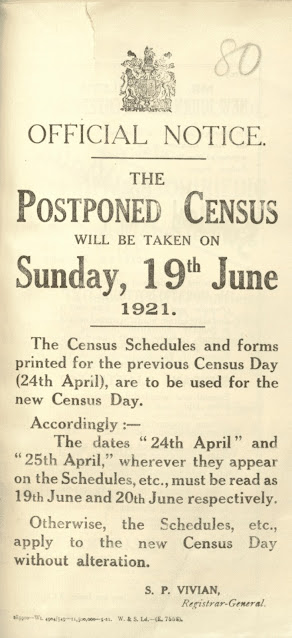
Poster courtesy of The National Archive


On 6th January 2022 the UK census taken on 19 June 1921. A first glimpse of the available data online reveals that there were 524 people living in the area between the Railway viaduct and Parish boundary along Bell Lane. The area of the Eton Wick Parish Council. Further investigation will be undertaken when more information becomes available. 

6" OS Map revised in 1910
courtesy of National Library for Scotland

The Eton Wick Census Project pages can be found here.

Sunday, 29 September 2019

World War 2 Eighty Years On - The 1939 Register for Eton Wick

With in a month of the Declaration of War by Neville Chamberlain in 1939 a record of every household in the UK was taken. The Register was taken on 29 September 1939 and the information was used to produce identity cards and, once rationing was introduced in January 1940, to issue ration books. Information in the Register was also used to administer conscription and the direction of labour, and to monitor and control the movement of the population caused by military mobilisation and mass evacuation. The Register was designed to capture the details of every member of the civilian population – military personnel were not recorded. It contains details of around 40 million people, recorded in more than 65,000 volumes (transcript books). 
A house in Prospect Place

The enumerator for Eton Wick recorded the names and details of 1,294 people in 313 households. Emma Woolhouse was the oldest person living in the village, she was 94 years old. Emma's first two homes in the village after marrying Thomas Woolhouse was at 8 and 2 Prospect Place. The 1939 Register records that the 10 houses that made up Prospect Place were empty.

The youngest child on the Register was Joan Tarrant who was 1 month old.

It should be noted that the 1939 Register recorded Eton Wick and Boveney New Town as one community following the Local Government Act of 1933 that brought to an end the separate councils for the two neighbouring communities and created Eton Urban District Council.

The Register includes the extra war time duties that residents had volunteered for. There are a number of closed records in the 1939 Register that has been released by the National Records Office. Local research has been able to add a further 13 names to the information available in the Register. 

You can view a transcription of the 1939 Register for Eton Wick by clicking on this link. or pasting this URL in to your internet browser: https://drive.google.com/open?id=1F18eOrMdf9OV_HyEbC1Sq2zOqg8YGpuxTzLX4FIdTO4 


Given Name Surname Extra duties
William Akers Auxiliary Fireman Eton UDC
George Ball Special Constable
Henry Barton Auxiliary Fireman
George Batt Police Messenger
Harry Batt Special Constable
John Bell Special Constable
John Bidmead Auxiliary Fireman
Charles Bond Ambulance Driver
Frank  Bond ARP messenger
Albert Bond ARP Warden
Eddie Bond Police Messenger
Ernie Bond Police Messenger
John Bow Ambulance Services First Aid Service Merthyr 
Laura Bow British Red Cross Nursing Services Merthyr 
William Brown ARP
David  Bryant Police Messenger
Edwin  Buckland Special Policeman
Harry  Burfoot Rescue and Demolition
Alice Burfoot Womens Volunteer Service
Harold Carpenter Auxiliary Fire Service Eton UDC
Henry Carpenter Auxiliary Fireman, Pump operator
Arthur Chamberlain ARP Air Raid Warden
Millicent A  Chantler Red Cross Nurse
Henry Chantler Air Raid Warden Eton UDC
Sylvia Chew ARP Ambulance Driver
Joyce Chew ARP Ambulance Driver
Archibald Chew ARP Joint Committee Evacuees
Miriam Chew Red Cross Civil Nursing Reserve
Annie Chew Womens Volunteer Service
Arthur Codd ARP Eton UDC
William Collyer ARP Windsor Castle
Harriett Cook Air Raid Warden Eton UDC
Albert Cooley ARP Road Repair Squad
Peter Cooley St John's Ambulance Nobel's Slough DIY Military Hospital
Ernest Drake ARP Senior Warden
Walter  Elkins ARP Warden
George Eyles ARP Warden (W. Thrupp Chief warden)
Douglas Eyles Police Messenger
Harry Friend Special Constable
Bob Friend Special Policeman
Mary Graham ARP First Aid
William Graham ARP Warden
Arthur Gregory ARP Warden Eton
Arthur Grubb ARP Emergency motor driver 
Lavina Hammerton Red Cross Nurse
Robert Heath ARP Services Somerset CC
George Hedges ARP Stretcher Bearer
Albert Hood Ambulance Driver
Lilian Husted Red Cross Nurse Enrolled for training
George Jacobs Demolition Squad(?)
Marion Johnson Air Raid Warden
Henry Johnson Auxiliary Fireman
George Kelley Special Constable
Peter Kemp Sgt. RAF VR no. 74097
Arthur Lane Special Constable
Norman Lane Special Policeman
Jane Mc Millan Red Cross Nurse
Frederick Mead Air Raid Warden
George Mills Retained Fireman Eton RDC
Richard Mitchener Auxiliary Fireman Reading
Thomas Morrell Rescue and Demolition Slough Borough Council
Albert Morrell Special Constable
Reverend Morris ARP Warden
Maurice North Auxiliary Fireman
John Oxlade ARP Rescue and Demolition
James Pass ARP Decontamination
Albert Prior Rescue and Demolition Eton UDC
John Prosser Special Constable
Ernie Prosser Special Policeman
Robert Pulvertaft Emergency Medical Service
Caroline Schafran Helper under evacuation
William Swain Auxiliary Fireman
Reginald Talbot Auxiliary Fireman Eton UDC
George Tarrant Special Constable
Ernie Thomas Special Policeman
Florence Thurston British Red Cross Nursing Auxiliary
Robert Weatherall Air Raid Warden Part time Eton Urban and South Bucks Councils
Ken  Weller ARP Messenger
Hubert Wells Eton Fire Brigade
Edward Wilkinson ARP Warden
Harry Wilson ARP messenger
William Woolhouse ARP
Ernest Woolhouse ARP Demolition Eton Wick


This article includes information from The 1939 Register, Frank Bond's articles in Our Village and Round and About Eton Wick: 1939 - 1945. 

Wednesday, 17 April 2019

Eton Wick Census 1911

The United Kingdom Census of 1911 was taken on Sunday 3rd April, that year and was the eighth of the UK censuses to include details of household members. The total number of persons returned as living in England and Wales at midnight on Sunday, 3rd April, 1911, was 45,216,665. This shows an increase of 3,757,944 upon the number enumerated on 31st March, 1901, and gives a decennial rate of increase of 9.06 percent. The 1911 Census is the first that the forms that were completed by each household are records made available by the National Records Office. Previous Census records that have been released are the books completed by the Enumerators.

Details collected include:

Names of each person who was resident in the house on the night preceding the census.

Relationship to Head of Household.

Age and sex of each person: The actual age in years or months for babies under one year are recorded in the 1901 census.

Particulars as to marriage.

Rank, Profession or Occupation.

Birthplace, county and country.

Whether Blind, Deaf or Dumb.

Place: street name, house number or house name.

Houses: inhabited, uninhabited or a building and the number of rooms.

The Superintend Registrar's District was Eton, Bucks and the Registrar's district was Eton. Enumeration District No. 6. There is no signature of the enumerator visible.

The area for the 1911 census included was the entire parish of Eton Wick. There is no further description of the area covered

The 1911 Census reveals that there were 147 households and 527 people in residence in the village at midnight on the 3rd April. The oldest person, Esther Wheeler at the age of 89, she was born in 1822. Her husband, William was 87.  Eda Alice Talbot and Felina Brades were both one month old, there were four children born in the first three months of 1911 within the civil parish of Eton Wick.

Click on this link to see our transcription of the 1911 census records for Eton Wick. We will be looking deeper into what the census reveals about Eton Wick and publish our findings in future articles.

Consolidated Census spreadsheet.

Wednesday, 3 April 2019

Woolhouse Family of Eton Wick

The Woolhouse surname was recorded in the 1841 Census and every national survey up unto the 1939 Register. There is evidence that the family had been living in Eton Wick or the Parish of Eton at the start of the 18th century. Woolhouse is the surname with the longest continuous name in the available records.

From 1841 census through to the 1939 Register there appear to have been 35 people with the Woolhouse surname. From William who was born around 1780 and was living at No.2 Prospect Place in 1851 with his wife Sarah to Edward, born in 1916 and was living in 6 Palmers Place in 1939 there is a connected story. Across the 98 years of these records they lived in 15 houses, the family were tenants of No.2 Prospect Place for more than 40 years.

From working on the land to running a business making and repairing bicycle; sawyer to builders foreman the family's employment is a reflection of the changing opportunities for work that the residents of the village had on offer during this period.


.
The Woolhouse Family of Eton Wick from 1841 to 1939

WW1 artifacts belonging to William Woolhouse are held in the Windsor Museum collection. The 1939 Register records that he was married to Eunice and the live at No.5 South View. This is one of the 'Homes for Heroes' built just west of the Windsor to Slough railway branch line. After being a Prisoner of War he became a tenant of the new house in 1925.


Wednesday, 22 August 2018

Trade and Commerce Grows in the Late 19th Century

Eton Wick at the end of the nineteenth century was a very different place from that at the beginning, and not just in terms of bricks and its population had risen from about a hundred people to well over eight times this. Many new families had moved into the village - none of the surnames recorded in the early parish registers as belonging to Eton Wick (1640s-1740s) was there a hundred years later. The first house-to-house census was taken in 1841 and the Enumerators' Schedules Books for this and the following three census years give the names and many other details of everyone living in the village at those dates. Several names found in the books are still familiar today - Ayres, Benham, Cooley, Deverill, Hammerton, Miles, Newell, Paice, Prior, Stacey, Woolhouse and others. Few families, however, were constant members of the village, and though some moved only short distances and sons and daughters returned when housing or employment made this possible, others stayed for only a few years. The majority of newcomers came from local villages and towns, but there were people from almost every English county and even Ireland.

This village of the mid-nineteenth century was still a very rural one with at least a third of the men working on the land - farmers, market gardeners, labourers, cowkeepers, jobbing gardeners and pigmen. It was very much a working-class community; more than half the men were either farmworkers, labourers or servants earning perhaps no more than £26 per annum. A rather smaller number were craftsmen - plasterers, coopers, sawyers, bricklayers, cordwainers, a blacksmith and a wheelwright. Most of these must have worked outside the village, except the wheelwright, William Simmonds, for his workshop was behind the Grapes. He must have been a very enterprising person, turning his hand to many trades, for in the twenty years that he is known to have lived in the village he is recorded as beer retailer, carpenter, wheelwright, builder, grocer and coal merchant.

This was a village without any very rich or very poor for the Census Schedules revealed none that were so destitute as to be classed as nor any that belonged to the privileged class of ‘gentry'. The richest members were undoubtedly the farmers of the two largest farms, Saddocks and Manor. In an era when the employment of servants was essential to show that one was above 'the poor and labouring' classes very few in Eton Wick could afford even one living-in maid. Only the Goddards of Saddocks Farm could boast three servants - a governess, a housemaid and general servant. In this household, besides the family with its seven children and the servants, there was also a farm hand living in. Saddocks was large enough by Victorian standards to house them all adequately, but others were by no means so fortunate. A family of nine including grown-up sons and daughters, as well as younger children, somehow managed to sleep and feed in one of the cottages of Prospect Place which consisted of only the one room up and down. More tragically, a mother and five young children were forced to spend at least one night, that of the 30th March 1851, sleeping in the backyard of a neighbouring cottage, having been 'kicked out of house and land'. Not many households in the village, however, were as large as these, in spite of the fact that families were larger - nine or more children was not uncommon - but the elder ones had usually left home before the youngest were born. Infectious diseases also killed many babies.

There must have been scores of villages not very different from Eton Wick, but in one respect it was unusual. This was in the number of working women. There was no question of a choice between marriage and a career, or between a career and a family. On reaching their mid-teens most girls of working class families left home to go into domestic service - to make room at home for the younger children, and because their parents were glad of one fewer mouth to feed and of the small savings the girls managed to send home. If they were lucky enough the girls would get married, and before they had many children, enjoy a few years when they could devote their energies to their own homes and families. Once several children had been born, then many of them found it necessary to turn their hand to any job that might add even a few pennies to the family budget. A few took on dressmaking or domestic service, or even working on the land, but the majority took to laundry work.

In few other villages of South Buckinghamshire were there such opportunities. This was almost certainly because of the proximity to Eton College. From about 1840 conditions at the College had begun to improve, resulting in the employment a greater number of people to attend to the needs of the boys and the staff. The College Laundry was built in 1881. Until this time all the school linen and boys' clothes were washed at small home laundries, no more than cottage wash-houses and sheds, mainly in Eton, Eton Wick and Chalvey. Undoubtedly, the women also washed for their more affluent neighbours and one, Elizabeth Kedge, of Eton Wick (she lived in part of the parsonage) reached the pinnacle as 'Laundress to Her Majesty'. By the end of the century five laundries were advertised in the trade directories - Frederick Burfoot of Alma Road, Mrs Haverley, Mr Sargeant, Mrs Sarah Miles and Mrs Lanfier of Albert Place.


With the laundries came other opportunities in the village. The 1830 Beer Act made it possible for anyone to open a beer house on the payment of a small sum to the Excise Officer. Within three years the Greyhound had received its first licence and a year later the Shepherd's Hut, and the Grapes in 1842. All three were cottages and probably at first sold the beer from a barrel in the kitchen. The licensees often followed another trade. William Simmonds has already been mentioned and David Deverill, beer retailer at the Greyhound in 1841 and 1851 was a labourer. He was succeeded by Isaac Deverill who had been living next door at Thatch Cottage as cowkeeper and dairyman, but who in 1861 told the census enumerator he was a farmer and beer retailer. His son, James, was a greyhound trainer, possibly with Her Majesty's staghounds. Presumably because he was proud of his son's job, Isaac chose the greyhound for the sign of his beer house.


Curiously too the road leading to the Greyhound was named after the family. For many years the road was known simply as Deverill's walk which in time was shortened to The Walk. Not all the beer retailers appear to have bothered with a sign and no mention of one has been found for the beer house run by William Woolhouse at Hope Cottage in the 1840s. At that date with a population of about three hundred the village had a choice of four beer shops and an inn - one for every fourteen families. No wonder in later years the church and chapel found it necessary to fight for temperance.

It is not known when the first shop in the village was opened, but it is likely to have been about this period. John Kirby was in 1846 and is to have lived at Hardings Cottages.  But he did not prosper for long and there was not to be another shop in the village for some years until William Simmonds opened his grocery sideline at the Grapes. Then about 1870 John Kirby returned to the village and again opened a shop, this time at Ada Cottage. He was an old man now and after his death his widow carried on for only a few more years. However, a new tenant took over the shop, and by 1887 it was a bakery and Post Office run by Thomas Lovell. A letterbox stood next to the Three Horseshoes for many years. Almost certainly by this date there was a second shop in the village, another converted cottage - Welman Cottage, or Thames View as it later became known and now Baron Stores.

There were to be no more shops in the village last century, though the rapidly growing area of New Town was almost immediately served two shops. Isaac Crabbe used his front room in the end house of Garrad Place as a general store. Mrs Elizabeth Burfoot was the other shopkeeper and probably was the first to serve at Shakespear Stores (2 Alma Road). Undoubtedly right from the first years Alma Road was the heart, the main street, of New Town; here besides the laundry and the shops were two small businesses. Perseverance Place had been built to the requirements of George Howell, maker, painter and decorator; his workshop adjoined the house. This building has been demolished, but many people remember when the house was used as a surgery. In the 1870s Henry Burfoot had only been a bricklayer living in a small cottage substantial workshop and yard behind. This is now K.G.B. Engineering Works. Henry Burfoot was more than a jobbing builder; indeed he advertised himself in 1891 as ‘builder and contractor, oven builder a speciality, hot range and boiler fixing’.

In the old village another enterprising person seems to have been Henry Elkins who lived in Albert Place in the last quarter of the nineteenth century. He had his own workshop and smithy, not by the house for there was no but on the other side of the brook in the triangular field known as Wheelwrights Yard. Of the other men who were their own masters three were connected with the roads - a fly proprietor who plied for taxi trade from Baldwin Bridge, a carman who hired out himself and his car, or long waggon, and an asphalter.