Showing posts with label Crime. Show all posts

Wednesday, 23 January 2019

The Story of Oliver James Stannett in his own word - Working With Horses

Dad came home one day and told Mum that they wanted a boy for 10/- a week to work between 7.30 and 7 - 8 pm. to clean shoes, cutlery, outside windows, scrub out two bars twice a week, take people's luggage to either Western or Southern stations and chop a certain amount of firewood. I did this and more for about six months until I got a whitlow on my finger so I got the sack.

Then Dad heard that there was a job going at Mr. Stillwell's stable at Clewer near Windsor race course. I got the job because I liked the horses. I was looking after a hunter, polo ponies, hacks, one stallion and one two-year-old racehorse which was being trained for racing. I must say a few words about Captain Vivien the two-year-old. The 'Guy' and I used to go on Windsor racecourse knocking a white polo ball about which I enjoyed. I asked the reason for it. He said, " To get the horses to learn to change legs as polo ponies have to do. " So I watched and they did, so there was no need for them to cross their forelegs in a race which would bring them down. I think being in the stables, the smell got into my blood and fetched me out in boils. At this time I had two on my neck and one on each cheek of my behind. I could not sit down but I did not tell the 'Guv' about it because I was managing very well until he said, "Saddle up the 'Cap. ' and we will have a knockabout." We saddled up and went to the course. The horse was a lot taller than the polo ponies so I had to reach down further and as I did both boils on my behind burst and it all ran down my legs, but what wonderful relief Funny thing is that I have not had a single boil since.
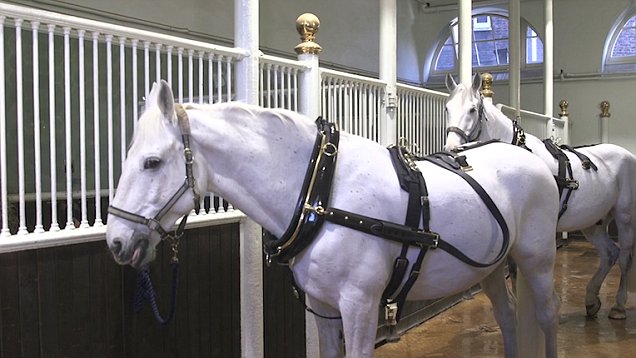
Windsor Greys courtesy of Daily Mail
I was receiving 18/- a week for working from 7.30 am. to 7.30, or to 9.00 pm. when the 'Guv' went to the sales in London just in case he brought one or two home with him. They were mostly army horses. Another chap came to work with me. His name was Bert Horton. His father was head coachman at the Queen's stables at Frogmoor in the Great Park which is where the Windsor Greys were born, bred and trained for the Royal Coaches.

For three years I didn't have a shirt to my back. Mostly I wore an old jacket. Then Bert Horton asked me if I would like an old chauffeur's suit including leather gaiters. It lasted me for two years until I left the stables.

We exercised our horses in the Great Park and always went along The Long Walk. On this particular day, a coach and horses came along the Walk to the Castle gates. My mate's horse bolted down the Old Windsor Road and when Bert came back he said it was my Dad. I said that I didn't notice because I had to keep my horse from following you. The horse was four years old and had never been broken to harness of any sort. The following morning Mr. Stillwell wanted to know what happened in the Park. I told him that it was the two-year-old which B. Horton was riding which bolted. So I was the only one to ride the two-year-old after that.

One day my mate's father came to see Mr. Stillwell and they both came to see me in the yard. Mr. Horton asked me if I would like to work at Frogmore. I had to refuse because I was the only one in our house bringing in money added to which I would have a six mile ride morning and evening which I did not relish. He told me that he liked the way I rode horses and there was a job waiting for me if I wanted one. The horses trained at Frogmore were the ones used to pull the Royal coaches.

Just after this happened the 'Guv' went to London for more horses. He told us to exercise the same two horses. When going through the park we came to a hedge about two feet high so we decided to jump it but my horse blundered and fell over it. Of course, he had to fall on me, across my right leg. Instead of waiting for him to get up I tried to pull my leg from under him and I twisted my knee which swelled up like a balloon. I managed to ride to the stable and the Boss had to take me home in the buckboard.

After I had been home a few days there was a knock at the door. It was Mr. Stillwell, my boss. He wanted me to go to the stable and catch a horse for him as they had been trying for hours. He was loose in the paddock at the back of the stables and nobody could catch him. The horse was a famous trotter. He had won five firsts, seven seconds and three thirds at the Olympia Horse Show in London. He had a small thick body and short fat legs. His feet were as big as small plates and his head was very nearly as big as his body. When he was trotting his feet came up to his ears and he was a picture to watch.

As we went out of the door I noticed a crust of bread on the table which I picked up and put in my pocket. The horse's name was Lonsdale. I always called him 'Lonny'. So when we got to the paddock the boss sent one of the chaps for some oats and bran in a sieve. I told him that I did not want it. Lonny was on the far side of the paddock. I called him, "Come on Lonny." He pricked up his ears and came trotting towards us. He stopped by the gate so I offered him a piece of bread crust and while he was chewing it I slipped the halter on him. I think that the Guy was a bit surprised. They had been trying to catch him all morning. The Guv didn't say a word until I got home. He said to Mum, "I think your boy is a marvel and I shall not turn him out again." I said, "Why not? You only need a piece of stale bread. "

There were some army chaps there helping the Guy while I was away. There were three tin trunks in the loft and I had to go and show them what was inside. They were full of silver sand in which was buried bridle bits of all descriptions, snaffle, double snaffle, straight bar and double bar with a cog in the middle (this was to stop the horses putting their tongues out ) and many more.

The two Army chaps broke the lock on the other one. It was full of bottles of wine which they took. Of course, I had to have the blame even when I told Mr. Stillwell that it was the other two I had shown it to. So I gave in my notice. I worked the following week, then asked him for a reference. He asked me where I thought I was going to work and I told him, "On the railway." He gave me one. 

This is an extract from the autobiography written by Oliver James Stannett (1903 - 1988) and republished here with the kind permission of his relatives who still live in Eton Wick. The collection of Oliver Stannett's articles can be found by clicking on this link.


Wednesday, 19 December 2018

The Story of Oliver James Stannett in his own word - Starting Work.

In 1915 when I was 12 my Mum and Dad applied for an exemption from school for me but we did not hear from the Education Board for over six months. When I was thirteen and a half I worked with Dad for about six months because we had pigs and another two acres of land on which we built a dozen pigsties.

Dad used to collect swill from about twenty houses in the village and they agreed to have a joint of pork for Christmas instead of being paid for it. Dad used to kill two pigs for this purpose. He used to feed them up so as to make good joints.

During wartime, he was only allowed to kill one pig for the family but someone had to split on him. So Dad went to see them (Ministry of Agriculture) and told them about all the children who had to have a joint. They told him that owing to his large family they would allow him two pigs but on no account must he kill more otherwise the Ministry would confiscate them. And, he must inform them every time they were being killed so that the Ministry could send an inspector to see that it was done properly. Who should come but a mate of Dad's so everything was O.K. and whoever came along and started asking questions would be shown the piece of paper from his pocket.

One chap at Wick named Roland Bond, who was a builder at the time, told the inspector that if Stannett could kill two so could he. He did and was fined £100. We believe that he was the one who reported Dad in the first place. Anyway, we had two large policemen up at the allotment.

Image courtesy of
Wiltshire Country Fayre
We had a big tin bath that hung on the wall. When the pigs were killed I would fetch them in a wheelbarrow and lay them in the bath one at a time. Then we would pour boiling water over them and used tin lids to scrape the hair off. It was surprising how easily it came off.

The chitterlings were done separately and I was the one who had to do them with a cane. After a thorough wash, they were threaded on to the cane, turned inside out and washed again. Mum always had one head to make brawn - it was beautiful stuff I am sorry that we can't get any like it today.


Eventually, Dad had forty-two sows and two boars but because he was the only one paying rent he had to sell up because it was crown land. So I had to get a job. 

This is an extract from the autobiography written by Oliver James Stannett (1903 - 1988) and republished here with the kind permission of his relatives who still live in Eton Wick. The collection of Oliver Stannett's articles can be found by clicking on this link.


Wednesday, 14 November 2018

The Story of Oliver James Stannett in his own word - Part Four

Dad got a job on the Thames Conservancy repairing Boveney Lock gates. They had finished the gates and had to repair the path with bags of cement and fill in behind them to make up the path. All the materials were brought in by barge.

One day they were waiting for the barge to arrive so decided to have their lunch. P. C. Pheasant came along to see what we were doing. There were planks going out on to the barge with a couple of wheelbarrows. P. C. Pheasant walked out to the end of the plank and looked into the river. Dad put his foot against the end of the plank and pushed and P. C. Pheasant fell into the river. Then a couple of men pulled him out. Without a word he got onto his bike and went home. I think Dad was a bit too artful for our P.C. Anyway P. C. Pheasant left Eton Wick as he was made inspector for a small place in the Midlands.

But there is one thing I must tell you which might have had some bearing on his attitude towards us. Just across the stream at the bottom of our garden was a small fever hospital for Eton College boys. There was a high hedge with poplar trees all round it so it was a hard job to get in. We had to be content with the apples that were overhanging.

We were there one day when we saw P. C. Pheasant coming across the common. We all bolted to the sewage farm and of course P. C. Pheasant had to follow. There was a big bank with sluice gates so that the whole field could be covered. Every fifty yards was a sluice gate. Several of the covers had rotted. We ran along the top of the bank. I looked round but P. C. Pheasant had disappeared. We stopped and then saw him coming out of the gate. He had gone in up to his waist. We disappeared. My Mum and Dad had a good laugh about it. Of course, he had his leg pulled unmercifully by the villagers but none knew how it happened. I think he was rather glad to get away from there.

One day when I was twelve years old Mum gave me tuppence (2d.) and asked me to go to W. Hearne, the shoe repairer's shop and get Dad two pairs of boot laces. The shop was situated next to The Grapes public house. I ran to the shop and went inside but there wasn't anybody there.

I shouted a couple of times but nobody came. As the laces were hanging up in bunches so that one could pull them out I decided to go round the counter and get two pairs. I thought of leaving the tuppence on the counter but decided against it in case someone came in and picked it up.

So I pulled out the till to put the tuppence in and got the shock of my life! A bell started ringing in the back room. Mr. Hearne came dashing in, "Ha! Caught you," he said. I stood there and started to explain but he would not listen. He said, " Stop there, I will fetch the village constable." So I waited about ten minutes. I could have run away but didn't. So I was taken to the Windsor police station. I was put in a cell. Dad came to see me and I was taken home.

The case came up a fortnight later and I was found guilty and ordered to have six strokes of the birch. I have never forgotten it. You see when I walked in there were blood stains all over the walls and floor. I had to lay on a table and the punishment was administered by a very large policeman. I didn't want any more like that.

I cannot understand why my mother never gave evidence for me. Anyway three weeks after Hearne sold his shop and bought a taxi. He must have found that I had not taken any money when he counted the money in the till so he packed up the repair business.


This is the only conclusion I can come to after thinking about it over the years. 

This is an extract from the autobiography written by Oliver James Stannett (1903 - 1988) and republished here with the kind permission of his relatives who still live in Eton Wick.