Showing posts with label 1900's. Show all posts

Friday, 24 May 2024

Photographic History of Eton Wick and Eton - Empire Day, possibly.


This interesting old photograph is a mystery, leaving much to be guessed at. It is possibly an Empire Day gathering, some time between 1906 and 1910. The location, with the railway viaduct in the background is certainly at, or near to the south side of Eton Recreation Ground. The new Recreation Ground at that time would probably not have had the benefit of hedges, as it was all formerly Lammas land. 

The assembly of presumably Eton Porny school children and absence of uniformed boy scouts suggests it predates the Scout movement of 1908 (or 1910, if the formation of the Eton troop is allowed for). The flags, adults and speaker leads one to believe it was an Empire Day Assembly, a national celebration day inaugurated in 1902, May 24th to commemorate the birthday of the late Queen Victoria. 

This article was first published in A Pictorial History of Eton Wick & Eton.


Monday, 23 August 2021

Tough Assignment - The Eton Wick Chapel in the Maidenhead Circuit.

The two services held each Sunday in the Eton Wick Chapel rarely figure in the records except when the change of time for the evening service was confirmed each spring and autumn. Circuit plans would have told us who was to preach there each Sunday and at the mid-week evening service (first mentioned in 1904), but unfortunately no early plans survive. We can be sure though  that most of the preachers came from outside the village, and mainly from Maidenhead where the Superintendent Minister resided.

Unlike incumbents of the Church of England, Primitive Methodist ministers rarely stay at any one place more than three years and share the conducting of services with other ministers and lay preachers. In spite of this there was no lack of fellowship nor contact between preachers and congregation. After all the preachers who came from outside the village had to make the journey on foot and often spent the whole day in the village being fed and looked after by chapel members. The five mile or more walk could seem a very long way to new preachers as Mr Lodge wrote with wry humour remembering his early days. Still feeling rather tired after walking from Maidenhead to Winkfield Row he was told by a lady there, 'You will never make a Methodist preacher; why William Evans comes six miles further than you and does not complain; a young man like you tired before you begin!'

Eton Wick did have one preacher of its own - John Lane. He was already accepted as a lay preacher by 1893 when the earliest of the surviving minute books begins. Another member of the Eton Wick Chapel had also become a preacher by this date, Frank Tarrant of Dorney. In 1893 he was away from the area working for the Evangelical Society. He came back for two weeks in the autumn of 1894 to take services at Cox Green and Eton Wick, but this was probably the last time for within a few years Frank Tarrant was to leave the Methodist Church for the Congregational. Soon afterwards he was ordained pastor of that church.

His conversion to Christianity had been one of Annie Tough's early successes and to the end of her life she was to remain proud of her protégée; she was delighted when he eventually became minister at Windsor. William Folley was also brought to Christ through the efforts of Mrs Tough though he belonged to the Maidenhead Church and not the Eton Wick Chapel; he was ordained in 1917 and soon after this he enlisted in the Royal Army Medical Corps.

Although she was busy in many roles, Mrs Tough was not yet a preacher, but in March 1901 she took the first step on the ladder by becoming an exhorter, a position that no longer exists, but which might be described as an apprentice preacher. She was on trial as an exhorter until the end of 1902 as were several others, all men, who came 'on the plan' at the same time. Annie Tough wasn't the first woman lay preacher in the Maidenhead Circuit, indeed the Maidenhead Chapel had been one of the first in the district to welcome them, but there were still very few. Francis (Frank) Paintin and S Baker from Eton Wick were also examined and accepted as exhorters in the early years of the century. Frank Paintin became a full local preacher in 1907 and, like Annie Tough, took services at Eton Wick as well as other chapels in the Circuit.

1924 Circuit Plan
Mrs tough was planned to preach at Eton Wick
in October at the Mothers Meeting.

Unlike incumbents of the Church of England, Primitive Methodist ministers rarely stay at any one place more than three years and share the conducting of services with other ministers and lay preachers. In spite of this there was no lack of fellowship nor contact between preachers and congregation. After all the preachers who came from outside the village had to make the journey on foot and often spent the whole day in the village being fed and looked after by chapel members. The five mile or more walk could seem a very long way to new preachers as Mr Lodge wrote with wry humour remembering his early days. Still feeling rather tired after walking from Maidenhead to Winkfield Row he was told by a lady there, 'You will never make a Methodist preacher; why William Evans comes six miles further than you and does not complain; a young man like you tired before you begin!'

Eton Wick did have one preacher of its own - John Lane. He was already accepted as a lay preacher by 1893 when the earliest of the surviving minute books begins. Another member of the Eton Wick Chapel had also become a preacher by this date, Frank Tarrant of Dorney. In 1893 he was away from the area working for the Evangelical Society. He came back for two weeks in the autumn of 1894 to take services at Cox Green and Eton Wick, but this was probably the last time for within a few years Frank Tarrant was to leave the Methodist Church for the Congregational. Soon afterwards he was ordained pastor of that church.

His conversion to Christianity had been one of Annie Tough's early successes and to the end of her life she was to remain proud of her prodigy; she was delighted when he eventually became minister at Windsor. William Folley was also brought to Christ through the efforts of Mrs Tough though he belonged to the Maidenhead Church and not the Eton Wick Chapel; he was ordained in 1917 and soon after this he enlisted in the Royal Army Medical Corps.

Although she was busy in many roles, Mrs Tough was not yet a preacher, but in March 1901 she took the first step on the ladder by becoming an exhorter, a position that no longer exists, but which might be described as an apprentice preacher. She was on trial as an exhorter until the end of 1902 as were several others, all men, who came 'on the plan' at the same time. Annie Tough wasn't the first woman lay preacher in the Maidenhead Circuit, indeed the Maidenhead Chapel had been one of the first in the district to welcome them, but there were still very few. Francis (Frank) Paintin and S Baker from Eton Wick were also examined and accepted as exhorters in the early years of the century. Frank Paintin became a full local preacher in 1907 and, like Annie Tough, took services at Eton Wick as well as other chapels in the Circuit.

Windsor and Eton Branch of the Women's Total Abstinence Union
tea party at Bell Farm 1904.

Mrs Tough also had her own way of conducting the campaign against the evils of drunkenness, a real problem in England before the First World War. She personally sought out those who found solace - and too much pleasure - in drink, and 'set herself prayerfully and earnestly to rescue them. In this she achieved remarkable success. She won many trophies, and was thrilled with joy at the transformation wrought in the homes and lives of her coverts'. Her biography in 'Christian Messenger' tells the story of one convert.

'There came to reside in the village an elderly man, named William Broad, of fine presence. He was addicted to intemperance, and the soul of many a convivial party on account of his sparkling repartee and mirth-provoking disposition. Our sister invited him, by note, to the chapel. He came a few times. To him it was a novelty to hear a woman pray, and it was afterwards known that he gave a boy a penny to tell him when our sister engaged in prayer, that he might listen outside to her supplications. Despite his bad habits, the Spirit of God laid hand on his heart. At his request Mrs Tough visited him and showed him the way to salvation and led him into the rest of faith. He was then sixty years of age. He at once became a total abstainer and non smoker, and opened his house for a weekly prayer meeting.

His boon companions soon understood the change was not only wonderful but real. True, his Christian life was uphill work owing to his deeply rooted habits and former associations, but he held on his way. Severe affliction attended his later days, and then the call came quite suddenly, and this brand plucked from the burning was safe at last'.

For the three years before his death, however, he allowed class meetings to be held in his house, and the cheerful room, blazing fire in winter and his own blunt and often witty speech helped to draw others to these prayer meetings who might not ever have set foot in the chapel.

In 1911 John Moore, Mrs Tough's father, died. He had been a tremendous support to her, moving to Eton Wick soon after her marriage. He was one of the chapel trustees and a benefactor in many ways, small and large. He was undoubtedly one of those men who liked to get involved and help run things - maybe it was from him that Annie took some of her inspiration - and he had time and sufficient money to do both. It was he that obtained the licence in 1895 so that marriages could take place at the chapel; his youngest daughter, Lilian, was the first bride ever to be married there. Two years later in 1913 John Lane also died. We know little of his strengths and influence, but he like Mrs Tough was a Primitive Methodist of long standing, an active member within the circuit as well as the chapel. He also was a trustee. The loss of the two men inevitably brought changes, which were no doubt increased by the advent of the First World War.

In June 1914 the circuit minutes report that a chapel committee is to be appointed to work with Mrs Tough, consisting of Mrs Lane, Mr Robinson and Frank Paintin.

How long the committee lasted isn't made clear, but it does seem that more and more the chapel revolved round Mrs Tough and more and more of her life was devoted to the chapel. As well as being trustee, society steward and organist, she now became the Sunday School Superintendent in place of John Lane. She had long been concerned with the Womens Meetings or Sisterhood as they were later known, and it is quite likely that she began these even before the chapel was built. She was the leader for many decades. The ladies met on a mid-week afternoon in the tiny schoolroom, bringing with them their sewing or knitting. The meeting opened with a hymn and then, while the ten or so members got on with their individual work, Mrs Tough read the week's instalment from a chosen Christian book. There were no speakers as today, but there was time before the end of the meeting for a cup of tea and a prayer.

There was much more to these meetings, however, than is implied in the above description, for it was through them and Annie's ability to understand other women's problems and to extend to them 'sympathy, tact, kindness and unbounded charity' that - in the words of the Rev Tolfree Parr - she 'won the hearts of the women and led many to Christ.' Was it this work that brought about the 'many recent conversions and the outpourings of grace' at Eton Wick which were reported in the circuit minutes of 1912. At no other time and for no other chapel in the circuit was there occasion to record such success. 

The Eton Wick History Group is most grateful for the kind permission given by the Eton Wick Methodist Chapel to republish this history, Tough Assignment on this website.

Monday, 6 January 2020

Characters and Families - The village 'Bobby'


P.C. Stanton pictured in front of his home, the village police house at the north end of Moores Lane, Eton Wick, around the turn of the 20th century. P.C. Stanton appears in another archive photograph of 1897 at the Queen Victoria Diamond Jubilee celebrations in Eton. There was a village policeman until 1976, when P.C. Tweddle retired and the Eton Police Station closed. The last time a resident policeman used this house was in 1960, by which time new police houses just off the Eton Wick Road had been built. Undoubtedly the old style village 'bobby' made it his business to observe and hear what went on in his community, and could often check crime before it became more serious or repetitive. 

This article was first published in A Pictorial History of Eton Wick & Eton.

Wednesday, 30 October 2019

Saddocks Farm House

Saddocks Farm House and Garden circa 1906
At this time, James and Julia Tarrant lived here, followed by one of their sons, Arthur, and his family. This photograph is of the south elevation of the house. Arthur's sons Cyril and Reg (J A) can still recall the rose covered trellis archway along the garden path and the immaculate flower beds on the lawn beyond the hedge. At the height of their farming days, James and his sons ran Saddocks, Manor, Crown and Little Common farms. At the end of the 20th century, Crown Farm is still in the hands of Jamie Tarrant, son of Reg (H). 

This article was first published in A Pictorial History of Eton Wick & Eton.

Wednesday, 23 January 2019

The Story of Oliver James Stannett in his own word - Working With Horses

Dad came home one day and told Mum that they wanted a boy for 10/- a week to work between 7.30 and 7 - 8 pm. to clean shoes, cutlery, outside windows, scrub out two bars twice a week, take people's luggage to either Western or Southern stations and chop a certain amount of firewood. I did this and more for about six months until I got a whitlow on my finger so I got the sack.

Then Dad heard that there was a job going at Mr. Stillwell's stable at Clewer near Windsor race course. I got the job because I liked the horses. I was looking after a hunter, polo ponies, hacks, one stallion and one two-year-old racehorse which was being trained for racing. I must say a few words about Captain Vivien the two-year-old. The 'Guy' and I used to go on Windsor racecourse knocking a white polo ball about which I enjoyed. I asked the reason for it. He said, " To get the horses to learn to change legs as polo ponies have to do. " So I watched and they did, so there was no need for them to cross their forelegs in a race which would bring them down. I think being in the stables, the smell got into my blood and fetched me out in boils. At this time I had two on my neck and one on each cheek of my behind. I could not sit down but I did not tell the 'Guv' about it because I was managing very well until he said, "Saddle up the 'Cap. ' and we will have a knockabout." We saddled up and went to the course. The horse was a lot taller than the polo ponies so I had to reach down further and as I did both boils on my behind burst and it all ran down my legs, but what wonderful relief Funny thing is that I have not had a single boil since.

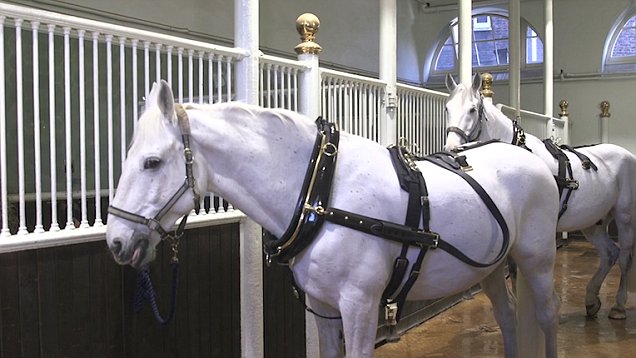
Windsor Greys courtesy of Daily Mail
I was receiving 18/- a week for working from 7.30 am. to 7.30, or to 9.00 pm. when the 'Guv' went to the sales in London just in case he brought one or two home with him. They were mostly army horses. Another chap came to work with me. His name was Bert Horton. His father was head coachman at the Queen's stables at Frogmoor in the Great Park which is where the Windsor Greys were born, bred and trained for the Royal Coaches.

For three years I didn't have a shirt to my back. Mostly I wore an old jacket. Then Bert Horton asked me if I would like an old chauffeur's suit including leather gaiters. It lasted me for two years until I left the stables.

We exercised our horses in the Great Park and always went along The Long Walk. On this particular day, a coach and horses came along the Walk to the Castle gates. My mate's horse bolted down the Old Windsor Road and when Bert came back he said it was my Dad. I said that I didn't notice because I had to keep my horse from following you. The horse was four years old and had never been broken to harness of any sort. The following morning Mr. Stillwell wanted to know what happened in the Park. I told him that it was the two-year-old which B. Horton was riding which bolted. So I was the only one to ride the two-year-old after that.

One day my mate's father came to see Mr. Stillwell and they both came to see me in the yard. Mr. Horton asked me if I would like to work at Frogmore. I had to refuse because I was the only one in our house bringing in money added to which I would have a six mile ride morning and evening which I did not relish. He told me that he liked the way I rode horses and there was a job waiting for me if I wanted one. The horses trained at Frogmore were the ones used to pull the Royal coaches.

Just after this happened the 'Guv' went to London for more horses. He told us to exercise the same two horses. When going through the park we came to a hedge about two feet high so we decided to jump it but my horse blundered and fell over it. Of course, he had to fall on me, across my right leg. Instead of waiting for him to get up I tried to pull my leg from under him and I twisted my knee which swelled up like a balloon. I managed to ride to the stable and the Boss had to take me home in the buckboard.

After I had been home a few days there was a knock at the door. It was Mr. Stillwell, my boss. He wanted me to go to the stable and catch a horse for him as they had been trying for hours. He was loose in the paddock at the back of the stables and nobody could catch him. The horse was a famous trotter. He had won five firsts, seven seconds and three thirds at the Olympia Horse Show in London. He had a small thick body and short fat legs. His feet were as big as small plates and his head was very nearly as big as his body. When he was trotting his feet came up to his ears and he was a picture to watch.

As we went out of the door I noticed a crust of bread on the table which I picked up and put in my pocket. The horse's name was Lonsdale. I always called him 'Lonny'. So when we got to the paddock the boss sent one of the chaps for some oats and bran in a sieve. I told him that I did not want it. Lonny was on the far side of the paddock. I called him, "Come on Lonny." He pricked up his ears and came trotting towards us. He stopped by the gate so I offered him a piece of bread crust and while he was chewing it I slipped the halter on him. I think that the Guy was a bit surprised. They had been trying to catch him all morning. The Guv didn't say a word until I got home. He said to Mum, "I think your boy is a marvel and I shall not turn him out again." I said, "Why not? You only need a piece of stale bread. "

There were some army chaps there helping the Guy while I was away. There were three tin trunks in the loft and I had to go and show them what was inside. They were full of silver sand in which was buried bridle bits of all descriptions, snaffle, double snaffle, straight bar and double bar with a cog in the middle (this was to stop the horses putting their tongues out ) and many more.

The two Army chaps broke the lock on the other one. It was full of bottles of wine which they took. Of course, I had to have the blame even when I told Mr. Stillwell that it was the other two I had shown it to. So I gave in my notice. I worked the following week, then asked him for a reference. He asked me where I thought I was going to work and I told him, "On the railway." He gave me one. 

This is an extract from the autobiography written by Oliver James Stannett (1903 - 1988) and republished here with the kind permission of his relatives who still live in Eton Wick. The collection of Oliver Stannett's articles can be found by clicking on this link.


Wednesday, 19 December 2018

The Story of Oliver James Stannett in his own word - Starting Work.

In 1915 when I was 12 my Mum and Dad applied for an exemption from school for me but we did not hear from the Education Board for over six months. When I was thirteen and a half I worked with Dad for about six months because we had pigs and another two acres of land on which we built a dozen pigsties.

Dad used to collect swill from about twenty houses in the village and they agreed to have a joint of pork for Christmas instead of being paid for it. Dad used to kill two pigs for this purpose. He used to feed them up so as to make good joints.

During wartime, he was only allowed to kill one pig for the family but someone had to split on him. So Dad went to see them (Ministry of Agriculture) and told them about all the children who had to have a joint. They told him that owing to his large family they would allow him two pigs but on no account must he kill more otherwise the Ministry would confiscate them. And, he must inform them every time they were being killed so that the Ministry could send an inspector to see that it was done properly. Who should come but a mate of Dad's so everything was O.K. and whoever came along and started asking questions would be shown the piece of paper from his pocket.

One chap at Wick named Roland Bond, who was a builder at the time, told the inspector that if Stannett could kill two so could he. He did and was fined £100. We believe that he was the one who reported Dad in the first place. Anyway, we had two large policemen up at the allotment.

Image courtesy of
Wiltshire Country Fayre
We had a big tin bath that hung on the wall. When the pigs were killed I would fetch them in a wheelbarrow and lay them in the bath one at a time. Then we would pour boiling water over them and used tin lids to scrape the hair off. It was surprising how easily it came off.

The chitterlings were done separately and I was the one who had to do them with a cane. After a thorough wash, they were threaded on to the cane, turned inside out and washed again. Mum always had one head to make brawn - it was beautiful stuff I am sorry that we can't get any like it today.


Eventually, Dad had forty-two sows and two boars but because he was the only one paying rent he had to sell up because it was crown land. So I had to get a job. 

This is an extract from the autobiography written by Oliver James Stannett (1903 - 1988) and republished here with the kind permission of his relatives who still live in Eton Wick. The collection of Oliver Stannett's articles can be found by clicking on this link.


Wednesday, 14 November 2018

The Story of Oliver James Stannett in his own word - Part Four

Dad got a job on the Thames Conservancy repairing Boveney Lock gates. They had finished the gates and had to repair the path with bags of cement and fill in behind them to make up the path. All the materials were brought in by barge.

One day they were waiting for the barge to arrive so decided to have their lunch. P. C. Pheasant came along to see what we were doing. There were planks going out on to the barge with a couple of wheelbarrows. P. C. Pheasant walked out to the end of the plank and looked into the river. Dad put his foot against the end of the plank and pushed and P. C. Pheasant fell into the river. Then a couple of men pulled him out. Without a word he got onto his bike and went home. I think Dad was a bit too artful for our P.C. Anyway P. C. Pheasant left Eton Wick as he was made inspector for a small place in the Midlands.

But there is one thing I must tell you which might have had some bearing on his attitude towards us. Just across the stream at the bottom of our garden was a small fever hospital for Eton College boys. There was a high hedge with poplar trees all round it so it was a hard job to get in. We had to be content with the apples that were overhanging.

We were there one day when we saw P. C. Pheasant coming across the common. We all bolted to the sewage farm and of course P. C. Pheasant had to follow. There was a big bank with sluice gates so that the whole field could be covered. Every fifty yards was a sluice gate. Several of the covers had rotted. We ran along the top of the bank. I looked round but P. C. Pheasant had disappeared. We stopped and then saw him coming out of the gate. He had gone in up to his waist. We disappeared. My Mum and Dad had a good laugh about it. Of course, he had his leg pulled unmercifully by the villagers but none knew how it happened. I think he was rather glad to get away from there.

One day when I was twelve years old Mum gave me tuppence (2d.) and asked me to go to W. Hearne, the shoe repairer's shop and get Dad two pairs of boot laces. The shop was situated next to The Grapes public house. I ran to the shop and went inside but there wasn't anybody there.

I shouted a couple of times but nobody came. As the laces were hanging up in bunches so that one could pull them out I decided to go round the counter and get two pairs. I thought of leaving the tuppence on the counter but decided against it in case someone came in and picked it up.

So I pulled out the till to put the tuppence in and got the shock of my life! A bell started ringing in the back room. Mr. Hearne came dashing in, "Ha! Caught you," he said. I stood there and started to explain but he would not listen. He said, " Stop there, I will fetch the village constable." So I waited about ten minutes. I could have run away but didn't. So I was taken to the Windsor police station. I was put in a cell. Dad came to see me and I was taken home.

The case came up a fortnight later and I was found guilty and ordered to have six strokes of the birch. I have never forgotten it. You see when I walked in there were blood stains all over the walls and floor. I had to lay on a table and the punishment was administered by a very large policeman. I didn't want any more like that.

I cannot understand why my mother never gave evidence for me. Anyway three weeks after Hearne sold his shop and bought a taxi. He must have found that I had not taken any money when he counted the money in the till so he packed up the repair business.


This is the only conclusion I can come to after thinking about it over the years. 

This is an extract from the autobiography written by Oliver James Stannett (1903 - 1988) and republished here with the kind permission of his relatives who still live in Eton Wick.

Wednesday, 10 October 2018

The Story of Oliver James Stannett in his own word - Part Three

I had started going to Eton Porney School when the 1914-18 war broke out. George and Albert both joined up in the Royal Life Guards at Windsor.

While going to Eton Porney School we used to have a Christmas party and magic lantern show every year. On this particular day I had my lunch taken from the cloakroom. (This was the only place we were allowed to put it, with our coats.) So I went to see the Head Master who lived on the premises and informed him that someone had taken my lunch.

Mr. Baker was very concerned and told me to wait a minute. He came out after five minutes and gave me two large pieces of fruit cake and two sandwiches. "There you are," he said. "And don't forget you will have no cake with your tea." But I had all the cake I wanted. I was worried because I thought that I wasn't going to get any at the party but when it was passed round the table I looked up at Mr. Baker and all he did was smile and nod his head so I got stuck in.

When I was about eleven years old, Eton College had a soup kitchen in Eton High Street where one could buy offcuts of bread. It cost tuppence for half a pillowcase full. John (Brewer) and I used to go every Friday morning and we would sit in the playing fields on the way home to search our cases for pieces of cake or currant bread - sometimes we were lucky other times not.

On other days we used to look into the dustbins of the college houses for anything that was any good. We always had plenty of writing materials, books with only two pages written on in pencil and pen nibs and pennies all stuck together. Very often we would find a cake in a cake box which had been thrown away by the boys. They always put it on top of the dustbin.

Sometimes when nothing else was forthcoming we would find a 7lb. tin of golden syrup with a nice lot of treacle inside. Then we would go along to the meadow. This was a meadow which ran nearly the length of the common. Near home, we would find the best and youngest clump of sour sorrel, which was very sour. Then we sat down and dipped the sorrel in the treacle and enjoyed life. So when we got home we did not want any tea, if there was any.

On the occasions when there wasn't the treacle tin came in handy. We three (Mum's brothers and myself) went collecting birds eggs and cooked them on a fire. We used to have birds' eggs often. At least we had something to eat. Autumn was the best time for swedes, turnips and spuds. We used to cook wheat when we had nothing else. When I look back I often wonder if it did us any good but I'm sure it did.

Dad took an acre of grassland for an allotment. This was when we shook the villagers. They were all puzzled about how the ground got dug without anyone working on it. I was given to understand that the men in parts and around the village were arguing about it. I used to wait for Dad to come home from work and after he had his tea he would say, "Come on Olly let's show 'em." We went to the allotment, of course, it was dark when we got there. He uncovered some bags of lime which we proceeded to throw over the ground. We dug until midnight or thereabouts. The moon came up a bit and we could see what we were doing. We always covered a certain amount of ground. Whatever we covered, we dug without leaving any sign that we had been there. It was surprising what we managed to do.

On Sundays we did planting only, you see, at that time Dad was working in the coal yard near the gas works. It was always getting dark when he got home. But what amused me was that men came out of two or three pubs to watch us. They all came up the path to see what we were doing. Dad told them how it was done and they got some lime for their own ground. Dad and I managed to do a whole quarter acre in three weeks.

This is an extract from the autobiography written by Oliver James Stannett (1903 - 1988) and republished here with the kind permission of his relatives who still live in Eton Wick.

Wednesday, 12 September 2018

The Story of Oliver James Stannett in his own word - Part Two

Not long after moving to Eton Wick I was eight years old. My eldest sister Florence was married to Jack Emery who had just come home from India and was demobbed from the army. I have never forgotten it because I was left out. You see I had no clothes, in fact, I was in rags, and if I remember correctly I had old plimsolls on. Being a small house the place was crowded with people. This was at 11, Castle View Terrace, close to Dorney Common. "Klondyke" we called it.

I got fed up with playing in the garden so I went indoors but was soon sent out again because of the state I was in. All that I had an eye for were the blancmanges and jellies on the table. I remember Mum and Ethel grabbing hold of me and telling me to stop in the garden and when it was all over they would put some by for me. I was satisfied with that and played in the garden watching until they all went. Then I went straight indoors to have a feed as I had been outside all day but all I saw was a pile of empty plates and dishes ready for washing-up. Mum and Ethel said that I had been out of sight and out of mind they had forgotten all about me. I don't remember what they gave me or if they had anything left to give. That was my first taste of weddings and after that, I made a point of cleaning out the saucepans after use. It is a thing that I have done ever since even at my own wedding.

Soon after that, we moved to Clifton Cottages at the other end of the village and that is where I first met Mum's family. After that, we always played together.

When I was nine years old we had a P.C. Pheasant as constable of the village and no way did he like the Stannett family. Of course, it may have been us kiddies, we used to play pranks on people.

There were no lights along the Eton Wick Road and it was always dark when we came out of school at Eton. There was a road at the side of us called The Walk. It was a private road. Then, because it was the first of May, all the cattle from the farms were let loose on the common. A rope had to be tied across the top of The Walk by law. My grandfather who looked after it all day from 8 am to 9 pm received one shilling for keeping the traffic off the road for the day.

At the side of The Walk was a grocer's shop, a paper shop and a sweet shop. I was helping Dad cut wood for kindling which would be sold. I asked John Brewer, my pal and Mum's brother, to fetch a long piece of string to go across the top of The Walk. I tied this to a bundle of wood which I placed on the path. The women always wore aprons in those days for groceries etc. When coming out of the shop they would pick up the wood and put it in their aprons. We would let them walk a few yards then pull it out. One or two would drop all their groceries so the women complained to P. C. Pheasant who, of course, had to come round to the Brewers and the Stannetts. He had a strong suspicion that it was us. Round about that time he was always threatening Dad, I heard him say that he would get him one day.

I must tell you about the time we had nothing in the house. I was ten years old. George, Sydney and I used to go around the hedges of the fields to catch birds roosting. George and Syd used catapults so as not to make a noise. It was surprising how many birds we caught. I went along to carry them home and didn't we have some lovely feeds.

At that time I was chopping wood for Dad. Mr. Bunce, who was a small dairy farmer, came to see Dad to ask him if he would empty a few cesspits for him at £5 a time. They were overflowing and because of the complaints he had to get someone quickly so he asked Dad who said, " Yes, just the job to make a few *shillings!”

Dad had a tank which was used to take sludge to the allotments from the pigsties. So he asked me if I would help him including holding the horse's head. It was a chance for me to stop up a bit later so I did. Dad told all the neighbours so they shut all their windows because of the smell floating about. We had four to do, two that night and two the next.

The difficulty was that they were situated near houses. Bunce supplied my Dad with a fifteen-foot pole with a bucket on the end and a shorter pole with a scoop on the end.

It was a long time since they had been cleaned. When one took the cover off it could be seen that the sludge was a foot thick and sometimes more. So we had to use the scoop before the bucket. It only took an hour. We emptied the tank three times for each cesspit taking the loads to the allotments.

The next night Bunce came round to see how we were getting on. "Alright." I said, "but it don't half make your hair grow." Of course, Dad and Bunce saw the funny side and burst out laughing.

Then we found out why Bunce had come. He wanted Dad to get into the cesspit with a crowbar and make a few holes in the bottom so that more water would drain away. Dad replied, "What do you take me for! If I did that in time I would have to dig it all out." "I suggest you get down and do it yourself."

We did them for another six months then we lost the job. I said to Dad that it seemed as if he had got somebody to make the holes for him. 

This is an extract from the autobiography written by Oliver James Stannett (1903 - 1988) and republished here with the kind permission of his relatives who still live in Eton Wick.

Wednesday, 15 August 2018

The Story of Oliver James Stannett in his own word - Part One

I was born on 25th April 1903 at Chertsey in Surrey. Dad worked on the Thames Conservancy repairing the Chertsey lock gates. 

According to my mother, when I was about three years old I was missing for about three hours. Nobody could find me.

There was a large gravel pit at the bottom of the garden. Dad came home and looked around the gravel pit and he said that he found me hanging on to a bush with my feet touching the water. How long I had been there I don't know.

I knew nothing about this until I was sixteen years old. When I asked Mum and Dad why I was so frightened of water they told me what happened at Chertsey.

You see I was a pupil at Eton Porney School, Eton and the class went bathing at Athens which was the Eton College boys' baths. I absolutely refused to go into the water with the boys so the master told some of the boys to throw me in. Some of them managed to do it but I must have kicked up such a fuss that they had to fetch me out. I told Mum about it when I got home and she wrote a note to the master explaining the reason for my behaviour. Anyway, after that I used to sit on the bank and watch them.

I think that (the gravel pit) was the reason why Mum and Dad left Chertsey and moved to Arthur Road in Windsor close to the Gasworks where Dad got a job on the retorts.

I think that I must have been about four years old because they tried to get me into the school at the other end of Arthur Road. St. Michael's it was called but they would not have me at that age.

I was playing in the road one day and a man in plus fours asked me why I was not at school. He was the School Board man. Mum told him. I don't know how he managed it, he only had one arm and rode a bike, but he picked me up put me on his saddle and took me to school. After that Mum took me to school as they agreed to let me go there.

The School Board man used to go to the school and find out who was not there. Then he would go round to their homes and take them to school. Nobody liked him. He was still around during the 1914 - 18 war when I saw him last. Dods I think his name was.

All that I did at school was to play with sand on a tray, trying to make sand castles etc. I got fed-up with this so I decided not to go to school. Across the road from us where two roads met there was a sweet shop that had three steps going up to the shop door which I hid behind until the School Board man had been and gone.

Anyway I left my hiding-place and went home. Mum 'created' at me for not going and offered me a farthing to get a liquorice long stick which was a foot long and half an inch wide. These, 1/2d Caliboncas and Port Wine toffee were all the sweets we ever got. I must have gone to school because I remember sitting in the classroom with paper and pencil. I think it was then that Mum and Dad moved to the other end of the road close to the school.

It was a square of houses built together and the only way that you could get into the square was through an archway in the middle of each side.

It was supposed to be a playground for kiddies but it was all gravel. The Church Army Band played there on Sundays. Dad grew flowers there. It was not big enough for veg. and he had several rabbit hutches there. The rabbits were white with pink eyes and the flowers were all colours.

I became interested in the sticks stuck in each plant with a flowerpot with straw put in it. Of course, I had to go and look. While I was doing that I had left the rabbit hutch door open and they were out into the garden! One good point was that they could not get out of the garden and Dad managed to catch them. I had a good talking to so I never touched them again.

Dad was always good to us. He never hit one of us. Not that I know of anyway.

Dad used to chew tobacco. One day I fell over and cut the palm of my hand. Of course it hurt and I yelled. Dad came out. "Let's have a look," he said. He looked at my hand, spat on it and then rubbed it in. “There you are," he said. I do not remember what happened after that.

Then something happened which I have never forgotten when I had toothache in both sides of my face which were swollen like balloons. Mum got a piece of flannel, mixed some vinegar and mustard together into a paste and spread it on my face. The pain went away and it kept me from school but I still had the swelling.

I must have been six years old when I was let out of school early. There was nobody in and I saw a bottle of beer on the kitchen table. I thought I would try it. So I took the bottle into the scullery, took the screw stopper out and had a good swig. Then I realized that it was paraffin! I choked and spluttered gasping for breath. As it happened the next door neighbour heard me and came to help. Mum came in and said, "Wait till your father gets home," but Mum and Dad just laughed their heads off. Dad said, "I think he has learned his lesson. I think he has been punished enough. "I have often thought on the big old fashioned clothes mangle with big rollers that I clung to when trying so hard to breathe. Soon after that we moved to Eton Wick. 

This is an extract from the autobiography written by Oliver James Stannett (1903 - 1988) and republished here with the kind permission of his relatives who still live in Eton Wick.

Wednesday, 24 January 2018

Boveney New Town Census 1901

The United Kingdom Census of 1901 was taken on Sunday 31st March, that year and was the seventh of the UK censuses to include details of household members. The total number of persons returned as living in England and Wales at midnight on Sunday, March 31st, 1901, was 32,526,075. This shows an increase of 3,523,550 upon the number enumerated on April 5th, 1891, and gives a decennial rate of increase of 12.17 percent.

Details collected include:

Place: street name, house number or house name.

Houses: inhabited, uninhabited or a building and the number of rooms.

Names of each person who was resident in the house on the night preceding the census.

Age and sex of each person: The actual age in years or months for babies under one year are recorded in the 1901 census.

Rank, Profession or Occupation.

Birthplace, county and country.

Whether Blind, Deaf or Dumb.

The Superintend Registrar's District was Eton, Bucks and the Registrar's district was Burnham. Enumeration District No. 1. The enumerator was Edward Groves.

The area for the 1901 census included was the entire parishes of Dorney and Boveney.

The 1901 Census reveals that there were 125 households, eight houses that were unoccupied and 481 people in residence in the parish of Boveney at midnight on the 2nd April. The oldest person, Ann Grames (or Grimes) at the age of 81, she was born in 1820. There were two residents in their 80’s. There were three children recorded at age 1 month Arthur Lea was the third child of Thomas and Martha, Nellie Newport, the fourth daughter of Albert and Selina and Eva May Oxlade, first child of John and Louisa. Three other children born in the first three months of 1901.

Click on this link to see our transcription of the 1901 census records for Boveney.. We will be looking deeper into what the census reveals about the growing village and publish our findings in future articles.

Wednesday, 8 June 2016

Garden Party at Bell Farm


The photograph was taken on 30th June 1904 at the tea party held by the Windsor and Eton branch of the Women's Total Absinence Union. 

There are nearly 100 people in this photograph, apart from Mr and Mrs Tough whose home Bell Farm was in 1904 can anyone help identify who attended this event.

30th June 1904 was a Thursday.

Tuesday, 31 May 2016

Two Photographs of Eton Wick Road Around 1900


These two photographs were taken by the Rev. Demaus, who was village curate at the turn of the century, and an enthusiastic glass plate photographer as these pictures demonstrate. They are used by the kind permission of his son. These scenes of life on the Eton Wick Road (taken near the Three Horseshoes, the upper one looking east and the lower photo west), can be compared with other photographs of the area in the book.

Note the unmetalled and very dusty road, lack of pavements, the horse drawn traders' traffic and the style of dress. The upper photograph shows Lovell's shop and Post Office (Ada Cottage). Both photos show the great oak tree that once stood in front of the Three Horseshoes. The lower photo shows the bay window of the Horseshoes, much as it is today, and likewise the Palmer Place terrace. There is no shop at Wellmans Cottages (later to become Thames View Stores).

In these photographs c1900 there are no street lights. These were to come later, initially two when gas first came to the village and by the 1930s when there were 44 lights between the Slads and Dorney Common Gate. The elm trees in the background are lining Brown's lane (now part of Common Road).

This article was first published in A photographic history of Eton Wick & Eton.