Tuesday, 25 May 2021

From the Parish Magazine - Eton Wick History Group Meeting - Village Shopkeepers - Past and Present

"As we live day by day we don't notice changes which are happening around us " 

So said Frank Bond as he introduced his talk on "Village Shopkeepers - Past and Present" on the 27th May 1998. He referred first to the hamlet which was Eton Wick in the year 1800, with just 100 residents; and the to the early 20th Century shops which sold hardware„ groceries etc., and his talk progressed through to illustrate not only the various changes which had occurred. in Eton Wick' s shops and services up to the present day, but also the considerable changes in the community itself There had been seven farms, now some had been adapted for riding schools and others given over to engineering. The countryside itself has undergone changes with areas previously used for crops now given over to leisure and recreation facilities. 165 years ago there were 300 people living in Eton Wick. There was no evidence of any shops here then, or any easy means of getting to shops elsewhere; for there was no transport, other than horse-drawn vehicle or 'Shank' s pony' . People grew their own vegetables, they would purchase milk, flour etc. from the farmers, and they would make home-make jams, pickles and other preserves for their larders; some would have kept poultry for their eggs and meat. There would have been work for the village' s blacksmith, a chimney-sweep, and also for cobblers and  boot makers. 

MUFFIN-MAN

By the 1920' s Eton Wick was being visited by the muffin-man, and a winkle-man and a man who sold fly-papers; did the fly-paper become a muffin-man or a cobbler in the Winter months? Gypsies came selling clothesline props and pegs - most people were a little afraid of Gypsies because of their apparent ability to successfully lay a curse on you if you upset them. Visits from the 'rag and bone man' with his horse and cart were more welcome, particularly by the children who might be given a balloon in ex-change for old rags. As the years progressed there were the annual visits from a `gentleman-of-a-darker-hue' who went from door to door selling ties, collar-studs, etc. from a suitcase. A Mr. Henry came out from Windsor every Thursday with a cart loaded with galvanised goods, ironmongery, soda, soap-flakes and the famous 'Reckitts Blue'. Another welcome visitor, perhaps in later years, was Tom Cox on his Walls Ice Cream Stop Me and Buy One' tricycle - the fact that he only had one leg gave him few problems. There were two other ice-cream vendors - Vettise's and Sacco's - they just came round on Sundays. Out of season these ice-cream sellers would use their carts to transport the rabbit skins and other goods they bought locally. Tom Cox also sold cakes and bread for Denney's bakery (14 cakes for 1s. 0d.). He was also pretty handy with his bicycle pump in that when some poor soul stepped out of hedge in front of him he hit him over the head with it. 

STABLE FIRE 

The Greyhound Pub with Mr & Mrs Newell

Eton Wick had its own coal merchants, delivering by horse and cart. Bill Parrot' s horse was stabled in what is now 'The Greyhound' skittle alley. Early in the 1930's Scottie Hood' s horse' s stable caught fire and Scottie had to be physically restrained from entering the inferno to rescue his horse. The horse perished but the village had a whip-round and raised enough for him to buy another horse. The coal carts, and others, would be cleaned up and would carry the children of the village on Sunday School outings. 

Chantler then took the shop over and added gas masks to the provisions on offer. Harry Chanter was a very helpful and kind man. He was a trustee of the Eton Poor's Estate for 60 years, he was held in great an affection. There were other tenants of the shop after Mr. Chantler, until it was converted into flats in 1987. 

ICE CREAM 

A Mr. Slade set up shops in St  Leonard' s Place (possibly named so because of its view across the Thames to St Leonard' Hill?), this was the first shop in Eton Wick to sell ice-cream. Mr Slade moved on to The Grapes'. In the mid 30' s Joan Taylor set up as a newsagents, early in the 50's it was taken over by the Cowells, then Paxton, Lock and in the 1960' s by Mr. Lunn. In recent years the shop has been converted into fiats and is now called Taylor Court. Yet another shop which no longer exists is the old aquarium shop in Wellmans Cottages. This shop was run from 1908 until 1923 by Bill Hearn - he stocked umbrellas, saddlery, etc. He sold the shop when his wife died and took premises in Victoria Road (From `General' Hill who made nuts in the War?) where he set up a workshop - he ran two taxis. Later this business was to become Ellis Motors, and engineering works was still in operation at the time of the talk. Mr Wiggins followed Mr. Hearn into the 'aquarium' shop (yet another place where Tom Cox used to work); it became Graham's grocers and Provision Merchant, then John Barron. Later it became The Aquarium Shop, and has now reverted to being a private dwelling. We mustn't forget the cycle shop run by Ted Woolhouse from Bonaccorde Cottages "Royal Enfield Made Like a Gun", now a private residence. 

There was a doctor' s surgery in Alma Road, and can you believe we once had a Co-op in Alma Road! There was also a small shop in Shakespere Place (1880). Charlie Ayres started selling groceries in there in 1898. Bill Bolton failed as a butcher there; he was followed by Lucie Binfield, then Mr. Wilshire and then the Chinneries who dealt with rationing. Harry Cook then used it as a workshop. This too, has since been convened into flats. Prior' s, the newsagents in Moore's Lane, was built by Annie Tough's father, James Moore. This shop was occupied by Mr Sibley and then by Mr Prior. 

31 & 31a Eton Wick Road

Another butcher's shop was George Mumford's at 31 Eton Wick Road (Bracken Flowers and a Betting Shop were there in 1998). Mr Mumford tended to get into trouble for letting people have meat in excess of the ration (it  even had a 'Flanagan and Allen' mention at the Victoria Palace). Mr Mumford altered the premises to accommodate his elder daughter and converted part (later to become the betting shop) into a Laundrette. The butcher's shop was later to become a Greengrocers, then a baker' s and is now Bracken the Florist. 

Bistro

In 1951 the Eton Urban District Council built the `Darvilles' parade of shops. In the shop 

nearest to the Village Hall was Mr Barnes (wet and fried fish), next came 'Arnolds' the Butcher's, (when Roy Arnold retired it became a hairdressers).The third shop was O'Flaherty (chemist); fourth was Clinch's Bakery and Darvilles the grocer next to them. Anderson (newsagent and gents' hairdresser) occupied the sixth unit and A. Bond & Son (greengrocer) the final shop opposite the Shepherds Hut. 

Terry Anderson (who acquired the land for the Catholic Church) sold to Gowers; Clinch sold to Darville - who doubled the size of the shop; O'Flaherty sold out to a Mrs. Baker, but there have been several tenants since. When Frank Bond sold his Greengrocers shop it had been in business for 90 years. 

In I973 the Bell Lane parade of shops was built; Joyce Howard (ladies clothing); another was for hi-fi and electrical goods and then homemade brewing equipment and vehicle sundries. Country Fair, the equestrian shop, is to close and be replaced by a bistro. The hairdresser' s has become `Pipedreams' for cake-baking accessories. 

The final photograph shown on this fascinating evening was of Mrs. Cooley and Pam with their milk-float - the last of our milk delivery people. A suggestion for a Millennium Memorial - commemorate site of the 1st school, the 1st official building for church services and the 1st Institute for Eton Wick. All in one building at the bottom of the garden of 'The Greyhound'

The following meeting was held on the 8th July 1998 when the topic was LOCAL FETES, FAIRS, CARNIVALS AND CONCERTS. 

During the 1990's the Parish Magazine of Eton, Eton Wick and Boveney reported on the meetings of the Eton Wick History Group. A member of the audience took shorthand notes in the darkened hall. This article was published in the June 1998 edition.


Monday, 17 May 2021

Tough Assignment - The Fund Raising Continued

Money matters dominate the early records of the chapel. The account book shows that there
was an income of almost £160 in the first year. The money came from special collections taken at the stone laying and opening ceremonies, donations, profits from teas and collections made outside the meetings and services by chapel members such as Mrs Tough, Mr Goodman and Mrs Lane. Of the 69 people who gave to the chapel this way, 62 made their contributions through Mrs Tough. By this simple statement in the account book we catch a glimpse of the energy and dedication of Annie Tough which was to characterise her contribution to chapel life for the next fifty years. 

Hers, however, was not the only effort and there were many helpers at the bazaar held over three days in December. The event merited a whole paragraph of description in the Windsor and Eton Express: 

Page from the Seat rent Book
'On Tuesday week and the following three days a bazaar was held to reduce the debt of the new chapel, opened in October last. The chapel was suitably decorated with mottoes. The stalls were prettily set off in a Swiss style by pink sateen and white muslin, evergreens and pink with white ruche. The rostrum was decorated with an archway of evergreen and roses, filled with artificial grasses and flowers kindly lent by Mrs Riley of Upton. The stallholders were Mesdames Cutler, Crabbe, Lane and Pierce, the Misses Moore and Davey. The amusements were 'Room of Art', galvanic battery, bran tub, cabinetto* kindly lent by Mr Moore) and piano. Miss Curie, of Dorney, (after the usual devotional service conducted by the Rev J Lee) in a few appropriate words expressed the pleasure it gave her to help a good work, and in a very pleasing and gracious manner declared the bazaar open. Both in decoration and throughout the sales the very efficient service was rendered by Messrs J Moore and family, J Lane, T Green, J Crook and A Cutler. Through the kind help of many friends in the neighbourhood the profits amounted to £16 1s 2d.' 

Few people in Eton Wick had more than a very modest income, and although by the standards of the time, as well as today, this sum was quite a small reward for such a lot of effort, it was the equivalent of half a year’s wages for many a village man. 

After this great effort, the subsequent years brought in much less money - an average of only £30 per annum for the remaining years of the 1880s and less than £17 per year in the 1890s. 

Donations now were few in number and the income came mainly from seat rents, collections at anniversary services, special collections for such items as 'lighting', profits on teas, the occasional entertainment, sale of 'bazaar articles' and the various small contributions made through chapel members' books. In the last few years of the 19th century only Miss Ada Moore continued collecting, and for a few years the income did not cover the expenditure and the treasurer had to lend the difference. 

A page from the earliest
Chapel Account Book.
In spite of this, however, each year £5 or £10 was 'paid off the principal', the £100 borrowed
from Miss (?) Lane to pay the remainder of the builder's bill in 1887. Tables, trestles and such homely items as brooms, teapots and spoons feature in the accounts of these early years and there are fairly frequent mentions of repairs. The clock was mended in 1893 and two years later the harmonium, which had been a gift from John Moore. Oil, wood, lamp glasses and candles were regular items of expenditure, as was the £3 paid each year to the chapel keeper. It was his or her responsibility each Sunday to light the upright stove in the chapel and the school room fire, to look after the oil lamps and to keep the chapel clean, a more onerous task than today for the untarred road was muddy or dusty according to the season. The winter of 1894 brought extra work clearing up after the floods which inundated the village.

Neither the seat rent book nor the account book, the only surviving chapel records from this period, give much indication of the richness of the spiritual life, but a little can be deduced. There were occasional mentions of the Sunday School and its scholars, so dear to the heart and the aspirations of Mrs Tough. A roll book was bought in 1893, and though we can only guess at the numbers on the roll, it was certainly no more than a dozen, for even seated close together on forms, no more than this could squeeze into the tiny back schoolroom. Sticky on hot summer days, it was wonderfully cozy in the winter heated by an open fire. Mottoes and testament cards were purchased and also school prizes, described as 'story books' one year. Oranges - a real treat for most village children - were bought at Christmas, and excursions (Sunday School treats) began as early as 1890. 

The Eton Wick History Group is most grateful for the kind permission given by the Eton Wick Methodist Chapel to republish this history, Tough Assignment on this website.

Monday, 10 May 2021

World War 2 Eighty Years On - May 1941 - A 500 Bomber Raid on London

Saturday May 10th

The 500 German bombers raiding London met with a tremendous anti-aircraft barrage during which eight were destroyed. Fire from the gun batteries sited at Dorney, Slough, Datchet and Windsor was intense. The bombing started huge fires in Hammersmith which could be seen from Slough as the night sky took on a red glow.

Eton U.D.C. Civil Defence and other voluntary services received thanks from the Council chairman for the way they had carried out their duties during the preceding months. The vote of thanks also embraced the Eton Fire Brigade who had given gallant service in air raids away from the town.

Eton had been a haven for London A.R.P. personnel, who after enduring several harrowing nights of duty, came to get a night’s sleep at the Baldwin Institute. An early morning call from Eton ARP night duty shift ensured that the sleepers returned to duty by the first train from Riverside Southern Railway station.

One or two small high explosive bombs fell on Dorney camp including an oil bomb into the Roundmoor ditch, with no significant damage being done. Other bombs fell in the sewage farm, Eton Wick one of which was an unexploded device (UXB). Later when the bomb exploded, it was frightening for those nearby but was also an amusing episode for two village lads as related by John Pardoe.

“With Malcolm Chamberlain I had been looking for moorhen nest but having had no success we made our way from Dorney back to the village via the sewage farm. On approaching the farm, several policemen were noticed accompanied by Billy Hutton, the farm foreman who immediately told us to clear off. However not receiving a quick response to his request Billy gave chase and got within maybe 20 yards of us when the bomb exploded. We escaped but poor Billy received some of the contents of the sewage beds”.

Dorney Camp Armoury - post war

The London blitz had rendered many families homeless and scattered and it was suggested to the Eton U.D.C. that some unused local properties should be requisitioned, and efforts made to house some of these people. The surveyor quickly pointed out that many of these properties in Eton and Eton Wick were in a very bad state of repair and would need money and time spent on them, also materials were not always obtainable. Air raid damage and military requirements had priority for building works, such as Dorney camp, which had now been completed with Nissen and wooden huts. Only the brick-built armoury was within the boundary of Eton Wick located across the Roundmoor ditch and accessed by a wooden bridge; today its location is the garden of 22 Tilstone Close.

Plan of Dorney HAA Camp.

Improvements in equipment brought the installation of Radar and more powerful 3.7- and 4.5-inch guns but camp accommodation did not improve as will be shown later.

The satellite image taken from Google Earth dated 23rd June 2018 reveals the outline of most of the WW2 Dorney Camp buildings as "Crop Markings". 

The wartime measure of permanent summertime with clocks set one hour advance of Greenwich mean time and two hours advanced in the summer months allowed long light evenings. On many such evenings the Whitley, Wellington, and Hampden bombers of the R.A.F. were seen flying over the village on their way to attack targets in occupied Europe or Germany. 

Armstrong Whitworth Whitley & Vickers Armstrong Wellington

To boost the sale of National Savings Certificate and War Bonds, city, town, and village National Savings Groups held special savings week to buy war weapons. The first of these special weeks, held during the last week of April, by Windsor, Eton, Eton Wick, and villages in the Eton Rural District was designated ‘War Weapons Week’. Various events took place including a display of modern weapons by the Grenadier Guards in Eton as well as the exhibition of a German Messerschmitt 109. At Eton Wick a great effort was made to ensure success and a programme of events for the week was arranged, starting with a Saturday evening whist drive held in the village hall. Members of the Methodist Chapel held a popular social evening which was well attended. The village school children gave their support with a fancy-dress parade around the village. Albert Bond, with his horse and cart suitably decorated for the occasion, headed the procession which ended at the mobile cinema van then visiting the village in support of the National Savings campaign. Another attraction was the display by the Grenadier Guards of weapons and armoured fighting vehicles. The value of Saving Certificates and Bonds sold at the village post office during the week were shown on an indicator board that had been made for the occasion by boys at Eton College and erected outside the village hall for this special week production machine tools were installed in the large display window of a Windsor store by the Slough engineering firm G.D. Peters. Machinist Connie Thorogood’s memory of the week is of Guards from the barracks showing more interest in the operators than the products, being a greater attraction than the firm’s efforts to recruit women for war work. During the following war years other special saving weeks would be held.

Restaurants and cafes supplying of meals were subject to war restrictions as to the number of courses served, cost and quantity. To help supplement the diet imposed by rationing the Ministry of food suggested community feeding centres, later called British Restaurants. Seeking an opinion, the Eton U.D.C. canvassed Eton and Eton Wick. Results showed sixty-four in favour with eleven against for Eton whilst Eton Wick returned fifty-four in favour and thirty three against. Having decided that community feeding should go ahead the restaurant was set up at the Eton Church Hall with Mrs Bowater as manageress. Seating 120 persons, the restaurant opened in December offering a plain menu of a meat meal 8d., Bowl of soup 2d., a Sweet 3d. and a cup of tea for 1d.


This is an extract from Round and About Eton Wick: 1939 - 1945. The book was researched, written and published in 2001 by John Denham. 

A extract from The Daily Telegraph : Story of the War: Volume 1

A RAID ON LONDON 

Saturday, May 10th. 

A very heavy raid on London caused many casualties, and great destruction. Several of London's most famous buildings were damaged, for the German 'planes unloaded their bombs indiscriminately in the heaviest attack since the " reprisal raid " of April 16th, which was the worst the capital had experienced. 

The attack in the brilliant moonlight cost the Germans at least thirty-three 'planes and about 160 trained personnel, the highest penalty they had paid in night raids. Our night fighters destroyed twenty-nine, and four others were shot down by A.A. fire. 

The German High Command communiqué said that hundreds of high explosives and more than 100,000 incendiaries were dropped in the raid, which was described as a reprisal for the "methodical bombing of the residential quarters of German towns, including Berlin ". 

London's famous Parliament clock, whose Big Ben chimes are nightly broadcast all over the world, was battered, but was still keeping perfect time and striking normally next day. 

A small bomb hit the top of the Clock Tower just above the face of the clock. The face Was dented and blackened, and some of the stonework and ornamental ironwork damaged.

Westminster Hall, the oldest part of the Houses of Parliaments, was hit. Damage was done to the roof, and a fire started among the timber. 

Firemen were able to save most of the historic timbered roof, which dates back to the twelfth century. 

Only scorched and blackened walls remained of the House of Commons chamber, where M.P.s had debated for ninety years. It was hit by a high explosive and a fire-bomb, and was reduced to a heap of rubble. The chamber of the House of Lords and other rooms in Parliament also suffered damage. 

Captain Elliott, the House of Lords resident superintendent, was killed, and two policemen on fire duty also lost their lives. No members and few officials were there at the time.

Westminster Abbey was left open to the sky. The main fabric was unharmed, but damage had been done by the water used by firemen and the roof over the Lantern, the central point of the Abbey, was destroyed and the pulpit partly destroyed. 

Part of the debris of the Dean's House, which was destroyed, fell on Cloister Garth, the historic square of turf in the middle of the cloisters, which themselves were severely damaged.

The most historic parts of the Abbey were uninjured. The eastern part of the Abbey, where the Royal tombs are situated, was left intact, as were the Sanctuary and the eastern chapels, containing other Royal tombs. 

Wearing his surplice and sitting in a pew in the darkened Abbey in the early hours of yesterday morning, Dr. Perkins, the sacrist, said " But for the A.F.S. men and our own fire-fighters, who put everything they had into the fight to save it, the Abbey must have been destroyed. 

" When the Deanery went, Dr. de Labilliere and his wife inspired us all by the calmness and fortitude they displayed in the face of the loss of their lovely home and of every article of their personal belongings. 

They stood on the lawn with the fires burning all around them, concerned only with the safety of others and the efforts of the firemen to save the Abbey from being completely destroyed." 

The British Museum was set alight by a shower of fire-bombs which burnt through the roof and set fire to the back of the building. Fire-watchers on the roof dealt with many of the fire-bombs, but others burnt through before they could be tackled.

Fortunately most of the treasures had been removed to safety, and the damage was comparatively light. 

The first raiders arrived late in the evening. Others followed in heavy waves, hurling high-explosive bombs and incendiaries at London. Guns and fighters harried them, but for most of the night the waves came on. 

Soon after the din of battle and of bursting bombs had died away, daylight showed a fading fog of smoke, turning the spring day to a weird November. Cinders had wafted down like black snow—the air had been acrid until the early hours. 

Fragments of charred paper and smuts were carried nearly 20 miles into country areas.

In many areas little heaps of sand and the remains of burned-out incendiaries on the pavements and roadways, testified to the large number of fire-bombs dropped. 

Five hospitals hit, three churches fired, buildings turned to reeking ruins and casualties at a hotel and a street market—these were some of the results that the enemy could show for his losses. But London's spirit was still sound. 

The following day, Sunday 11th May 1941 the Daily Telegraph reported: 

Last night Rudolf Hess, Deputy Fuhrer of Germany and one of Hitler's closest friends, landed in Scotland by parachute after flying from Germany—one of the most astonishing and puzzling incidents of the war. There were many conflicting explanations. Berlin announced that he was mentally deranged. 

Monday, 3 May 2021

Photographic History - Village Characters - The Tough family

The Tough family at Bell Farm.

Charles Tough was manager of Council-owned Bell Farm. This photograph, taken around 1908, shows Charles and his wife Annie (both seated, facing camera). The other adults are believed to be Annie's sister (seated right), and Archibald Chew with Charles and Annie's niece Annie F Moore standing on the left. Archie Chew and Annie Moore married in 1910, and like the Toughs, were pillars of the Methodist Church in Eton Wick.

This article was first published in A Pictorial History of Eton Wick & Eton.

Monday, 26 April 2021

From the Parish Magazine - Eton Wick History Group Meeting - Press Gang

The History Group meeting on the 3rd March 1998

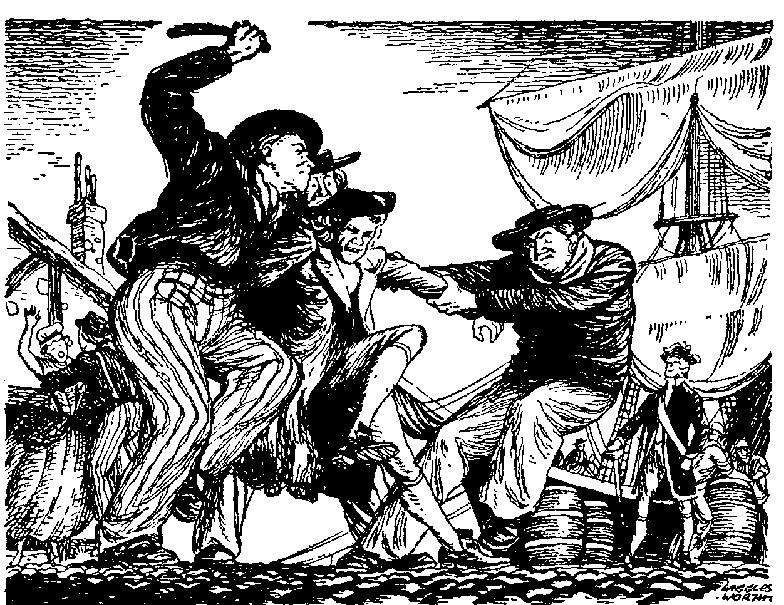
Press Gangs and the Kings shilling!

A talk about Press Gangs presented by Dr. Judith Hunter

I believe the general picture of a Press Gang is that of a gang of seafarers storming around seaside towns, knocking chaps on the head and bundling them on board ship to act as crew; or for the 'luckier' ones, tricking them by slipping coins into the poor innocents' tankards of ale and then claiming that they had entered into a contract by accepting pay in advance - and off to sea they went. But no, it is far more complicated than that, as the Eton Wick History Group found out from Dr. Judith Hunter at their meeting on 4th March. 

Armed with information gleaned from the Admiralty Minute Books, the Public Records Office at Kew and various other sources, and prompted to investigate simply as a result of curiosity triggered by coming across a reference to a Press Gang in Reading, Dr. Hunter covered the history of the Press Gang in as far as the Seven Year War against Austria, France and Russia (1756-1763). Apparently in 1754, lust before the War began the number of men in the navy was just under 10,000 but by the end of the War they numbered approximately 82,000 - the majority of whom came from Merchant Navy ships. The Royal Navy ships would be stationed in the Channel and would send a gang, under a Lieutenant, to board inward-bound merchant ships and gather up the seaman, returning with them to the Royal Navy ships; sometimes fire would be exchanged but nevertheless the majority of sailors were impressed from the merchant ships and so could end up spending many years at sea unable to return home to far, and friends. The Royal Navy didn't train its sailors, it preferred that they came already experienced from being in the Merchant Service. Some of the coastal traders were issued with a certificate which protected them from being pressed into service; unless, of course, there was a 'hot press' which would be at a time of emergency when anyone could be taken - even from theft own homes - and a record shows that on a least one occasion the groom, best man and half the male guests from a Wedding Reception were taken; but once these impressed people had been checked over perhaps only a third of them would be retained as being sufficiently able-bodied to be of use. 

Almost every coastal village and town had its fishermen and so these areas were a natural source of manpower. A press gang, under the command of a Captain (on half-pay + £5 per week) would 'open a rendezvous' at a village and stay overnight, perhaps publicising the fact by hanging a flag outside, or employing a fife drummer. The Captain (who would probably lodge at a rather better class of Inn than that used for the rendezvous) would have two or three Lieutenants (each earning 5s.0d. per day plus 10s.0d. for acquiring each able seaman or 5s.0d. for an able-bodied landman) and these Lieutenants would be supervised and regulated by the Captain - hence he would be called a Regulating Captain. They would take seamen for preference, but they could also take land workers as well - if they looked suitably young and strong; and they would try encouraging people to join voluntarily, initially, tempting them with exciting stories of life at sea. and exotic ports of call, and the weekly ration of I lb. bread, I lb. port, 1/2 pint, peas and 1 gallon beer. 

The gangs operating under the Lieutenants were usually composed of local residents generally hired specifically for the purpose and who would be aware that they were less likely to be impressed themselves if they were part of the official press gang. The King and Government would offer a 'Royal Bounty' of £3 per able-bodied seaman, £2 for an ordinary seaman and f1 for a landman; some Mayors offered their own bounties and there is a record in Bristol of a wife receiving additional corporation bounty; so perhaps these bounties were passed on to the families of the seaman. It is hoped so because wives and families lost their breadwinner when their man was impressed and would have had to have applied to the Parish Officers for some small amount of money; soldiers' wives and children were on a starvation list. When things were warming up for the Seven Year War the Admiralty ordered that press warrants be issued to cover many towns, both coastal and inland, including Reading. There are records of the Mayor of Oxford asking that the Regulating Captain at Reading assist him by guarding five men who he had 'secured' at Oxford. Those taken were often gathered together in a gaol, or Bridewell. It is assumed that they were then made to walk to a port (London?) and if a tender was not available to take them to a ship, they would be gaoled again at the port until one was available. 

Once at sea, the impressed seamen could do quite well:. Their pay (paid out by the ship's captain) would come from the Admiralty and 'prize money' was paid out when an enemy ship was Captured 3/8 of the prize went to the Captain, 1/4 went to the Captain of the Marines, 1/8 went to the Lieutenants, and the crew and Marine 'other ranks' received 1/4 between them; and there is a record in 1762 of the capture of a Spanish frigate resulting in seamen receiving prize money of £485 each - although a more normal amount would be £10-20. Dr. Hunter read from copies of letters from Admirals and Captains dated around the mid-18th century and they made fascinating listening. Mr. Frank Bond thanked Dr. Hunter and her husband, Rip, for this very enlightening talk. 

The the following meeting held on 15th April 1998 and the topic was the "History of Local Bridges over Streams and River" - presented by John Denham. 

During the 1990's the Parish Magazine of Eton, Eton Wick and Boveney reported on the meetings of the Eton Wick History Group. A member of the audience took shorthand notes in the darkened hall. This article was published in the April 1998 edition.

Monday, 19 April 2021

Tough Assignment - A Chapel of Their Own 1886

At first Mrs. Annie Tough met with considerable opposition from the owner of the land; she was after all in no position to offer a fair price for a plot, however small. There were no rich patrons offering a hundred guineas or more as there had been when St John the Baptist's Church was built, and however dedicated the band of Methodists, they were few in numbers. We know the names of only a handful of them - John Moore, Ada Moore, John and Emma Lane Mr & Mrs Thomas Green and Henry Goodman. Annie's father had left Rotherhithe and bought land in Boveney New Town on which were built Snowdrop, Primrose and Shakspear Cottages. He and his family lived at Primrose Cottage. Annie's younger sister, Ada, already an adult woman, also came to live in the village. John Lane was a master builder who, after being widowed, had met and married a member of the Maidenhead Church and was thus brought to Primitive Methodism. Henry Goodman came from Dorney where his family had been prominent Primitive Methodists since the 1850s. No doubt these and other loyal workers supported Mrs Tough to find a site for the chapel, but it was she who finally wore down the resistance of James Ayres, the developer. As a businessman he was far less impressed by her ardent Christianity than her sheer persistence! At long last she 'obtained from him a conditional promise that if a certain gentleman effected a purchase of land that day she should have a site for a chapel.' The sale went through and he kept his word. 'I give it to you', he said, 'as a reward for your perseverance'. 

The stage was now set for the next great effort - raising the money to build the chapel. The land was a gift, though as Mr Ayres had refused to give it to anyone except Mrs Tough, it had first posed a problem, solved in the end by the property being invested in her as Trustee. The cost of the building was only to be about £300, not a great deal even in those days for a church, but a considerable amount for the Primitive Methodists of such a small community to find. But find it they did, and in a very short time there was sufficient money guaranteed for the work to begin. 


It was a proud moment that first Sunday in October 1886 when the chapel was at last officially opened. We can still see the building with its yellow bricks, porch, and arched windows, and its inscription 'Primitive Methodist Chapel 1886.' From Alma Road it looks very much as it did a hundred years ago. No doubt it was viewed with immense pride that day, but no records survive to tell us the details of the occasion. Imagination must paint the picture of the congregation crowded into the tiny chapel - Mrs Tough supported by members of the Moore family, John Lane, skilled tradesman and foreman with Henry Burfoot (who built the chapel), village and circuit members of the Methodist Church, as well as many other well wishers from the neighbourhood. 

 In spite of the rain the meeting held the next day attracted a good congregation. It was a circuit as well as chapel affair and Mr Lodge of Maidenhead acted as chairman. Addresses were given by church members from Maidenhead, Dorney and Slough as well as by John Lane of Eton Wick, who was the chapel treasurer and one of the eight trustees. This was a time for congratulations, a time for appraisal of successes achieved - and the work yet to be done. No doubt the speakers talked of the spiritual life of the chapel, but it was the more practical considerations that the local newspaper reported. over £130 had already been raised towards the building fund, but a further £145 was still required to clear the debt. 

The Eton Wick History Group is most grateful for the kind permission given by the Eton Wick Methodist Chapel to republish this history, Tough Assignment on this website.


Wednesday, 14 April 2021

World War 2 Eighty Years On - April 1941 - Incendiary Bombs Fell On Eton Wick School.

German aircraft continued to fly over the district most nights throughout the months of April and May to raid the cities of Birmingham, Coventry, Leeds, Sheffield, and London.

Len Downs, now residing in Dorney, was serving with 273 Bty. H.A.C. A.A. equipped with 3.7" mobile guns, machine guns and searchlight and he recalled that the troop were frequently called to action whilst stationed on Dorney Common during this time. 

Whenever the guns were in action there was always a danger of injury and damage from falling shrapnel but sometimes no air raid alert sounded and with no warning the guns would commence firing. My experience of falling shrapnel was whilst using the public phone situated near the village hall, when the firing began and odd pieces that fell onto the road ricocheted hitting the phone box with a loud frightening bang. The intense gunfire rattled doors and windows, greenhouses and garden sheds also suffered from the explosions. At night, even if the guns did not fire, those living close by the camp were awakened from their sleep as commands of range, height and bearing were shouted to those manning the guns.”

(Joan Ballhatchet)

April 14th

Fortunately, the local schools were on holiday as bombs and incendiaries fell in the district. Two incendiary bombs fell on Eton Wick school, one falling on the roof whilst the other fell through into the infants’ room where a cupboard was set on fire doing slight damage.

“A number of incendiaries had dropped across the allotments below the school in Sheepcote Road. Searchlights were sweeping the sky in search of the enemy planes whose dull drone seemed to be continual. I rushed about the allotments piling soil on the burning bombs. Within minutes the flames would burn through the soil and the operation was repeated. It was on this night my father became Eton Wick's only air raid casualty. The school like most public buildings had a wall of sandbags about six feet high along the old buildings main wall. 

My father, an Air Raid Warden, was on duty near the school and could see the incendiaries burning inside the building. Realizing that the blaze had to be tackled immediately he climbed onto the protective wall of sandbags and using one of the bags broke the window to gain entry. He then climbed through to extinguish the fires. On getting through the broken glass, he cut his hand. After the fire was extinguished it was pointed out to him that all his effort to affect the entry was unnecessary as the school door was always left unlocked for just such an emergency."
(Frank Bond).

This is an extract from Round and About Eton Wick: 1939 - 1945. The book was researched, written and published in 2001 by John Denham.