Wednesday, 27 June 2018

THE VILLAGE GROWS

Palmer Place
One of the most important features of the nineteenth century was the tremendous rise in the population and the growth Of the towns and villages; Eton Wick was no exception. It was by no means a constant or steady increase, nor was this to be expected but, crowding apart, it was the decades when the village saw an increase in the number of houses that also saw a rise in the village population. However, there was very little building land available; the jealously guarded Lammas rights saw to that. The alternatives were to divide the land already used for housing by either squeezing houses in between the older ones, or by shortening the gardens and building on them, or to dig up the orchard and meadow still within the village area. Of course, the reasons why any one of these things happened depended on the wishes, interests and, perhaps, the business sense of the individual owners of the land as well as the pressing need for houses. 

The years after the Napoleonic wars were lean years, slump years when over the country as a whole there was a dearth in the building of cottages. Many were allowed to fall into ruin and people who had to make the best of such homes suffered. Yet in Eton Wick at least seventeen houses had been built before the end of the 1820s. By 1841 when the first house-to-house census was taken, there were sixty-two houses, three times the number at the beginning of the century. Several were built by the owner-farmer of Bell Farm, John Atkins, such as Bell Farm Cottages, Prospect Place which used to stand between the Three Horseshoes and the Grapes, and the oldest of the Clifton Cottages opposite the Greyhound. Others were built by Eton townsfolk who owned land in the village - Hardings Cottages which were demolished to make way for Clifton Lodge old people's flats and the Parsonage. 

Most of these were rented working-class cottages - the earliest were built of red bricks with peg-tile roofs, but as the century progressed yellow bricks and purple slates became ubiquitous. They were very plain houses with either one room up and one down, or more usually two; each house had a garden, though it was smaller than those of earlier centuries. This is the housing that has mostly been demolished since the war - perhaps rightly so, for by today's standards it had many defects. Yet in its time it was very good accommodation, comparing princely with the back-to-back houses and cellar homes of so many industrial towns, or the one-room hovels of many country villages. Several of the houses had wells and others pumps, though no doubt the brook was still used for water. Cottages were expected to share facilities as is clearly shown in a deed of 1833 which specifies the rights of the occupiers of the ten cottages making up Prospect Place to use the one well, one pump and one privy. 

Two houses did not fit into this general pattern. One was the large six-bedroomed house, built in 1826 as a gentleman's residence, 'convenient to Windsor and Eton and with a very pleasant view of the Castle'. Today this is the Parsonage, but it if it was built as a speculative venture, which seems possible from the advertisement in the contemporary 'Windsor and Eton it does not seem to have been successful, for within a decade the house had been divided to form three dwellings. The other was Thatch Cottage, built in 1833 by Isaac Deverill for his own use. It had quite a large garden and a shed probably used as a cowstall for he was a cowkeeper. 

From 1841 to the end of the century the census records give the figures for the number of people and houses in the village. They show that from 1851 to 1860 the population of Eton Wick rose by forty percent and the number of houses in proportion. In the next ten years, there was a further seventeen percent increase. Dry statistics perhaps; but at the time the people must have wondered what the village was coming to and regretted the change, just as they have done several times since when the village they remembered was fast disappearing. By 1881 the number of people living in this part of the village was at its highest until after the Second World War. 

The village, however, had not yet spread beyond the confines of the old area; instead, almost all the houses were squeezed into the village area or near the farms. Gardens became much smaller; few were now big enough to keep a pig and chickens or even a cow. Henry Palmer of Dorney Court bought much of the gardens belonging to Hope Cottage and built the six houses of Palmer Place on the land. Ye Olde Cottage lost its garden too for the building of Clyde Place, Bonacourt Cottages and Ada Cottage. Even the gardens of Prospect Place became much smaller when Albert Place and Victoria Terrace were built along the edge of the common and Vine Cottage next to the Three Horseshoes. No longer could the common be thought of as the centre of the village, for the Eton Wick Road was clearly more important. 

The houses were very much alike in plan and again plainly styled in yellow bricks, similar to those built earlier in the century and many thousands in other towns and villages. They differed, however, from the much older houses of the village in many ways apart from their outward appearance. Each room had its tiny grate which little resembled the great hearths of the seventeenth and eighteenth centuries made to burn large logs and to heat a bread oven built alongside. These small grates were made of iron and burnt coal, though it is unlikely that any besides that in the kitchen was used regularly. Coal was far too expensive. A few lucky housewives now had the luxury of a wash-house with a built-in copper. In themselves, such outhouses were not new in Victorian times, but never before had they been such a feature of terrace houses or designed specifically for the onerous chore of washing. For village housewives, they were indeed a great boon, comparable to the introduction of spin driers a century later. 

Victorian Copper
Victorian Grate


This is an extract from The Story of a Village: Eton Wick 1217 to 1977 by Judith Hunter.


Wednesday, 20 June 2018

Dairy Farm

Dairy Farm circa 1900

The earliest known deed for Dairy Farm House is dated 1704, but refers to previous owners, so the house is likely to be older than this. At that time the farm is recorded as comprising forty acres, which included Wheatbutts Field and the land on which Hope Cottages were later built. There were also five closes of arable and pasture land, and sixteen strips dispersed in North Field, the Hyde and Waterslades. Within a few decades, Dairy Farm had been reduced to a mere seventeen acres, the greater part being lost to other farms. 

In the early 1900s when this picture was taken, the farm was run by Charles Nottage. Charles died in 1913. His son Arthur, together with Arthur's brother-in-law Edwin Ashman farmed the land through World War I. Nottage and Ashman were followed in the 1920s by Harry Blakiston Morris and his family. The eldest son, Ted Morris, was co-founder of the well-known Slough Builders Merchants Miller, Morris and Brooker. 

Bob Bond (son of Roland Bond, the founder of R Bond & Sons, Contractors) bought Dairy Farm in the late 1930s and worked it (in addition to his role in the Contracting Company) until his death in 1975. It is no longer a farm. Some of the land and buildings have been developed as livery stables, and two houses have been built on the land fronting the western end of the Common. 

This is an extract from A Photographic History of Eton Wick and Eton published by the Eton Wick History Group in 2000.

Wednesday, 13 June 2018

Eton Wick Newsletter: Our Village December 2009

Eton Wick and it's 19th Century Changes 

Having previously looked at the growth of Eton Wick it is now time to reflect on some of the happenings that importantly changed the lives of earlier generations. For centuries hamlets and villages like ours were centred around farms and the small clusters of labourers' dwellings; all having well trod cattle and foot tracks. Such as they were, the local tracks or roads would have been seasonally either very muddy or dusty routes between farms and fields, labourer cottages, market or the nearest water source. 

In Eton Wick we have at least four of those 'in' village roads and three other 'through' tracks that connected the village to the outside towns and villages. The 'in' tracks were (a) Sheepcote Road and (b) that part of Common Road that bisects the Great Common and connects between Manor and Saddock Farms and Sheepcote Road. The third is Bell Lane that connects Bell Farm with the main road of today and the old Kings Highway; and lastly Browns Lane (now known as part of Common Road) that gave access from Dairy Farm to the main road. 

Over the years some roads have changed their name. The main part of Common Road is probably as old as there have been dwellings along it. Additionally there were many tracks that did not develop, a few of these still survive. The three through roads were Inner Meads Lane between the Common Road farms and Eton's Common Lane; the old Kings Highway between the top of Bell Lane and Brocas Street, Eton, that was joined by a track from Old Boveney, immediately south of the Eton Wick Church; and the road we all use and was later designated the B3026. The first two have declined rather than developed, but should give us a good idea of the roads our forefathers were used to. Tracks still used include the path from the Great Common to Chalvey, paths to the river, also between Bell Farm and Little Common; across the 'sleds' to Meadow Lane, and across Dorney Common to Old Boveney. You will doubtless think of others. 

Since the 1870's at least another fourteen roads have been created in what we now know as Eton Wick. The Walk, Victoria Road, Alma, Inkerman and Northfield Roads were developed between 1875 and 1900; Tilstone Avenue in the mid 1930's and at least another eight since WWII ended in 1945. Albeit some are estate roads and/or cul de sacs. In its early years Moores Lane was not in Eton Wick and not known by that name until John Moore came to the area in the 1880's. There was a footpath across the fields known then as the 'slipes' and leading to Cippenham. Since the Slough sewage farm and later it's staff houses were developed half way to Cippenham, the road was improved and we know it as Wood Lane. 

The 20th Century brought many changes to the village with the coming of gas (1910), electricity from 1949, main drainage, subsequent central heating and double glazing, but I think there were more noteworthy advances in the 1800's. At the outset the population was approximately 100. There was no school, church or cemetery, no shops or public meeting place and no piped water. Even the Thames must have seemed untamed with no weirs to control the flow — hence more flooding — and no pound locks to make navigation easily possible. Young children would have worked in the fields with mum; weeding, gathering and gleaning for the backyard hens. They rarely left the village and probably some never did. 

Some village lads helped with the horse drawn barges, each leading their 'charge' along the towpath to Marlow where they unhitched the horses and stabled overnight with the horse before riding it back across Maidenhead Thicket to Windsor. My Father did this as a schoolboy in the late 1890's and was paid the princely sum of one shilling (5p). 

In those pre school years of early 1800's many would have been unable to read or write. The first school locally was Eton Porny, built in 1813 and replaced with the present school in 1863. It was another 27 years before Eton Wick's first school (1840) which again was replaced by a school in Sheepcote Road in 1889. Even then the school attendance was not always considered necessary or possible. It was not until 1875 that schooling became compulsory. 

As late as 1888 an item in the Parish Magazine reported that 90 children could be educated free of charge at Eton Porny, subject to regular and punctual attendance of Sunday School for at least one year and of being parishioners of Eton, born in wedlock. Until 1890 schooling was not necessarily free and a charge of two pence or more each week was the norm! This may not seem much but for labourers working for perhaps one pound, having several children, could amount to 10% or more of the family budget being paid out for an education that parents themselves had never enjoyed. 

In the years before schools, Sunday Schools had meant just that; the opportunity to learn to read and write as well as being taught the gospel. Apparently Eton Wick did have a circuit preacher for a while in the early 1800's. With no hall or school he would have needed to use a farm barn or a local cottage.

Between the 15th Century and 1875 the Eton College Chapel had served as the Parish Church. There was no other church in the town until 1769 when a small chapel was built near the present site of St. John the Evangelist. Being unsatisfactory it was replaced 50 years later, itself to be replaced by the present church in 1854. Eton Wick had to wait and make do with going to Eton or perhaps Dorney until in 1867 St. John the Baptist was built. The Methodist Chapel in Alma Road was built 19 years later, in 1886, and in that year a branch of the Temperance Guild came to Eton Wick. Although the village had a church in 1867 the churchyard was not consecrated for burials until 1892. The Eton cemetery near Cotton Hall was first used in 1847 and for 45 years villagers were obliged to go there for burials. The first Parish Magazine was produced in 1878, just three years after the Parish Church was established at Eton's St. John the Evangelist and much of local history used by writers since then have used the writings of Reverend John Shepherd in those early magazines, and his subsequent book. 

The first shop of any consequence in the village was that of Thomas Lovell, baker, post office and household goods, recorded in 1878 at the Ada Cottage (immediately west of the 'Three Horseshoes' public house). 'The Shoes' was first recorded in the Victualler's Recognizance's around 1750. The Greyhound' and The Shepherds Hut' were first licensed in the mid 1830's and The Grapes' (later The Pickwick' and now a restaurant) in 1842. 

Boveney's first pound lock was installed in 1838 and was replaced by the present lock in 1898. 

Socially the village came of age in the last decades of the 19th century, forming a Horticultural Society with its first show in 1878; (twelve years before Eton Town's first show). A village Football Club around 1880, a Cricket Club in 1889, a Young Men's Club in 1885, a Rifle Club in 1899 and getting its first allotments in 1888 and 1894. Also in 1894 both Eton Wick and Boveney New Town each had its own five man Council, to manage their affairs independent of Eton for the next 40 years. This had not happened before and has not been so since. 

In 1892 piped water came to Eton Wick. Only recently built houses would have had this luxury, away from the hitherto shared pumps, but it not only provided water indoors but introduced garden cesspits and indoor toilets. Early recipients included those in The Walk and in Victoria Road. 

The first trains crossed a wood viaduct over The Slads and the Thames in 1849 and this must have heralded affordable coal for the masses. Its earlier transport depended on barges. 

Yes, I think the 19th Century brought us more real advances. We could say 'light years' ahead, even though the village depended on candles and oil lamps — the gas (1910) and electricity 40 years later had still to arrive. In 1800 there was no Boveney New Town and the village population was around 100. In 1899 there were 450 in Eton Wick and slightly more in Boveney New Town. Now it has roughly trebled the 1899 combined total. 


This article was originally published in the Eton Wick Newsletter - Our Village as is republished with the kind permission of the Eton Wick Village Hall Committee. Click here to go to the Collection page.

Note: since this article was written in 2009 The Pickwick first became The Silk Road and then closed. The Three Horse Shoes and the Shepherds Hut have also closed leaving the village with one pub, The Greyhound open for business. The pubs that were known as the Shoes and the Grapes have been converted into houses as have all the other former commercial properties on the north side of the Eton Wick Road over the past 50 years. The Shepperds Hut's future is as yet unknown.


Thursday, 7 June 2018

Events on Silver Jubilee Day

This is the programme of events that were held on the Recreation Ground to celebrate Her Majesty Queen Elizabeth II 25 years as monarch. 


ETON WICK SILVER JUBILEE DAY 


TUESDAY 7TH JUNE 1977

From 10 a.m. — 6 p.m. FUN for all bring the family.

10.00 a.m. -        Day starts with Eton Wick Silver Jubilee Queen cutting the tape across the entrance and letting everyone.

10.15 a.m. -        Races start for age groups. e.g. Egg & Spoon, Three legged,  
                           Obstacle, Bean Bag and Straight Race.
                           PRIZES for all Races.

10.30 a.m. -        Marathon Pram Race commences, continues all day.
                           PRIZES.

11.00 a.m. -        Cake competition in the Gym. (For all ages and entries must be received by 10.30 a.m.) Cakes are non-returnable and are to be used for the afternoon tea. 1st, 2nd, and 3rd PRIZES.

12.00 p.m. —      Side Shows around the arena will be available, all are FREE OF CHARGE' e.g. Welly Throwing, Skittle Alley, Tent Pitching Display, Treasure Hunt. Scout Ariel Runway etc.

12.50 p.m. -        Suggest you bring a picnic lunch and sit somewhere around the field to eat it. The Bars will be open for drinks.

2.00 p.m. —        Fancy Dress Competition. All ages.
                           Decorated Cycles Contest. All ages.
                           PRIZES for both events.

2.30 p.m. -          Bingo Session In the Gym for the over 60’s (PRIZES ONLY) Followed by The Glamorous Gran contest.
                           Then a free tea followed by a sing-song.

3.00 p.m. -          Five-a-side football starts. Three age groups wanted.
                           5 – 10 years, 11 – 15 years and Adults. Prizes for each group. Dress optional.

4.00 p.m. -          Knobbly Knees Contest and Lovely Legs Contest. PRIZES.

4.30 p.m. -          Tea will be served to all children free of charge.
                           (20p donation gratefully received.)

Races and Games will continue throughout the day, until evening.

It is known that there were Street Parties also held elsewhere in the Village on the day of the Jubilee. If you have memories of 7th June 1977 or photographs taken on the day we would be delighted to hear from you.

Wednesday, 30 May 2018

The Eton Inclosure Bill

By the end of the eighteenth century the Commissioners of the Crown had become interested in the enclosure of Eton's commons and Lammas lands. All over the country enclosure was taking place and there was much publicity for its advantages. According to their estimate the land needing to be dealt with in Eton comprised three-quarters of the parish. Little, however, seems to have been done until John Penn, Lord of the Manor of Stoke Poges as well as Eton, began making plans to push an Inclosure Bill through Parliament. He had already succeeded in Stoke Poges against considerable opposition, particularly over the enclosure of Stoke Common which furnished turf and furze, used as fuel by many poor families as well as the workhouse and the Hastings Hospital. In the end a compromise had to be reached, and perhaps because of this the Eton Inclosure Bill specifically excluded the Great Common. However, even this concession was not sufficient to ensure the smooth passage of the Eton Inclosure Bill through Parliament, for John Penn made the tactical error of not consulting the Crown or giving them opportunity to appoint their own Inclosure Surveyor. The particular problem in Eton was the proximity of Manor and Saddocks Farms. Not without considerable ingenuity could the different plots of land be rearranged so that, as well as each farm receiving its fair share, the share formed a  compact block adjacent to the farmhouse.  When at last the Officers of the Crown became aware of Penn's plans it was too late to do anything except oppose the Bill.

This was not only a battle between landowners; townsfolk and villagers were worried about the likelihood of their loss of rights and did the only thing open to them - they presented a petition to Parliament. They protested that 'the Bill instead of producing any beneficial effects (would) tend to diminish the comforts and prosperity of the Inhabitants by depriving them of the Right of       depasturing their cattle on the Lammas lands, thereby increasing the Poor Rates, the burden of which is already quite as much as can be borne'.


Over one hundred and eighty people signed the petition or made their mark if they could not write, and amongst them several who almost certainly came from Eton Wick like Joseph and Phillip Tarrent, John Atkins and Tholpas Goddard. Other parishes had presented petitions, but often in vain, for Parliament mostly comprised landed gentry who tended to think in terms of protecting their own interests.  As tithe-owners the Provost and Fellows of Eton College had originally been as interested as John Penn in the proposed Bill, but it seems possible that at the last moment they changed sides.  Perhaps their loyalty to the Crown was called into question; they were after all considerable leaseholders from the Crown. They had the power to sway the balance in Parliament by influencing the Members of Parliament, many of whom were old Etonians. This however is speculation, and we shall never know the full story, for the records were lost when the Houses of Parliament were burnt down.  The Bill was defeated on 1st May, 1826: the town and village celebrated with bonfires and testing in the local inns. A banner was painted on blue silk for the occasion and paraded triumphantly through the streets proclaiming the sentiment that was to burn brightly for another century or more, 'May Eton flourish free and ever protect her rights'.


No other Bill for the enclosure of Eton was ever presented to Parliament. The people of the parish continued to be vigilant in preserving their rights, even to the extent of taking a man to court about 1840 for building two houses on part of South Field near the village. It was his own land; yet when the case was tried at Aylesbury he was ordered to pull them down because they were built on Lammas land. When in the middle of the nineteenth century the Crown once more became interested in enclosure, the College was opposed to it and the Penn estates were 'in circumstances that render(ed) it difficult to be dealt with'. Not until 1902 did the Crown successfully negotiate with the Lord of the Manor to overcome the inconvenience of the scattered strips, and even the the pasturage rights, or Lammas rights, were not extinguished, but only an exchange effected. The rights still exist though most people lost theirs through the Commons Registration Act of 1965.  To some people the rights have become an inconvenient anachronism, while to the majority it is just something that has nothing to do with them. Yet it is these rights that have preserved Eton Wick as a village and prevented it from becoming engulfed in a suburban sprawl.

Wednesday, 23 May 2018

Recollections of boyhood holidays spent in Eton 1931-1939

The memories I relate here are those I recall after a lapse of more than 70 years. They are fragmentary in nature and of no special significance, except insofar as they give me pleasure in recalling scenes of my boyhood.

My first acquaintance with Eton would have been in 1931. We lived in Belfast, where my father had moved after the 1914-18 war, and this was my first journey outside Ireland. Leaving Belfast on the evening boat to Liverpool, we journeyed by train to Euston, then over to Paddington, from whence we traveled to Slough, changed trains for the Windsor branch line, and arrived in Windsor Central sometime in the late afternoon. Crossing Windsor Bridge, we walked down the High Street until we came to a Garage. Suddenly we turned down a narrow lane — Tangier Lane. A short distance further on we turned off into Sunbury Road, where my grandparents lived at No. 11. A meal, and then, for my sister and 1, bed. Sunbury Road was a quiet little cul-de-sac, at the end of which was a large yard containing some timber sheds and a wired-off hen run. On the opposite side of the road was a small shop of the General Store variety, where my sister and I — when we were given the money — bought Sherbet Bags from which one sucked sherbet through a liquorice tube, Grandma occasionally gave us scraps of bread to feed to the hens, which were owned by a rather dour man whose name I cannot remember with certainty.

Granddad's house was small, two downstairs rooms and a kitchen. The WC was outside, accessed from the back garden. It was in the front room that, one sunny afternoon, I discovered on a bookshelf Jules Verne's "From the Earth to The Moon". I was entranced by this, and could hardly put it down when called for tea.

Two sounds stay in my memory. One, the mellow chimes of the College clock; the other, the peculiar yodelling call of the milkman "Milk-ooo", as I sat reading in the front room.

In those years, the High Street was quite busy with buses and lorries of various sorts, although as the years passed the traffic became heavier. However, it was easy enough to cross over to the passageway leading to St. John's — which at that time still had a spire — and which brought us into South Meadow, A short distance away were two swings, which my sister and I made frequent use of
The river played a large part in our holidays. At approximately the spot where the river boats now start, one could hire rowing boats of various sizes. My father, whose service in the Royal Navy in the 1914-18 war probably influenced his choice, always hired a four-oar Gig, in which in the course of time I learned to row quite competently under his instruction, and could "feather" my oars. The photograph below shows one of these Gigs with my sister and I rowing, with father and Granddad in the stern seat Granddad is the one with a cap and the tiller lines over his shoulder. I think that I was making some uncomplimentary remark to my sister.


We usually rowed up towards Boveney, as I remember my father instructing me to turn "bows on" to the not inconsiderable wake left by the river steamers of that time, so this photo was most likely taken by my mother somewhere on the way.

River steamers at that time started from Riverside, and had to lower their funnels to pass under Windsor Bridge. A partial view of one of the steamers in shown on Page 122 of the series of photographs of Windsor and district taken by the late Samuel Logan in the mid 1930's, and is reproduced below.


On the way up to Windsor, there was at the corner of the Bridge and on the left hand side, there was a small shop that sold fishing tackle (could this by the one mentioned by Brinsley-Richard in his "Seven Years at Eton"?). One day my father bought a fishing rod and tackle, and, equipped with sandwiches and ginger beer tablets, he and I proceeded along the Brocas until we found a suitable spot to sit and cast our 1ine into the water. Our catch that day was five gudgeon. We had them fried for tea and a disappointment they were, as they had a distinctly muddy flavour, as also had our ginger beer when we dissolved the ginger beer tablets in river water. 

My father was always interested in church architecture, and we never failed to take a walk up to Boveney Church which I think was still in use at that time. The door was open, and I recollect the Sanctuary Lamp suspended from the roof was lit on the occasion of my first visit. 

At that time, Windsor was not nearly as crowded with tourists as it is now. Access to the Castle was simply a matter of walking through the Henry VIII Gateway — no queue or entrance charge — and thereafter the whole Castle, with the exception of the private areas, was open to one. Up the circular staircase in the Round Tower, passing the Sebastopol Bell and onto the battlements, the Curfew Tower, Cloisters, and down the Hundred Steps. Other walks took us through the College, past the Cloisters, where the pump was still in working order, out past King Prajadhipok's Garden and so over to Fellows Pond and Sixth Form Bench, where for the first time in my life I saw a kingfisher. 

Reverting to Granddad's house, the street door opened directly into the front room, where the penny in the slot gas meter was installed. As the only lighting was by gas, a sudden diminution in the light warned that another penny had to be put into the meter. Cooking was by gas stove in the kitchen, entered from the living room, where a large coal-fired range was still in place, but never used except possibly in winter for heating the room. 

In the garden at the back was an arch, over which and along the railings separating the house Granddad had trained hops which, according to Grandma, came from the "Hop Garden". My father took a root of this home, where it flourished. In course of time I took a root of this when I moved to and settled in Dublin. It still grows vigorously in my back garden, and it is to me my last living link with Eton. 

With the outbreak of war our visits to Eton ceased, and I did not see it again until 1948. Grandma was dead, and Granddad was in a nursing home in Slough. That summer I went to visit him, and stayed in the Cockpit which at that time took paying guests. Apart from the damage to the College, Eton looked much the same as I remembered it. Buses to Slough were still operating via the High Street, Undoubtedly, the closing of Windsor Bridge to traffic has, in my opinion, improved Eton by restoring to it comparative calm and peacefulness. 

While jotting down these recollections of the past, brief and inconsequential as they are, I wondered why I have such an interest in, and affection for, Eton. It may simply be that I was so happy and received so many new experiences there as a boy. It may be because it appealed so much to my interest in history and things of the past.

By S. Baldwin

Saturday, 19 May 2018

Charles Fountain Ralph Godwin (Trumpeter No. 2556) — 1st Battalion Life Guards

Charles Fountain Ralph Godwin (Trumpeter No. 2556) — 1st Battalion Life Guards 7th Cavalry Brigade 3rd Cavalry Division. [After 1918 No. 1 Battalion, Guards Machine Gun Regiment).

Charles Godwin
from a family photograph
courtesy of Anton Yuskan
Charles Godwin's home address until he married was 11 Parson's Green Lane, Fulham. He was a regular peacetime soldier serving as a trumpeter in the band of the 1st Life Guards. As a bandsman he had trained at the Kneller Hall School of Music. He was one of several guardsmen who, while stationed at Windsor, met and married local girls. After he married Nellie Bunce his home address was given as Rosedale, Eton Wick. This was a fine detached house, next to the parsonage, home of local farmer and village councillor Mr Henry Bunce and his family. The Bunces had always been very supportive of Nellie, and when the Godwins had a baby daughter in 1915 they were pleased to accept yet another new addition to their household.

The Life Guards, together with the Royal Horse Guards (the Blues) constituted the Household Brigade 'the soldiers of the Sovereign". On August 4th 1914, the day war was declared, the 1st Life Guards were at Hyde Park, and on September 1st they moved to Ludgershall along with the 2nd Life Guards and the Royal Horse Guards. On October 7th 1914 the Brigade moved to Zeebrugge, and a week later were en route to Passchendaele, east of Ypres. An account of this journey by a Life Guard office, Lord Worsley, states: 

The day before yesterday we were in the saddle for 17 hours, scarcely off one's horse all that time; then 2 hours rest and off again for 16 hours. 

The village of Passchendaele in 1914 bore no comparison to the utter devastation and carnage of later in the war.

Charles was a bandsman, but in wartime the musicians were usually used as stretcher bearers within their unit, and most probably he would have been engaged in this other role from time to time. The Guards of the Household Regiment were better paid than other soldiers. Privates received Is 9d (9p) a day, whilst other cavalry privates received 1s 2d (6p) a day and the infantry privates 1s 0d (5p) a day.

Both Battalions of Life Guards were involved in the October Battle of First Ypres. At the end of the month they bore the brunt of a German attack south of Zandvoorde and were forced back to Klein Zillebeke after suffering very heavy casualties. The following month they had further action against the Prussian In May 1915 they fought, Guard at Nonne-Bosschen, again with heavy losses. dismounted, during the Frezenberg Ridge actions. They fought on the Somme in 1916, and the following year, as a unit of the Household Cavalry, they stood by in readiness for the breakthrough of the enemy lines during the fighting in Arras. The chaos of a modern battlefield, together with machine guns, made such a cavalry attack quite impractical however. On March 10th 1918 it was decided to retrain the 3rd Cavalry Division and designate them The Guards Machine Gun Regiment (G.M.G.R.).

The 1st Life Guards becoming the 1st G.M.G. Battalion the 2nd Life Guards the 2nd G.M.G. Battalion, and the Royal Horse Guards the 3rd G.M.G.B. They went into training for their new role in April/May 1918 at Étaples, on the French coast, between Boulogne and Paris. Étaples was in fact a series of military camps and hospitals spread over a large coastal area. It was during this period of training that Charles Godwin died. His daughter Lilian said she understood her father was killed while playing with the band in hospital grounds by a German aircraft returning from a raid over England.

The facts are marginally different. On May 19th 1918 Whit Sunday, 20 to 30 Gotha bombers raided London, killing 44 and injuring 179 people. Seven planes were shot down. At 10 pm two squadrons of Gothas attacked Étaples. The 2nd Battalion left their quarters for the open spaces, One hour later, another Gotha plane attacked the camp. On this occasion, the tents and two companies of the 1st Battalion were hit. The toll was 43 killed and 82 wounded. No mention is made of the band playing, but allowing for the late hour, and it being Whit Sunday, it is very probably the band did play in front of a hospital but earlier on that day.

Étaples Military Cemetery courtesy CWGC
Trooper Godwin was among the 43 killed. Four days later the training was completed and the machine gunners went to the front, near Arras. The Windsor and Eton Express of June 8th 1918 printed: 

Godwin C.F.R. Trumpeter Band of 1st Life Guards. Killed in France May 19th 1918. Dearly loved husband of Nellie Godwin of "Rosedale" Eton Wick.

Softly at night the stars are gleaming,
Over his silent grave,
Now he is safely in God's keeping,
One we have lost, but could not save.

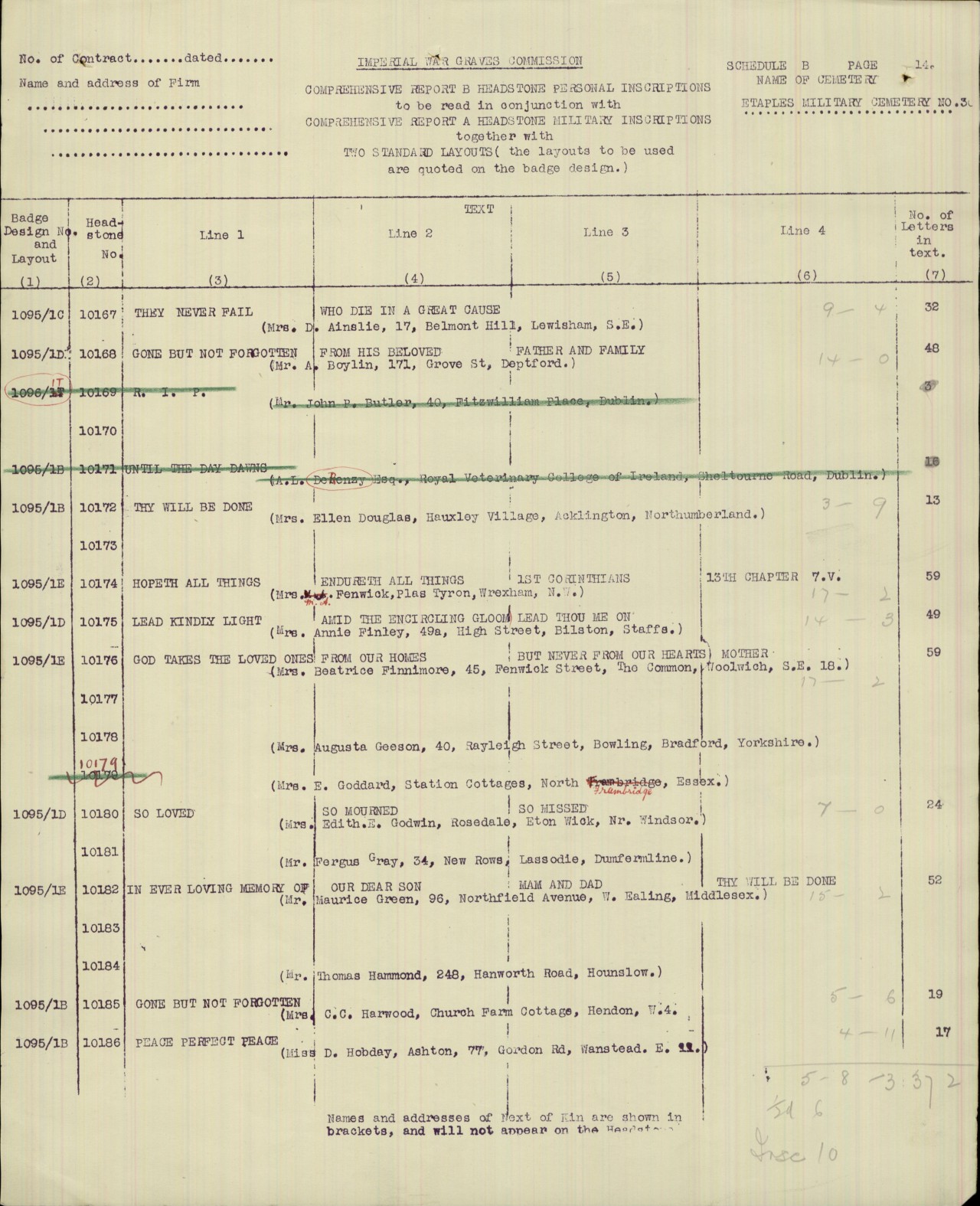
Charles is buried in Étaples Military Cemetery, France. It is a large cemetery, the grave is in Plot 66; Row C; Number 14. The recorded deaths in the cemetery are: 8,786 UK, 1,122 Canadian, 461 Australian, 261 New Zealand, 113 other allied and 655 Germans. His widow, Nellie, married again and as Mrs Slade had two more children. At one time she kept the shop at what we now know as Taylor's Court and later, lived at The Grapes public house (later renamed The Pickwick) where her husband was the landlord. 

Charles's age is not known, but was probably in his mid-twenties. He is commemorated on the Eton Wick Memorial and on the Eton Church Memorial Gates.


This is an extract from Their Names Shall Be Carved in Stone  
and published here with grateful thanks to the author Frank Bond.


The Eton Wick War Memorial page on Buckinghamshire Remembers website.


Grave Registration courtesy CWGC


 Headstone documents courtesy CWGC

Note: Charles Godwin was born on 4th September 1890 and christened at St Andrew's Church, West Kensington on 27th March 1892 during the same service as his younger sister Violet.